Guides
Gerbil vs hamster
Two burrowing rodents with the same published floor figure, and a housing bill that is not remotely the same.
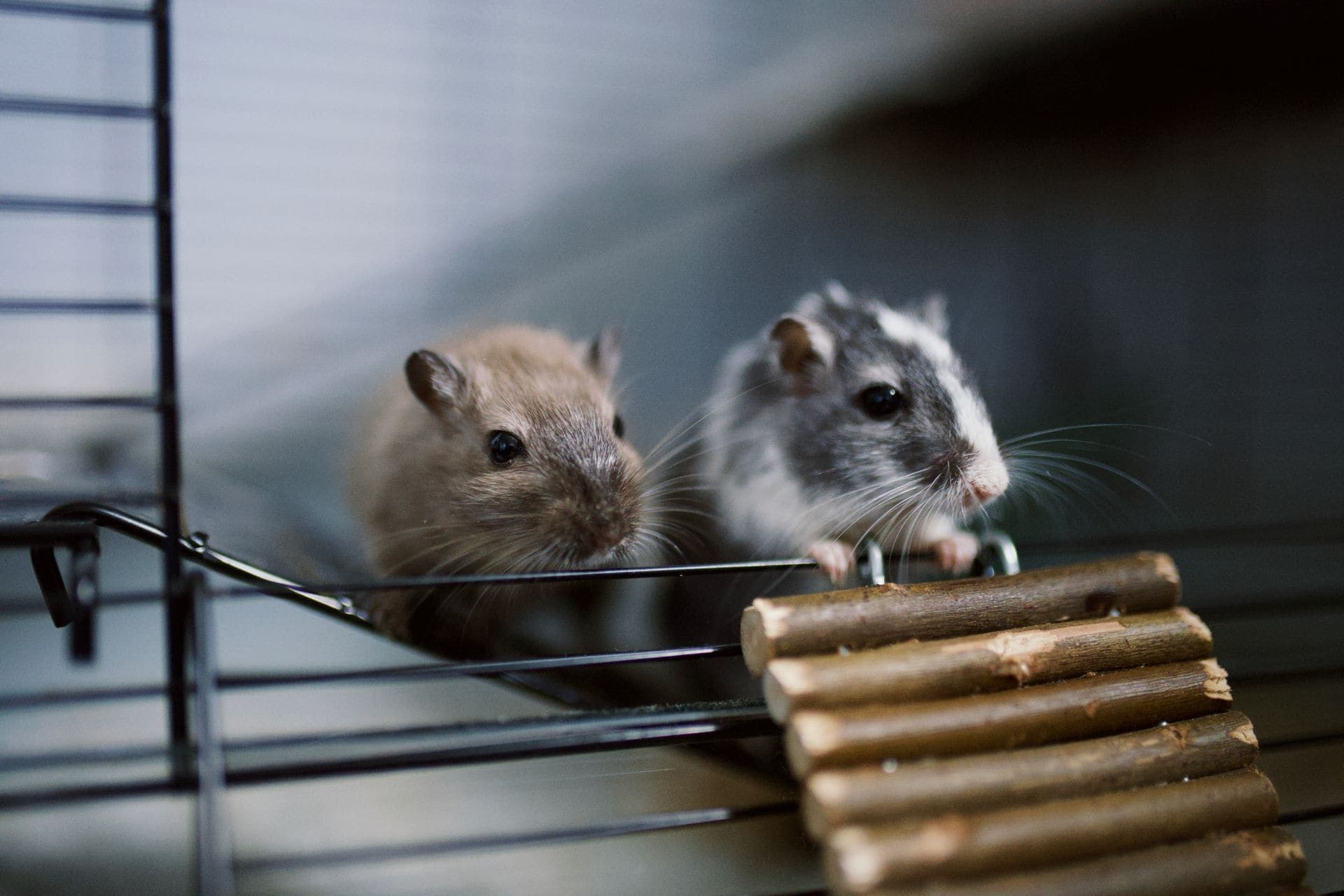
Get a hamster if you want one animal in a cage you can buy ready-made, and gerbils if you want a pair you can watch tunnel and you are willing to buy a tank-style enclosure to do it. The published figures look almost identical — PDSA gives 100 x 50cm as the minimum hamster cage and Woodgreen gives 100 x 50 x 50cm for gerbils — but they mean opposite things. PDSA states hamsters do not need to live with other hamsters, so that floor houses one animal. The RSPCA states gerbils need to live with other gerbils and should never be kept on their own, so the same floor is the minimum for two, and three needs 120 x 50cm. The second difference decides your shopping list: the RSPCA advises against bar cages for gerbils and asks for solid glass walls with a wire-mesh top, which removes the entire ready-made wire-cage half of the market that a hamster can legitimately use.
Almost every comparison of these two species is about temperament — which is friendlier, which bites, which is awake when you are. Those are real questions and they are the second set. The first set is what the animal has to be housed in, because that is the part you cannot negotiate with after you have brought it home.
So this page compares them on housing: the floor figure and what it houses, whether a wire cage is allowed, substrate depth and volume, wheel diameter, temperature, lifespan, and what the whole setup costs to get right. Best small pets does the same job across every species on this site if you have not narrowed it to these two yet.
The figures, side by side
| Hamster | Gerbil | |
|---|---|---|
| Minimum floor | 100 x 50cm (PDSA), 775 sq in | 100 x 50cm for two (Woodgreen), 120 x 50cm for three |
| How many animals that houses | One. PDSA: hamsters do not need to live with other hamsters | Two. RSPCA: gerbils should never be kept on their own |
| Wire cage acceptable? | Yes, if the floor figure is met | No. RSPCA advises against bar cages; asks for solid glass walls and a mesh top |
| Bedding depth | At least 25cm / 10in (PDSA) | 20-30cm (RSPCA); 20-25cm throughout (Woodgreen) |
| Substrate volume for the minimum enclosure | About 125 liters at 25cm | About 100-125 liters at 20-25cm, for the pair |
| Wheel | 30cm / 12in for a Syrian, 20cm / 8in for a dwarf (PDSA) | 12in upright solid wheel, not plastic (Woodgreen) |
| Temperature | 18-21C (PDSA) | 20-22C for adults (PDSA) |
| Typical lifespan | About two to three years (PDSA) | Two to three years, sometimes four to five (PetMD, vet-reviewed) |
Every figure in this table is the named body's own published figure, read 15 October 2026 and linked in full below. The square-inch conversion and the substrate volumes are our arithmetic from those figures.
The difference that matters most: one animal or two
Gerbil enclosure minimum size · minimum
100cm long x 50cm wide x 50cm high for two gerbils, and 120cm x 50cm x 50cm for three
Our conversion: 5,000 cm2, or 775 square inches of floor for a pair
Read the two minimums quickly and they look like the same requirement. They are not, and the gap is the whole comparison.
PDSA is unambiguous on hamsters: they do not need to live with other hamsters, and most species are solitary and prefer to live alone. The RSPCA adds that Syrian and Chinese hamsters are not naturally sociable and should always live on their own, and that while dwarf species can sometimes live in pairs or trios with the right conditions, even dwarf hamsters do not need the company of other hamsters to be happy — and many pairs fall out later in life. So a 100 x 50cm cage is a complete, compliant home for one hamster, and buying a second animal is a choice with a real risk attached rather than a kindness.
Gerbils are the reverse. The RSPCA states plainly that gerbils need to live with other gerbils and should never be kept on their own, that they can be kept in same-sex pairs or groups formed early in life and kept stable, and that additional members should not be added later because established groups are unlikely to accept newcomers — with the possible exception of juveniles under five weeks old. That last clause is worth absorbing before you buy: a gerbil group is a thing you form once. You cannot replace a lost animal from the pet store the way you can top up a tank of fish.
Which means the honest framing is this. A hamster is one animal in a 775 square inch box. Gerbils are a bonded pair in a 775 square inch box, formed early, kept together for life, and if one dies the survivor is on its own in an enclosure sized for two with no straightforward way to fix that.
The difference that decides what you can buy: bars
Gerbil bedding depth and enclosure type · recommendation
a bedding depth of 20-30cm, in a gerbilarium ideally around 50cm high
Our conversion: roughly 8 to 12 inches of substrate under about 20 inches of height
A hamster can live in a wire cage. The best-built ones in the category are genuinely good products, and if a wire cage clears 775 square inches of continuous floor it is a legitimate hamster home. The practical difficulty is that almost none of them do — best hamster cages works through which get closest — but the category is open.
For gerbils the category is closed. The RSPCA asks for solid glass walls, a secure wire-mesh top and a solid floor, and advises against bar cages on the basis that gerbils may injure their legs or damage their teeth on them. Woodgreen goes further and warns against the mesh shelves fitted to ready-made enclosures, because they can damage feet, and against solid shelves, because a weaker gerbil may become stuck underneath. Between the two, the entire ready-made wire-cage aisle is ruled out by the people who publish the guidance — not by us.
That leaves tanks, converted glass display cabinets and the small number of purpose-built solid-walled enclosures, which is a shorter and more expensive list. Woodgreen says so itself: suitable gerbil housing is very limited and can be tricky to find. Best gerbil cages is the shortlist, and it is five products long for a reason.
What gerbils can actually live in
Solid panels, a mesh lid and enough internal depth for 20cm of substrate. These two are the closest things sold as finished products to what the RSPCA describes, and both clear the 100 x 50cm floor figure on each dimension rather than on area alone.
 Illustrative
A Syrian that needs real burrowing depth
Niteangel Vista Hamster Cage, Large
47.1 x 22.7 = 1,069 sq in external footprint
The largest mainstream single-piece hamster enclosure we could verify, and the only one whose external footprint clears our 775 sq in floor with room to spare even after you allow for wall thickness.
Check price on AmazonWe do not print prices. #ad Disclosure
 Illustrative
Deep burrowing without a DIY build
BUCATSTATE Hamster Cage 3.0, 47 in
47 x 23.6 = 1,109 sq in (7.7 sq ft) by our arithmetic
The deepest substrate capacity we could verify on a mainstream enclosure: an 11 in bedding claim on a 1,109 sq in floor is the combination almost nothing else offers.
Check price on AmazonWe do not print prices. #ad Disclosure
The hamster-only half of the market
The best-built wire cage in the category, which a hamster may use and a gerbil may not — and which, in the interest of not overselling it, is 620 square inches against a 775 square inch figure. Beside it, the one wheel we have measured that clears both the 30cm Syrian figure and Woodgreen's 12-inch gerbil figure.
 Illustrative
Build quality and a complete set of fittings
Savic Hamster Heaven Metro Cage
80 x 50 cm = 4,000 cm2, or 620 sq in
The best-built wire cage in the category and still 20 percent short of the floor area its own country's veterinary guidance asks for.
Check price on AmazonWe do not print prices. #ad Disclosure
 Illustrative
Any Syrian hamster
Niteangel Super-Silent Hamster Exercise Wheel, 12.8 in
Occupies roughly 13 x 6 in of enclosure floor
The only wheel in this range that clears PDSA's 30cm minimum for a Syrian, which makes the size choice within the range more important than the choice of range.
Check price on AmazonWe do not print prices. #ad Disclosure
Cost: the cheaper animal is the more expensive pet
A gerbil costs less than a hamster at almost every pet store, and is substantially more expensive to house. Three reasons, and they compound:
- 1.You are buying for two animals, not one. The floor figure is written for a pair, and keeping one is ruled out by the body that publishes the figure. There is no single-gerbil budget option.
- 2.The cheap half of the enclosure market is unavailable. Wire cages are the inexpensive way to reach floor area, and the guidance rules them out. A solid-walled enclosure or a tank conversion starts higher, and the conversion route needs a lid you build yourself.
- 3.The substrate bill is the same or larger, and it is the larger line than people expect. Both species want roughly 20 to 25cm of bedding, but the gerbil figure is stated as throughout the enclosure rather than in a deep area, and the first fill of a minimum enclosure runs to 100 liters or more. Best gerbil bedding does that arithmetic in full.
The hamster's budget route genuinely exists, and it is a bin cage — a large storage tub with a mesh panel cut into the lid, which reaches 775 square inches for less than any ready-made cage. How to build a bin cage covers it. The gerbil equivalent is a DETOLF conversion, which is cheap on floor area and is a weekend of building rather than a purchase.
Where the two are genuinely alike
Four things, and they are the reason the choice is close rather than obvious.
- Both burrow, and both are much better pets when allowed to. The deep-substrate setup is the single change that most improves either animal's life, and the guidance for both lands in the same 20 to 25cm range. If you already keep one species well, the other is not a new skill.
- Both need a wheel most kits do not include. PDSA's 30cm Syrian figure and Woodgreen's 12-inch gerbil figure are the same number in different units, and the wheel supplied in a starter kit clears neither. What size wheel a hamster needs applies almost unchanged to gerbils.
- Both live about the same length of time. Two to three years for a hamster on PDSA's figure; two to three for a gerbil, with four to five known, on a vet-reviewed source. Neither is a decade-long commitment, and both are long enough that housing them properly is worth the outlay.
- Both are ruled out of softwood bedding. Pine and cedar are the wrong substrate for either, for reasons that concern phenols rather than wood as such. Aspen and paper are fine for both.
Gerbils are the better watch; hamsters are the better handle
Having done the arithmetic, the temperament question is worth a short honest paragraph, carefully bounded by what we can actually say. Gerbils are day-active in a way hamsters mostly are not, they live in a group, and the behavior you get from a correctly deep enclosure is a visible tunnel system built by two animals working together. That is a genuinely different thing to own than a solitary nocturnal animal, and it is the reason people who keep gerbils are so emphatic about them.
A hamster is a one-animal relationship. It is awake in the evening, which suits some households and not others, and it is the species almost all of the small-pet market is built around — which means the cages, the wheels, the information and the shortlists are all deeper and cheaper. If what you want is an animal to handle, the hamster is the conventional answer and it is conventional for a reason.
What we would not do is pretend either is low-maintenance. Both need an enclosure most of the market does not sell, 100-plus liters of substrate, a wheel bought separately, and a weekly spot-clean rather than a monthly strip. Best small pets for beginners ranks every species on exactly that workload if the honest answer for your household is neither of these two.
The enclosures, assessed
Our pick · A Syrian that needs real burrowing depth
Niteangel Vista Hamster Cage, Large
The largest mainstream single-piece hamster enclosure we could verify, and the only one whose external footprint clears our 775 sq in floor with room to spare even after you allow for wall thickness.
- Dimensions
- 47.1 x 22.7 x 26.9 in external (manufacturer-listed)
- Continuous floor
- 47.1 x 22.7 = 1,069 sq in external footprint
- Bar spacing
- No bars on the long walls: MDF panels with a mesh top
- Material
- MDF carcass with aspen veneer, glass front, wire mesh lid
- Bedding depth possible
- Deep front glass panel takes roughly 10 in of substrate
What it gets right
- 1,069 sq in external footprint clears the 775 sq in PDSA minimum by a wide margin
- Solid panels on three sides mean substrate can be piled deep without spilling
- Mesh lid takes a 12 in wheel mounted from above
- Front glass makes bedding depth visible, so you can see when it drops below 10 in
What it gets wrong
- MDF absorbs urine if the liner is breached; it is not a wipe-clean surface
- Heavy and awkward to move once filled with 10 in of substrate
- Assembly is not tool-free
Who should buy something else
Skip it if you want to hose the enclosure out. MDF and water are a bad combination, and a glass tank or a coated-steel cage is the better choice for anyone who cleans that way.
Specifications read from Niteangel product listing on 27 September 2026. Floor-area arithmetic is ours and is shown above so you can redo it.
Illustrative- Floor area vs threshold10
- Bedding depth9
- Wheel compatibility9
- Material durability7
- Cleaning access8
We do not print prices. #ad Disclosure
Number 2 · Deep burrowing without a DIY build
BUCATSTATE Hamster Cage 3.0, 47 in
The deepest substrate capacity we could verify on a mainstream enclosure: an 11 in bedding claim on a 1,109 sq in floor is the combination almost nothing else offers.
- Dimensions
- 47 x 23.6 x 25.5 in; manufacturer states 7.8 sq ft of floor
- Continuous floor
- 47 x 23.6 = 1,109 sq in (7.7 sq ft) by our arithmetic
- Bar spacing
- No bars: clear acrylic panels in an aluminum frame
- Material
- Aluminum frame with thickened clear acrylic panels
- Bedding depth possible
- Manufacturer states the deep base takes up to 11 in of bedding
What it gets right
- 1,109 sq in clears our 775 sq in floor by 43 percent
- 11 in of stated bedding capacity exceeds PDSA's 25cm (10 in) figure
- Acrylic and aluminum wipe clean and do not absorb urine
- Stackable frame, so a second unit can go above without extra floor space
What it gets wrong
- Acrylic scratches, and a scratched panel is permanently cloudy
- No bars means no climbing surface; enrichment has to come from the layout
- A full 11 in of substrate in this footprint is a lot of bedding to buy and replace
Who should buy something else
Wrong for a hamster that climbs rather than digs. If your animal spends its waking hours on the bars, an enclosure with no bars removes most of what it does.
Specifications read from BUCATSTATE product listing on 27 September 2026. Floor-area arithmetic is ours and is shown above so you can redo it.
Illustrative- Floor area vs threshold10
- Bedding depth10
- Wheel compatibility8
- Material durability8
- Cleaning access9
We do not print prices. #ad Disclosure
Number 3 · Build quality and a complete set of fittings
Savic Hamster Heaven Metro Cage
The best-built wire cage in the category and still 20 percent short of the floor area its own country's veterinary guidance asks for.
- Dimensions
- 80 x 50 x 50 cm (31.5 x 19.7 x 19.7 in)
- Continuous floor
- 80 x 50 cm = 4,000 cm2, or 620 sq in
- Bar spacing
- 9.5mm (3/8 in)
- Material
- Powder-coated wire on a deep plastic base, made in Belgium
- Included fittings
- Two platforms, two houses, wheel, exterior tunnel, toilet, bottle, two bowls
What it gets right
- 9.5mm bar spacing is safe for dwarf hamsters
- Deep base and heavy-gauge wire; the build genuinely outlasts cheaper cages
- Ships with everything except substrate
- Platforms add usable area above the floor
What it gets wrong
- 620 sq in falls 155 sq in short of the 775 sq in PDSA minimum
- The included wheel is far below the 12 in a Syrian needs
- Platforms do not count towards continuous floor, so the shortfall is real
Who should buy something else
Wrong if this is your only enclosure and you keep a Syrian. It is a good cage at the wrong size, and the platforms do not make up the difference.
Specifications read from Savic / Lixit product listing on 27 September 2026. Floor-area arithmetic is ours and is shown above so you can redo it.
Illustrative- Floor area vs threshold5
- Bedding depth6
- Bar spacing safety10
- Material durability9
- Cleaning access9
We do not print prices. #ad Disclosure
Number 4 · Any Syrian hamster
Niteangel Super-Silent Hamster Exercise Wheel, 12.8 in
The only wheel in this range that clears PDSA's 30cm minimum for a Syrian, which makes the size choice within the range more important than the choice of range.
- Dimensions
- 12.8 in running diameter; stand adjusts 13.2-17.3 in
- Continuous floor
- Occupies roughly 13 x 6 in of enclosure floor
- Bar spacing
- Not applicable
- Material
- Plastic drum on a dual ball-bearing hub with a weighted base
- Running surface
- Solid track with raised grooves for grip; no slats, no bars, no axle
What it gets right
- 12.8 in clears the 12 in (30cm) PDSA minimum for a Syrian
- Solid running surface, which PDSA requires explicitly
- No central axle, so nothing for a spine or tail to strike
- Adjustable stand height suits a deep-bedded enclosure
What it gets wrong
- Needs roughly 13 in of enclosure height plus the stand
- Large enough that a 550 sq in cage loses a meaningful share of its floor
- Plastic track scratches and eventually gets noisier
Who should buy something else
Too big for a dwarf hamster: an oversized drum makes the running surface feel flat and unstable to a small animal. Use the 8.2 in instead.
Specifications read from Niteangel product listing on 27 September 2026. Floor-area arithmetic is ours and is shown above so you can redo it.
Illustrative- Diameter vs threshold10
- Surface safety10
- Noise9
- Stability9
- Fit in a large enclosure8
We do not print prices. #ad Disclosure
Which to get
Gerbils if you can commit to a pair for their whole lives, you want to watch burrowing behavior rather than handle an animal, and your budget covers a solid-walled enclosure plus 100 liters of substrate up front. The deep tank is not a luxury version of gerbil keeping; it is the version the published guidance describes.
A hamster if one animal suits your household better, if you want the option of a wire cage or a self-built bin cage to reach the floor figure affordably, or if you would rather handle your pet than observe it. The 775 square inches still has to be real — that part does not get easier — but you have many more ways to get there.
And if the honest answer is that neither enclosure fits the space you have, that is a result rather than a failure. The arithmetic is there precisely so you can find that out before an animal is involved.
Questions people ask
Do gerbils need a bigger cage than hamsters?
Can gerbils live in a hamster cage?
Are gerbils or hamsters better for beginners?
Can you keep a single gerbil?
Do hamsters and gerbils need the same bedding depth?
Can gerbils and hamsters live together?
Sources
- PDSA — The ideal home for your hamster — The 100 x 50cm minimum cage, the 25cm bedding depth, the 30cm and 20cm wheel figures, the 18-21C range, the statement that hamsters do not need to live with other hamsters, and the two-to-three-year lifespan
- RSPCA — Hamster company — That Syrian and Chinese hamsters should always live on their own, and that dwarf species can sometimes live in pairs or trios but do not need company to be happy
- Woodgreen Pets Charity — How to house your gerbils — The 100 x 50 x 50cm minimum for two gerbils and 120 x 50cm for three, the 20-25cm bedding depth throughout, the 12-inch solid non-plastic wheel, and the warnings against mesh and solid shelves
- RSPCA — Gerbil company — That gerbils should never be kept alone, that groups must be formed early and kept stable, and that new members should not be added later except juveniles under five weeks
- RSPCA — Gerbil environment — The 20-30cm bedding depth, the solid-glass-walls-and-mesh-top construction and the advice against bar cages
- PDSA — The ideal home for your gerbils — The 20-22C adult temperature range and the burrowing, nesting and dust-bath advice
- PetMD — How long do gerbils live — The two-to-three-year typical pet gerbil lifespan with four to five known; reviewed by Melissa Witherell, DVM, updated June 2024. Used because no charity on this page publishes a gerbil lifespan figure