Hamsters
What size cage a hamster actually needs
One number, one source, and a method for measuring the cage you already own against it in about two minutes.
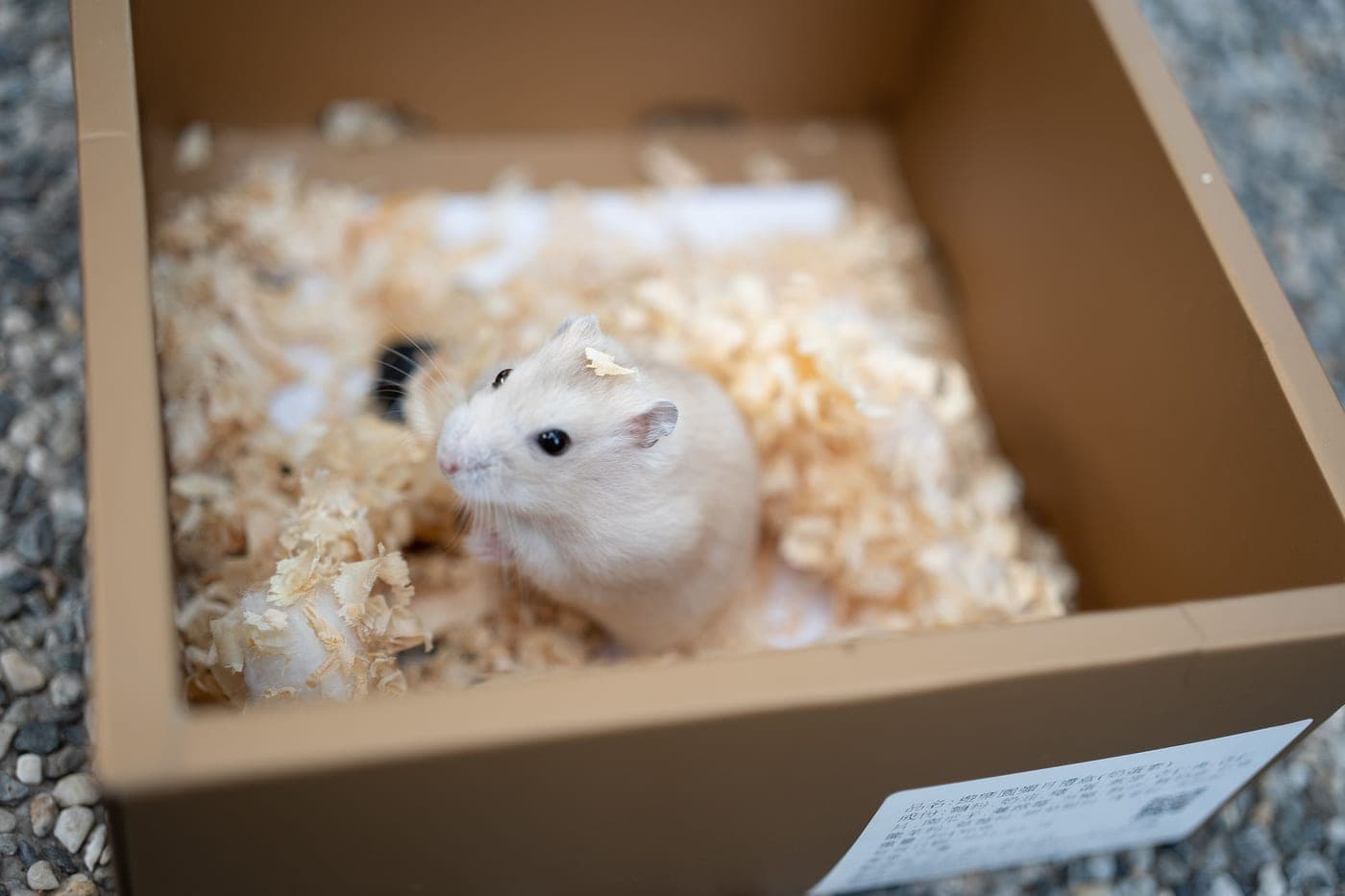
A hamster needs at least 775 square inches (5,000 cm2) of continuous floor space — the figure PDSA publishes as 100 x 50cm, and the same figure published independently by Blue Cross, Wood Green and Germany's veterinary animal-welfare association. Continuous means one unbroken surface: shelves, upper levels and tubes do not count. The figure applies to dwarf and Syrian hamsters alike.
Hamster cage minimum size · minimum
100cm x 50cm
Our conversion: 5,000 cm2, or 775 square inches of continuous floor
That number is larger than almost every cage sold as a complete hamster kit, which is the awkward fact underneath this whole subject. If you are reading this having already bought one, you are in the position most people are in, and the useful question is not whether the cage was a mistake but what the cheapest route to the threshold looks like from here. That is at the bottom of this page.
Why continuous floor is the measurement that counts
Every published figure is a floor-area figure, not a volume figure, and the reason is behavioral. A hamster's day, in the wild and in a cage, is a sequence of things done in different places: a nest, a food store, a latrine corner, a burrow system, and a great deal of running. Those uses need to be separable. A hamster that has to nest where it toilets is a hamster whose enclosure is too small, whatever the total volume of plastic surrounding it.
Height and shelves add volume without adding separable floor. A shelf is somewhere to sit; it is not somewhere to build a second burrow, because a hamster burrows downwards into substrate, and there is no substrate on a shelf. This is why the published figures are all about the base and why a three-level cage advertised on its total surface area is measuring the wrong thing.
How to measure the cage you already own
- 1.Measure the inside of the base, not the outside of the cage. On a wire cage the plastic base is often an inch narrower at the top than the bottom; use the floor. On the Prevue 528, for instance, the external footprint is 32.5 x 19 inches while the base interior is 30 x 16.
- 2.Multiply length by width. 30 x 16 = 480 square inches. That is the whole of the arithmetic.
- 3.Add nothing. No shelves, no upper levels, no tube volume, no attached extensions that are not continuous with the base.
- 4.Compare to 775. 480 against 775 is 62 percent of the minimum. Now you know what you have rather than how it looks.
| Enclosure | Continuous floor | Percentage of the minimum |
|---|---|---|
| Kaytee CritterTrail One Level | 230 sq in | 30% |
| Kaytee CritterTrail Super | about 448 sq in at the base | 58% |
| Prevue 528 (base interior) | 480 sq in | 62% |
| BUCATSTATE 2.0, 31in | 552 sq in | 71% |
| Savic Hamster Heaven Metro | 620 sq in | 80% |
| BUCATSTATE 3.0, 39in | 774 sq in | 99.9% |
| Niteangel Vista Medium | 924 sq in | 119% |
| IKEA DETOLF on its back | 1,086 sq in | 140% |
| Niteangel Vista Large | 1,069 sq in | 138% |
| BUCATSTATE 3.0, 47in | 1,109 sq in | 143% |
Dimensions from each manufacturer's own listing, read 27 September 2026 and linked in our roundup. Percentages are our arithmetic against the PDSA figure.
The pattern in that table is the useful finding: there is a cliff between about 620 and 924 square inches, and it maps almost exactly onto the line between cages marketed as hamster cages and enclosures marketed as something else. The products that clear the threshold are a furniture cabinet, two MDF-and-glass enclosures and an aluminum-framed acrylic box. Almost nothing sold with a hamster on the packaging is on the right side of it.
Does the figure differ for Syrians and dwarfs?
PDSA's 100 x 50cm is stated for hamsters generally, without splitting by species, and Blue Cross, Wood Green and the German veterinary association do the same. Some bodies do split: Swiss Animal Protection publishes 10,000 cm2 for Syrians and 8,000 for dwarfs, and several European organizations publish a smaller dwarf figure.
Our position is to use the single figure, for a practical reason rather than a doctrinal one. Dwarf hamsters are smaller but not less active — the running distance a dwarf covers overnight is comparable — and a species-split figure gives owners of the smaller animal permission to buy the cage that was already too small. There is more detail in minimum cage size for a Syrian and dwarf hamster cage size requirements, including where the split argument has merit.
Floor area and bedding depth are the same problem
Hamster bedding depth · minimum
at least 25cm (10 inches)
This is the connection most cage-size discussion misses. PDSA asks for at least 25cm — ten inches — of bedding, and a burrow needs to run horizontally as well as down. Ten inches of substrate in a 480 square inch base is not a burrow system; it is a deep box in which a hamster can dig one hole. The floor-area figure and the bedding-depth figure are two measurements of the same requirement, and an enclosure that satisfies one while failing the other has not really satisfied either.
There is also a hard physical constraint: to hold ten inches of substrate you need walls that are solid to at least that height. A wire cage with a four-inch plastic base cannot hold ten inches of bedding no matter how tall the wire above it is, because the substrate spills. This is why the enclosures that clear the floor-area threshold also tend to be the ones with deep solid walls — the two specifications select for the same design. Our deep bedding guide covers the practicalities, including how much bedding ten inches actually is.
What the wheel does to your usable floor
Wheel diameter, Syrian hamster · minimum
at least 30cm (12 inches)
A 12-inch wheel and its stand occupy roughly 13 by 6 inches, which is about 78 square inches. In a 1,069 square inch enclosure that is 7 percent of the floor and irrelevant. In a 480 square inch cage it is 16 percent, and it is 16 percent taken out of the middle rather than from a corner. The wheel size guide has the figures for both species; the point here is that floor area and wheel size interact, and a cage that is marginal on floor becomes worse once a compliant wheel is in it.
What to do if your cage falls short
In rough order of cost, and none of these requires replacing the cage you own with an equivalent one.
- 1.Convert a storage tub. A large food-grade polypropylene tub with a mesh panel cut into the lid clears the threshold for the price of the tub and an hour of work. Our bin cage guide covers ventilation, which is the part people get wrong.
- 2.Convert an IKEA DETOLF. Laid on its back it gives 1,086 square inches of continuous glass floor, which is 140 percent of the minimum, for less than a purpose-built enclosure of that size. You have to build a mesh lid. Full conversion guide.
- 3.Buy a purpose-built enclosure that clears it. Three do, and they are in our roundup with the arithmetic.
- 4.Keep the existing cage as a secondary space. If you have a wire cage with good bar spacing, it is a perfectly reasonable carrier for cleaning days or a quarantine setup. It does not have to be wasted; it just cannot be the home.
What does not work, and is worth saying because it is widely suggested: adding a second story, adding tubes, or connecting two small cages together. None of those adds continuous floor. A 480 square inch cage with a second 480 square inch cage bolted on through a tube is two cages that are each too small, which is a different thing from one cage that is big enough.
The three enclosures that clear the figure
These are the only options we assessed whose continuous floor exceeds 775 square inches. Full assessments, specifications and the ones that fall short are in our best hamster cages roundup.
 Illustrative
A Syrian that needs real burrowing depth
Niteangel Vista Hamster Cage, Large
47.1 x 22.7 = 1,069 sq in external footprint
The largest mainstream single-piece hamster enclosure we could verify, and the only one whose external footprint clears our 775 sq in floor with room to spare even after you allow for wall thickness.
Check price on AmazonWe do not print prices. #ad Disclosure
 Illustrative
Deep burrowing without a DIY build
BUCATSTATE Hamster Cage 3.0, 47 in
47 x 23.6 = 1,109 sq in (7.7 sq ft) by our arithmetic
The deepest substrate capacity we could verify on a mainstream enclosure: an 11 in bedding claim on a 1,109 sq in floor is the combination almost nothing else offers.
Check price on AmazonWe do not print prices. #ad Disclosure
- Illustrative
The most floor area per dollar, if you will build a lid
IKEA DETOLF glass display cabinet
laid on its back, 163 x 43 cm = 7,009 cm2, or 1,086 sq in
A furniture cabinet that gives 1,086 sq in of continuous floor for less than any purpose-built enclosure of that size, provided you accept that it ships without a lid.
View at IKEAWe earn no commission here. #ad Disclosure
A closing note on how to hold this figure. 775 square inches is a minimum published by veterinary bodies, which means it is the level below which housing is inadequate rather than the level at which it is good. If you clear it, you have not done something remarkable; you have got past the floor. The bodies that publish these numbers say so themselves, repeatedly, and the fuller discussion of what the different published figures are and where each comes from is on our hamster welfare minimums page.
Questions people ask
How many square inches should a hamster cage be?
How big do hamster cages need to be?
Do shelves and upper levels count towards cage size?
Can you use a guinea pig cage for a hamster?
Is a bigger cage always better for a hamster?
How much space do hamsters actually need to be happy?
Sources
- PDSA — The ideal home for your hamster — Minimum cage size 100 x 50cm; bedding at least 25cm; wheel at least 30cm for a Syrian
- San Diego Humane Society — Hamster care — Bedding at least 6in with 8-12in best; wheel 8-10in dwarf and 10-12in Syrian
- RSPCA — Hamster environment — Qualitative guidance; publishes no numeric floor-area figure
- Prevue Pet Products — Small Animal Home 528 — Base interior 30 x 16in against a 32.5 x 19in external footprint