Guides
How big should a gerbil cage be?
The floor figure is published and it is the same as a hamster's. What it houses, and what material it has to be made of, are not.
100cm long by 50cm wide by 50cm high for two gerbils, and 120 x 50 x 50cm for three. That is Woodgreen Pets Charity's published minimum, and in inches it is 39.4 x 19.7 x 19.7 for a pair, or 775 square inches of floor. Two things make that figure harder to shop for than the equivalent hamster number, which happens to be identical. The first is that it is stated for a pair rather than a single animal, because the RSPCA says gerbils should not be kept alone — so 775 square inches houses two gerbils where it houses one hamster. The second is the height: 50cm exists so that an animal can dig down 20 to 30cm and still stand fully upright above ground, and the RSPCA puts an adult gerbil at about 12cm tall. Most enclosures sold at the right floor area are nowhere near 50cm deep.
Gerbil enclosure minimum size · minimum
100cm long x 50cm wide x 50cm high for two gerbils, and 120cm x 50cm x 50cm for three
Our conversion: 5,000 cm2, or 775 square inches of floor for a pair
The ranked product version of this decision is the best gerbil cages. This page is the figure itself: where it comes from, what it means in the units you will actually be shopping in, how it scales with the number of animals, and why the published guidance rules out an entire category of product that would otherwise be the obvious answer.
The figure in the units on the box
| Gerbils | Published figure | In inches | Floor area | Substrate at 20cm |
|---|---|---|---|---|
| Two | 100 x 50 x 50cm | 39.4 x 19.7 x 19.7 in | 775 sq in (5,000 cm2) | 100 liters |
| Three | 120 x 50 x 50cm | 47.2 x 19.7 x 19.7 in | 930 sq in (6,000 cm2) | 120 liters |
| Four (our extrapolation) | Not published | Add roughly 8 in of length per animal | About 1,085 sq in | About 140 liters |
The first two rows are Woodgreen's stated minimums; the inch conversions, the square-inch floor areas and the substrate volumes are our arithmetic, at 1,000 cubic centimeters to the liter. The four-gerbil row is clearly marked as our extrapolation from the step between the published two- and three-animal figures, because Woodgreen publishes no figure for four.
The substrate column is the part that catches people out, and it is why the best gerbil bedding exists as a separate page: the first fill of a minimum-sized gerbil enclosure at the published depth is 100 to 125 liters, which is more than the largest single pack any brand on sale holds. The enclosure price is not the setup price.
Why the 50cm height is a real specification
Gerbil bedding depth and enclosure type · recommendation
a bedding depth of 20-30cm, in a gerbilarium ideally around 50cm high
Our conversion: roughly 8 to 12 inches of substrate under about 20 inches of height
Run the arithmetic the RSPCA's two figures imply. Substrate at 20 to 30cm, an adult gerbil about 12cm tall, and the animal needs to be able to emerge from a burrow and stand upright above the surface. 30cm of substrate plus 12cm of gerbil is 42cm before you allow any clearance at all, which is exactly why the published enclosure height is 50cm and not 40. An enclosure with a 775 square inch floor and a 25cm wall is not a compliant gerbil enclosure filled to the published depth — it is a compliant gerbil enclosure with four inches of substrate in it, which is a different thing.
This is the single most useful consequence of the figure for a shopper: measure the wall height before you measure anything else. Of the four enclosures we would consider, the deciding specification is not floor area, which several clear comfortably, but how much substrate the walls will actually retain.
What the figure rules out, and it is most of the aisle
Woodgreen advises against wire cages for gerbils, and against the mesh and solid shelves fitted to ready-made enclosures. The RSPCA goes further and asks for solid glass walls with a secure wire-mesh top and a solid floor, advising against bar cages on the basis that gerbils may injure their legs or damage their teeth on them. Both charities are describing the same product category and ruling it out, which means the gerbil answer is a tank, a display cabinet or a solid-walled enclosure — and Woodgreen says plainly that suitable gerbil housing is very limited and can be tricky to find.
Tank sizes, since the guidance points at glass
| Tank | Published dimensions | Floor area | Against 775 sq in |
|---|---|---|---|
| 29 gallon | 30 x 12 x 18 in | 360 sq in | Short by 54 percent |
| 40 gallon breeder | 36 x 18 x 16 in | 648 sq in | Short by 16 percent |
| 55 gallon | 48 x 13 x 21 in | 624 sq in | Short by 19 percent |
| 75 gallon | 48 x 18 x 21 in | 864 sq in | Clears it |
| 90 gallon | 48 x 18 x 24 in | 864 sq in | Clears it, with more height |
| 125 gallon | 72 x 18 x 21 in | 1,296 sq in | Clears it by 67 percent |
Tank dimensions are the standard figures published in the retail chart cited under Sources; the floor areas and comparisons are ours. Note that the 55 gallon has more water volume than the 40 breeder and less floor, because gallons measure height as much as footprint — which is the single most useful thing to know when the guidance points you at aquariums.
So the smallest standard aquarium that clears the published gerbil floor is a 75 gallon, and the 40 gallon breeder that gets recommended constantly is 16 percent short. A 40 breeder is not a disaster and it is not compliant, and we would rather say which it is than call it big enough.
How to measure what you are looking at
- 1.Measure the inside of the base. External footprints on wooden and MDF enclosures include wall thickness, which on a 20mm carcass is nearly an inch and a half of width lost per side.
- 2.Measure the wall height above the floor, not the overall height. A mesh lid frame, a sloped roof or a glass front that stops short all reduce what the enclosure will hold.
- 3.Count one level. Woodgreen advises against the mesh and solid shelves fitted to ready-made enclosures in any case, so shelf area was never going to count towards the figure.
- 4.Check the lid aperture. 1cm welded mesh is the figure Woodgreen gives for a homemade lid. A gerbil is a better climber than its body shape suggests.
- 5.Then check the substrate bill. Floor area multiplied by 20cm, divided by 1,000, gives liters. For a minimum-sized enclosure that is 100 liters, and it is a real cost.
Four enclosures measured against 100 x 50cm
Two solid-walled enclosures that clear the floor figure comfortably, the 39.3 inch model that lands at 99.8cm and misses it by two millimeters, and the glass display cabinet the published guidance names by type. Floor figures are each manufacturer's published dimensions with our arithmetic shown.
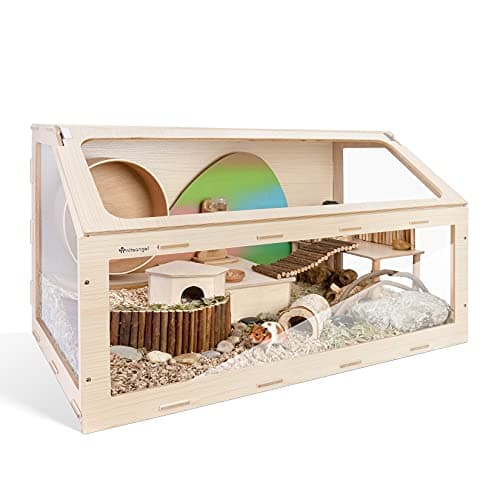
A Syrian that needs real burrowing depth
Niteangel Vista Hamster Cage, Large
47.1 x 22.7 = 1,069 sq in external footprint
The largest mainstream single-piece hamster enclosure we could verify, and the only one whose external footprint clears our 775 sq in floor with room to spare even after you allow for wall thickness.
$309.95View on AmazonPrice as of October 17, 2026. #ad Disclosure
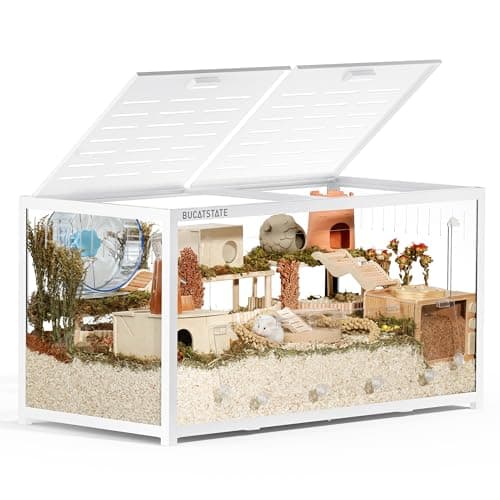
Deep burrowing without a DIY build
BUCATSTATE Hamster Cage 3.0, 47 in
47 x 23.6 = 1,109 sq in (7.7 sq ft) by our arithmetic
The deepest substrate capacity we could verify on a mainstream enclosure: an 11 in bedding claim on a 1,109 sq in floor is the combination almost nothing else offers.
$265.99$279.995% offView on AmazonPrice as of October 17, 2026. #ad Disclosure
A dwarf hamster in a tight space
BUCATSTATE Hamster Cage 3.0, 39 in
39.3 x 19.7 = 774 sq in (5.4 sq ft) by our arithmetic
Lands within one square inch of the 775 sq in minimum, which makes it the smallest enclosure we are willing to list and a borderline call we would rather you avoided.
$170.95$179.995% offView on AmazonPrice as of October 17, 2026. #ad Disclosure
 Illustrative
The most floor area per dollar, if you will build a lid
IKEA DETOLF glass display cabinet
laid on its back, 163 x 43 cm = 7,009 cm2, or 1,086 sq in
A furniture cabinet that gives 1,086 sq in of continuous floor for less than any purpose-built enclosure of that size, provided you accept that it ships without a lid.
No buy link: not sold on Amazon, and on no programme we are part of.
If you are still deciding between species rather than between enclosures, gerbil versus hamster is the comparison that matters here, because the two share this floor figure and it means completely different things for each.
Questions people ask
What is the minimum cage size for two gerbils?
Is a 40 gallon breeder big enough for two gerbils?
Can gerbils live in a wire cage?
Does PDSA publish a gerbil cage size?
How tall does a gerbil enclosure need to be?
Sources
- Woodgreen: how to house your gerbils — The 100 x 50 x 50cm and 120 x 50 x 50cm minimums, the advice against wire cages and the glass-cabinet recommendation.
- RSPCA: gerbils environment — The 20-30cm bedding depth, the 50cm height, the 12cm adult height and the advice against bar cages.
- RSPCA: gerbils company — Why the published figure is stated for a pair rather than a single animal.
- PDSA: the ideal home for your gerbils — Publishes no numeric enclosure size for gerbils, which we record rather than fill in.
- Standard aquarium dimensions chart — Published tank dimensions used for the floor-area conversions above.