Guinea pigs
MidWest Guinea Habitat Plus review
It misses the preferred floor figure and it is the only cage on this site a cat cannot get into. Which of those matters more is the whole review.
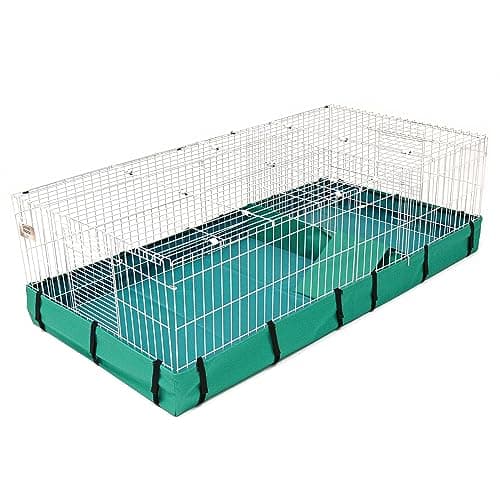
Buy the MidWest Guinea Habitat Plus if you have another pet in the house, and buy a C&C cage if you do not. That is the whole decision and it turns on one feature rather than on floor area. The Habitat Plus measures 47 x 24 inches, which is 1,128 square inches or about 7.8 square feet by our arithmetic against a manufacturer-stated 8 square feet. Humane World for Animals publishes 7.5 square feet as the bare minimum for two guinea pigs and 10.5 square feet as preferred, and we buy to the preferred figure — so this cage clears the minimum and misses what we recommend by 2.7 square feet. Against that it is the only guinea pig enclosure we assess that ships with a removable wire mesh top and a divider panel, and a lid is not a luxury in a house with a cat or a dog. An open-topped pen with 2.7 more square feet in a room with a predator in it is not the better buy.
Guinea pig cage minimum · minimum
7.5 sq ft (about 30in x 36in) bare minimum for one; 7.5 sq ft minimum for two, with at least 10.5 sq ft (30in x 50in) preferred
There is a second reason this cage is worth its own page, which is that it is the only guinea pig enclosure on this site with a buy link. The Kavee C&C cages we rate above it on floor area are not sold on Amazon and are on no affiliate programme we are part of, so per our own disclosure rules they appear as reference entries with their specification source cited and no buy button. We would rather say that out loud on the page than let a reader assume the one with a button is the one we rate highest. On floor area alone, it is not.
The specifications, as published
| Specification | Figure |
|---|---|
| External dimensions | 47 x 24 x 14 in |
| Living space | 8 sq ft, manufacturer-stated |
| Floor area | 47 x 24 = 1,128 sq in, about 7.8 sq ft (our arithmetic) |
| Wall height | 14 in |
| Lid | Removable wire mesh top |
| Divider | Divider panel with lock-in-place ramps |
| Floor | Washable PVC-lined canvas bottom |
| Our assessment | 8.4 out of 10, on published specifications |
Dimensions, the stated living space, the lid, the divider and the canvas floor are from the MidWest product listing cited under Sources. The square-inch and square-foot conversions and the score are ours; our scores assess published specifications rather than reporting test results. The small gap between the stated 8 sq ft and our 7.8 is the usual difference between a rounded marketing figure and the external dimensions multiplied out.
The lid, which is the reason to buy it
Guinea pigs are a prey species and a cat is a predator that lives in the same room. A C&C cage with 13.8 inch walls and no top is open from above to anything that can jump onto a 14 inch wall, which is every cat and most dogs. The mesh top here removes that entirely, and it also removes the second problem nobody mentions: a toddler. If the honest description of your household includes another animal or a small child, a lid moves from nice-to-have to the specification you are buying.
It is worth noting what the lid costs you. A mesh top makes the cage harder to reach into, it is one more thing to take off at cleaning time, and it slightly reduces the sense of open space the C&C format gives. Those are real and they are small next to the thing it prevents.
The divider, which is the reason to keep it
The divider panel with lock-in-place ramps turns one cage into two, and the situations where that matters are specific but common: introducing a new pig and needing a see-but-not-touch period, separating two boars that have fallen out, isolating an animal that is recovering or on medication, or keeping a newly weaned male apart. Every one of those otherwise means buying or borrowing a second enclosure at short notice. Having it built in is the kind of feature you do not value until the week you need it.
The floor, and what it does over time
The base is a PVC-lined canvas bottom, which is solid, washable and considerably kinder to feet than wire — Humane World for Animals states plainly that cages with wire floors are not acceptable for guinea pigs, along with plastic tubs and glass aquariums, so a solid floor is a requirement rather than a preference. The canvas does one thing well and one thing badly. It is light, it wipes down and it does not crease like a correx base. It also absorbs urine at the seams over time, and once the seams have taken it up the smell lives in the cage rather than in the bedding. A fitted fleece liner on top is the fix, and it is the reason we assess liners at all — the best guinea pig cage liners is the shortlist and liners versus disposable bedding is the economics of the choice.
Where it loses to a C&C cage
- Floor area. 7.8 square feet against a Kavee 4x2's 10.6, which clears the preferred figure for a pair where this does not. 2.8 square feet is a quarter more room, and for guinea pigs floor is the thing that stops a pair pacing.
- Expandability. Expanding a C&C cage means buying grids; expanding this means buying another whole unit. If there is any chance of a third pig, the modular format is the cheaper long-term purchase and the C&C cage guide explains how the sizing works.
- Wall height, marginally. 14 inches here against 13.8 on a Kavee, so this one is fractionally better and both clear the published 12 inch minimum. Not a real difference.
- Long-term floor durability. Correx creases at the corners and is cheap to replace; canvas absorbs at the seams and is not replaceable separately.
Who should buy it
A household with a cat or a dog, a household with a small child, anyone who may need to separate two animals, and anyone who wants a finished product out of a box rather than a flat-pack grid build. For those buyers this is the right cage and the 2.7 square foot shortfall against our preferred figure is the price of the lid. The honest mitigation is floor time: the cage is the base, not the whole range, and daily run time in a secured pen is how a 7.8 square foot cage becomes an adequate life. Our cage-size recommendation does not change, and guinea pig cage size for 2 is where that figure is worked through.
Who should not: anyone buying on floor area alone with no other pets in the house. For that buyer the modular C&C format gives a quarter more room at a similar spend and grows with the herd, and C&C versus store-bought cages is the direct comparison.
The cage reviewed on this page
7.8 square feet with 14 inch sides, a removable mesh lid, a divider panel and a washable solid floor. The cage to buy if there is another animal in the house.
A pair in a house with a cat, or two pigs that need separating
MidWest Guinea Habitat Plus
47 x 24 = 1,128 sq in, about 7.8 sq ft
7.8 sq ft clears the bare minimum for a pair and misses the preferred figure, but it is the only cage here that ships with both a lid and a divider.
$80.99View on AmazonPrice as of October 17, 2026. #ad Disclosure
Questions people ask
Is the MidWest Guinea Habitat Plus big enough for two guinea pigs?
Does it have a lid?
Can you split it into two cages?
Does the canvas floor hold up?
Sources
- MidWest Guinea Habitat Plus listing — Dimensions, the stated 8 sq ft, the mesh top, the divider panel and the PVC-lined canvas floor.
- Humane World for Animals: guinea pig housing requirements — The 7.5 and 10.5 sq ft figures for two, the 12 in wall height and the statement that wire floors are not acceptable.
- RSPCA: guinea pigs environment — Cleaning frequency, and the bedding materials named as suitable and unsuitable.