Ferrets
Ferret escape-proofing
If the skull fits, the ferret fits. Then there are the four other places they get out.
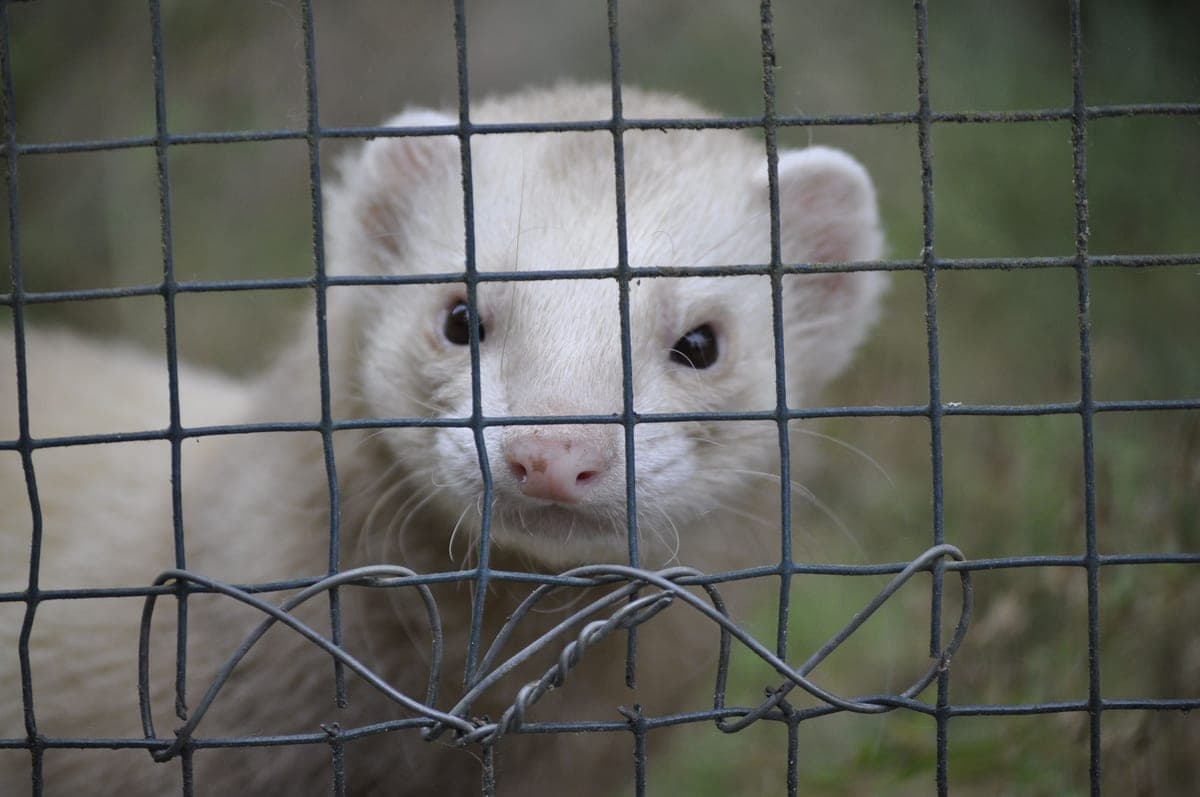
A ferret gets out through five things, in order of frequency: bar spacing wider than half an inch, a latch it can operate, gaps at pan level, gaps where a stand meets the cage, and a door left unlatched. The governing principle for all of them is the skull test: if a ferret's head fits through a gap, the ferret fits, because the ribcage compresses and the skull does not.
The skull test
This is the single idea that makes ferret containment predictable. A ferret assesses a gap by putting its head into it, and its judgment is accurate: if the head goes through, the rest follows. Shoulders and ribs compress; a skull does not.
Which means the relevant measurement is not the ferret's apparent width but the width of its head, and that changes with age. A kit's skull passes a one-inch gap. A grown hob's does not. This is why escapes cluster among young animals, and why an owner is genuinely surprised — the cage held the adults in the same household perfectly well.
The practical version: if you can push a closed fist of roughly your ferret's head size through a gap, so can the ferret. Check every gap in the enclosure that way rather than measuring, because measurement misses the corners where panels meet.
1. Bar spacing
Half an inch or tighter. No welfare body publishes a ferret bar-spacing figure, so this is our threshold — and it is the reason we recommend the Critter Nation over the Ferret Nation despite the names, as covered in Ferret Nation vs Critter Nation.
| Cage | Published spacing | Holds a kit? |
|---|---|---|
| MidWest Critter Nation 161 / 162 | 1/2in | Yes |
| Savic Royal Suite 95 | 13mm (about 1/2in) | Yes |
| Prevue Feisty Ferret 485 | 7/8in | Not reliably |
| MidWest Ferret Nation 182 | 1in | No |
From each manufacturer's published listing, read 27 September 2026.
2. The latch
Ferrets are dexterous and persistent, and they have all night. A simple drop-hook, a turn-button or a single-action catch is a mechanism a ferret will eventually work, and it only has to succeed once.
What to look for and what to add:
- Two distinct actions to open. Lift and slide, or squeeze and turn. A ferret can do one thing at a time with a paw; two in sequence is a much harder problem.
- A carabiner or small padlock through the latch. This is the cheapest escape-proofing available and it removes the weakest point on most cages outright.
- Check every door, not just the main one. Pan-access doors, feeding hatches and stand-level openings all count.
- Watch which door your ferret works at. Animals are consistent. The door it pushes at is the door that will open.
3. Gaps at pan level
This is the least obvious route and a common one. Where a removable pan meets the cage frame there is often a small gap, and a ferret that digs in its litter corner will find it. The gap is usually a fraction of an inch at the front edge, which fails the skull test for a kit.
Check it with the pan fully seated and again with the pan pushed slightly out of position, because that is the state it will actually be in after a ferret has been digging. If there is a gap, a strip of correx or a length of trim taped inside the frame closes it without creating the cavity that mesh lining does.
4. Where a stand meets the cage
Both MidWest cages and the Savic sit on stands, and the junction between the stand and the cage body is a place where a gap can exist — particularly after a cage has been moved a few times and the frame has flexed.
It also matters for a different reason: a ferret that gets into the space between a cage and a stand is somewhere you cannot easily reach, which turns a containment problem into a rescue. Check this junction on assembly and again after any move.
5. The door somebody left open
Worth stating plainly because it is the most common cause of a lost ferret and none of the specifications above address it. A ferret notices an open door long before you notice you left it open, and a ferret out of its cage in an unproofed room is in real danger — from other animals, from recliner mechanisms, from washing machines, from doors.
The habit that fixes it: latch the door as part of the same motion as closing it, every time, rather than as a separate step. And count your ferrets before you close the cage, because a ferret asleep in a hammock and a ferret behind the sofa look identical from the doorway.
The room, not just the cage
Since VCA publishes a requirement for at least two to three hours a day out of the cage, a ferret will be loose in a room by design. Ferret-proofing that room is part of housing rather than separate from it.
- 1.Block every gap under and behind furniture that a ferret can enter and you cannot reach into. The skull test applies to the room too.
- 2.Reclining chairs and sofa beds are the classic ferret hazard. The mechanism is exactly the kind of space a ferret investigates. Many owners remove them from a ferret room entirely.
- 3.Check the washing machine and tumble dryer every time before use. Ferrets sleep in dark enclosed warm places and that is a description of a drum.
- 4.Cupboard doors and appliance gaps. Ferrets open cupboards, and a ferret in a cupboard with cleaning products is a poisoning risk.
- 5.Cable runs and heating pipes that pass through a wall are ferret-sized routes to another room.
- 6.Count them before you leave the room. Every time.
The one-minute weekly check
- Push a fist-sized object at every panel join and door edge. Anything it passes through, a kit passes through.
- Open and close each latch. Anything that opens in one action gets a carabiner.
- Seat and unseat each pan, checking the front edge gap in both positions.
- Look at the stand junction.
- Check hammocks for holes, because a hole a ferret can get its head through is the same geometry problem in fabric.
The cages, on containment
Two with half-inch or 13mm spacing that hold a kit, and one with one-inch bars that does not — included because it is a good cage for adults and the honest reason kits escape.
 Illustrative
Ferrets of any age, and kits especially
MidWest Critter Nation Double Unit (162)
36 x 24 = 864 sq in (6 sq ft) per level, two levels
The half-inch bar spacing is the whole argument: it is the same cage as the Ferret Nation with a gap a ferret kit cannot get its head through.
Check price on AmazonWe do not print prices. #ad Disclosure
- Illustrative
Two ferrets that sometimes need separating
Savic Royal Suite 95 Rat and Ferret Cage
95 x 63 cm = 5,985 cm2, about 928 sq in (6.4 sq ft) per level
The most floor per level of the three big ferret cages and the only one that splits into two separate cages, at 13mm spacing that is functionally the Critter Nation's half-inch.
Check price on AmazonWe do not print prices. #ad Disclosure
- Illustrative
Adult ferrets that climb
MidWest Ferret Nation Double Unit (182)
36 x 25 = 900 sq in (6.25 sq ft) per level, two levels
Slightly more floor per level than the Critter Nation and a one-inch bar gap, which is fine for a grown ferret and the reason kits escape.
Check price on AmazonWe do not print prices. #ad Disclosure
Questions people ask
How do ferrets escape from cages?
What bar spacing stops a ferret escaping?
Can I add mesh to a cage with wide bars?
How do I stop a ferret opening its cage door?
What do I need to ferret-proof a room?
Why do ferret kits escape from cages that hold adults?
Sources
- VCA Animal Hospitals — Ferrets, housing — At least two to three hours a day out of the cage, which is why room-proofing is part of housing
- MidWest Homes for Pets — Critter Nation — 1/2in bar spacing
- MidWest Ferret Nation 182 product listing — 1in bar spacing
- Prevue Pet Products — Feisty Ferret Home 485 — 7/8in wire spacing