Ferrets
Ferret cage setup checklist
Nine things, arranged so the litter stays on one level and the sleeping happens on another.
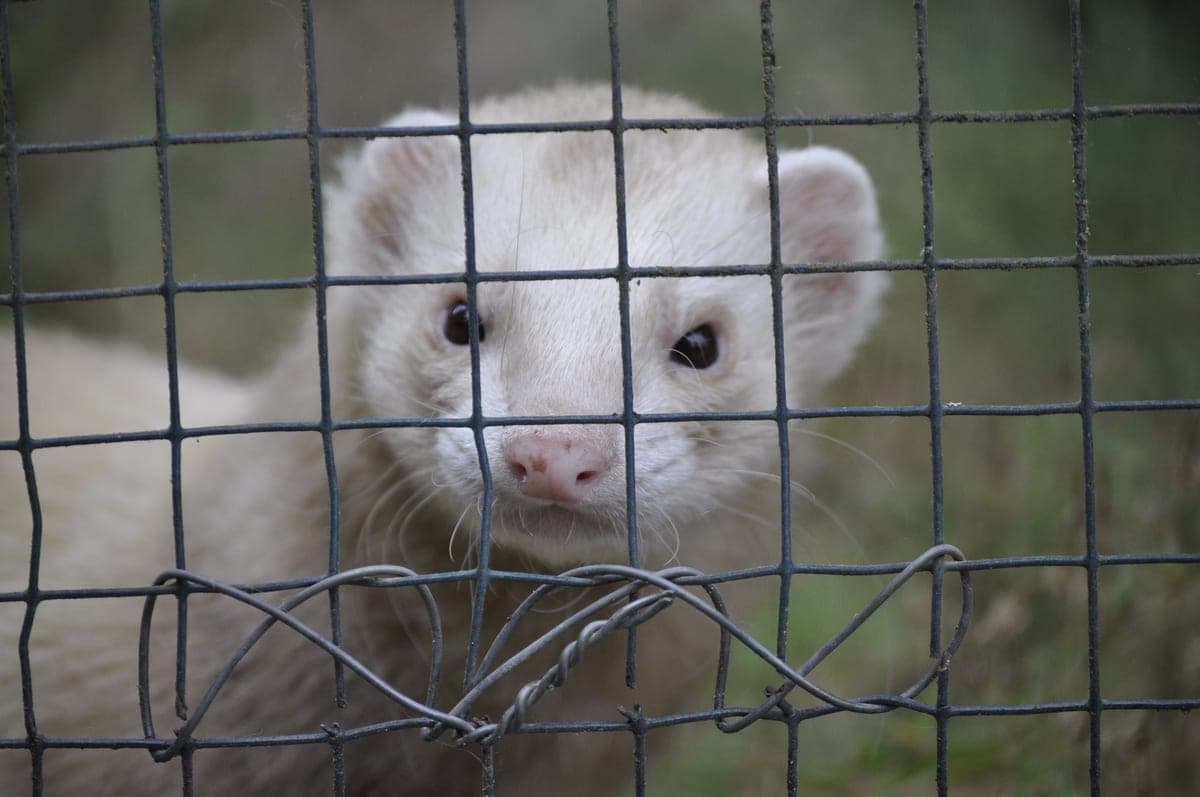
A ferret cage needs nine things: a multi-level cage with 6+ square feet per level and half-inch bars, fitted fleece liners, two or three sleeping options per ferret at different heights, a high-backed litter tray per level, a heavy water bowl, food in a fixed bowl, tunnels, hard chew-safe toys, and a latch a ferret cannot operate. Arrange it with litter low and sleeping high.
The nine
1. The cage: 6+ square feet per level, half-inch bars
Ferret cage suggested minimum · suggested minimum
24in x 24in x 18in high (60cm x 60cm x 45cm)
Our conversion: 576 square inches, or 4 square feet, of floor
VCA's suggested minimum is smaller than every cage sold, so our thresholds do the work: six square feet of usable floor per level on a multi-level cage, and half-inch bar spacing, because a kit's skull passes a one-inch gap. Ferret cage size and best ferret cages.
2. Fitted fleece liners
Cut to the pan, not approximately. Ferrets dig at edges, and a liner with a loose corner ends up under the ferret rather than under its feet. Fleece rather than towelling, because loops catch claws. Ferret bedding and liners.
3. Two or three sleeping options per ferret, at different heights
VCA notes ferrets sleep 12 to 18 hours a day, and where they do it is a hammock or an enclosed sack rather than the cage floor. More than one each, at different heights, because ferrets are particular and change their minds. Mix open hammocks with enclosed sacks; most ferrets prefer something they can get inside.
4. A high-backed litter tray per level
Ferrets back into corners to toilet, so the back wall matters more than the floor area. A flat tray gets used and missed. One per level, changed daily — a ferret that finds its tray unpleasant chooses a cage corner instead, and undoing that habit is much harder than preventing it.
5. A heavy water bowl
Bowls rather than bottles: ferrets drink more from a bowl, and they play in water, which is a feature rather than a problem. Heavy ceramic or a clip-on bowl, because a light bowl becomes a toy. Check it twice a day, because a tipped bowl is an empty bowl.
6. Food in a fixed bowl
Clip-on or heavy, for the same reason. Ferrets are obligate carnivores with a very fast gut transit, so they eat little and often and food should be available rather than portioned into meals. Diet is outside our scope here — this is a housing site — but the bowl arrangement is not.
7. Tunnels
The single best-value enrichment for this species. Ferrets are built to go through things, and a length of wide flexible tunnel or a cardboard tube gets more use than anything else you can put in a cage. Wide enough that the animal is not squeezing, and open at both ends — a tunnel with one entrance is a dead end, which matters when two ferrets meet in it.
8. Hard, chew-safe toys
Hard plastic or solid rubber, nothing with loose stuffing and nothing with small detachable parts. Ferrets chew and swallow, and gut obstruction is a surgical emergency in this species. Latex squeaky toys are a specific hazard: they get chewed into pieces exactly the wrong size.
9. A latch a ferret cannot operate
Two distinct actions, or a carabiner through the existing latch. This is the cheapest escape-proofing available and it addresses the second most common route out. The others are in ferret escape-proofing.
How to arrange the levels
This is the part that makes a weekly difference and it is rarely mentioned.
- 1.Litter tray on the lower level. Ferrets will use whichever level the tray is on, and litter kicked from an upper pan lands on the lower one. Put the mess at the bottom.
- 2.Main sleeping hammocks on the upper level. Ferrets prefer to sleep at height, and it keeps bedding away from the litter.
- 3.Water and food on the lower level, away from the litter tray. Easier to check and refill, and less far to fall if a bowl gets knocked.
- 4.Tunnels linking the levels, or running along the upper level where the ramp arrives.
- 5.A second smaller litter tray on the upper level if you have more than two ferrets, because an animal that cannot be bothered to go down will use a corner.
What to leave out
- Loose bedding on the cage floors. Ferrets do not burrow; it gets kicked out and it brings back the softwood question a fabric setup had eliminated.
- Stuffed beds. A ferret opens them and eats the filling. Gut obstruction is surgical.
- Looped towelling. Claws catch in loops and the loop tightens. Ferret bedding safety.
- Latex squeaky toys and anything with small parts. Chewed into exactly the wrong size.
- Clumping clay litter. Ferrets dig in litter and ingested clay clumps in the gut.
- Wire ramps and wire shelves without covers. Foot injuries. Our recommended cages ship with covers; if yours does not, cover them.
The order to set it up in
- 1.Site the cage. VCA publishes a ceiling of 80F (27C), so out of direct sun and away from radiators. Ferrets are heat-sensitive and heat stress develops fast. Cage placement.
- 2.Assemble and check every gap with the skull test before anything goes in. Panel joins, pan edges, the stand junction.
- 3.Fit the liners, then the litter trays in the corners the animals are likely to choose — the ones furthest from where the food will be.
- 4.Hang the hammocks, several, at different heights, checking each clip.
- 5.Water and food bowls, fixed down, away from the litter.
- 6.Tunnels and hard toys last, in the space that is left.
- 7.Latch everything and count the ferrets before you walk away.
The three purchases that matter
The cage, a liner cut to its pan, and paper litter for the trays. Hammocks, tunnels and bowls are cheap or improvised; those three are the structure.
 Illustrative
Ferrets of any age, and kits especially
MidWest Critter Nation Double Unit (162)
36 x 24 = 864 sq in (6 sq ft) per level, two levels
The half-inch bar spacing is the whole argument: it is the same cage as the Ferret Nation with a gap a ferret kit cannot get its head through.
Check price on AmazonWe do not print prices. #ad Disclosure
 Illustrative
Lining a Ferret Nation or Critter Nation pan
Nation Accessories Fleece Liner Set
Covers a full Nation level
The right answer to ferret bedding, because ferrets do not burrow and a washable liner removes the whole loose-substrate question at once.
Check price on AmazonWe do not print prices. #ad Disclosure
 Illustrative
The litter corner of a ferret cage
Small Pet Select Paper Bedding
Not applicable
A paper bedding for the one place a ferret cage needs loose material, which is the litter corner and nowhere else.
Check price on AmazonWe do not print prices. #ad Disclosure
And the figure that no amount of setup replaces: VCA publishes at least two to three hours a day out of the cage, noting that more is better. A perfectly arranged cage with no out-of-cage time is the worse setup. Build the routine at the same time as the cage.
Questions people ask
What does a ferret cage need?
What is the best ferret cage setup?
Do ferrets need hammocks?
Bowl or bottle for ferret water?
What toys are safe for ferrets?
How many litter trays does a ferret cage need?
Sources
- VCA Animal Hospitals — Ferrets, housing — Suggested minimum cage size, 12-18 hours of sleep, 2-3 hours out of the cage daily, temperature at or below 80F
- MidWest Homes for Pets — Critter Nation — 1/2in bar spacing, full-width doors, deep pans, ramp covers
- House Rabbit Society — The dangers of softwood shavings — Cited for the loose-substrate caution