Ferrets
Do ferrets like beds?
They like dark and enclosed, which is not the same thing as a bed. What a ferret will actually use, and how many of them a cage needs.
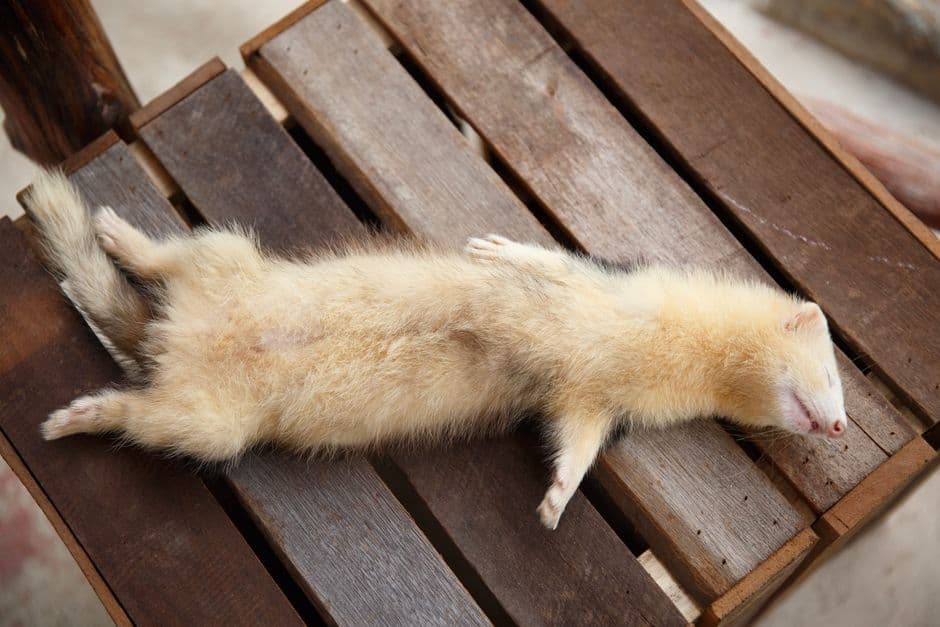
Yes, emphatically — but a ferret's preference is for dark and enclosed rather than soft and open, and that distinction decides what you buy. VCA states that a dark, enclosed sleep area is critical for a ferret and lists what they will actually use: a t-shirt, a towel, a blanket, a cloth bag, or a commercial hammock or tent. A ferret sleeps 12 to 18 hours a day, so this is the single piece of cage furniture the animal spends most of its life inside. An open pet bed will get slept on; a hanging sack or enclosed hammock will get slept in, which is what the animal is asking for.
The reason the question keeps getting asked is that the pet aisle sells ferrets the same product it sells cats: a padded open-topped oval. Ferrets will use one, usually by dragging it into a corner and then burrowing under something. The behavior is the clue. A ferret in the wild descends into a burrow to sleep, and the enclosure it wants is a tube or a pocket, not a cushion.
What a ferret will actually sleep in, in rough order of how reliably it gets used
- 1.A hanging sack or enclosed hammock. Dark inside, suspended off the pan, and up at the warm end of the cage. This is the format most ferrets choose when they have the option.
- 2.A fleece tunnel or sleep tube. Does the same job as a sack, and is the one that doubles as a toy during waking hours.
- 3.A flat hammock. Used heavily, but as a lounging surface more than a bed. Most cages benefit from one of these and one enclosed option.
- 4.A cloth bag or an old t-shirt. VCA names both. Free, washable, and the thing a ferret sleeping badly in a new cage will often settle into first.
- 5.An open pet bed. Used, but typically after the animal has pulled bedding on top of itself. Treat it as a fallback rather than the plan.
Whatever the format, every one of these is a fabric item inside a cage with a chewing animal in it, and the material rule matters more than the shape. Safe and unsafe ferret bedding is the page with the full material list; the short version is fleece and tightly woven cotton yes, terry towelling and anything with visible loops no, and VCA's own line is that if you see a ferret chewing its cloth bedding, it MUST be removed.
What goes under the bed
We do not carry a verified shortlist of hammocks or sleep sacks — the category is full of unbranded listings whose fabric we cannot check, and we are not going to name one we have not read a specification for. What we can recommend is the washable fleece flooring that goes under them, which is the other half of a sleeping area and the part that decides whether the cage smells. Two are cut to specific cage footprints; the GuineaDad has a pocket a ferret will get into.
 Illustrative
Lining a Ferret Nation or Critter Nation pan
Nation Accessories Fleece Liner Set
Covers a full Nation level
The right answer to ferret bedding, because ferrets do not burrow and a washable liner removes the whole loose-substrate question at once.
Check price on AmazonWe do not print prices. #ad Disclosure
- Illustrative
Anyone already running a Kavee cage
Kavee Fleece Liner for C&C Cages
Covers the cage base it is sized for
The liner that actually fits the cage, which sounds trivial until you have chased a folded corner full of urine around a 4x2 for a week.
Check price on AmazonWe do not print prices. #ad Disclosure
- Illustrative
Replacing disposable bedding entirely
GuineaDad Fleece Liner
Covers the cage base it is sized for
A washable liner with a built-in pocket, which is the one fleece feature that addresses a real guinea pig behavior rather than just absorbency.
Check price on AmazonWe do not print prices. #ad Disclosure
How many sleeping places one cage needs
More than one per ferret, and at more than one height. The practical reason is temperature: VCA puts the ceiling for a ferret's environment at 80F (27C), and a hanging sack near the top of a tall cage in August is several degrees warmer than a tunnel on the bottom pan. Give the animal both and it will pick correctly on its own, every day, without you measuring anything.
The second reason is social. A bonded pair will usually pile into one sack and ignore the other three, and then one of them will have a week of wanting to sleep alone. A cage with a single sleeping place turns that into a dispute. Two enclosed options and one flat hammock is a sensible floor for a pair, and it is cheap, because two of the three can be a folded t-shirt and an old pillowcase.
Ferret environmental temperature · minimum
at or below 80F (27C)
Where the sleeping area goes in the cage
- Away from the litter corner, diagonally if possible. Ferrets back into a corner to use a litter tray, and a sack hanging over one is a sack that gets used as a litter tray.
- Off the pan, not on it. A suspended sack stays dry, stays cleaner, and keeps the floor clear for the animal to run on. On a Nation-style cage the clips go straight onto the bars.
- Not directly under a mesh top in a sunny room. This is the single most common overheating setup, and it is invisible until a hot afternoon.
- Reachable by you without taking the cage apart. You are going to be washing these weekly for the life of the animal.
On a multi-level cage this is easier than it sounds, because the tiers do the separating for you: litter and food on the lower pan, sleeping at the top. The best multi-level ferret cages is the page that works through which cages give you two full tiers to split like that.
The weekly job this creates
Fabric in a ferret cage is a consumable. Washing is weekly, on a hot wash with no fabric softener — softener coats fibers and makes a fleece less absorbent, which is the opposite of what you want under a sleeping animal. Inspection is also weekly, and it is a specific check rather than a glance: hold each sack up to the light and look for a hole, a frayed seam or a loose thread. A thread a ferret swallows is a foreign body, and that is a surgical problem rather than a laundry one.
Questions people ask
Do ferrets like beds?
How many hours a day do ferrets sleep?
Do ferrets need a hammock?
How many beds should a ferret cage have?
Can a ferret sleep in a cat bed?
How often should ferret bedding be washed?
Sources
- VCA Animal Hospitals — Ferrets, housing — States that a dark, enclosed sleep area is critical, names t-shirts, towels, blankets, cloth bags, hammocks and tents, publishes the 12-18 hours sleep figure, the 80F ceiling, and the instruction to remove cloth bedding a ferret chews
- RSPCA — Ferrets — General ferret welfare guidance, including the need for somewhere to hide and sleep away from activity