Ferrets
How high can ferrets jump?
Nobody credible publishes a number, and the number is the wrong thing to ask for. What is published is that ferrets have poor eyesight and misjudge jumps.
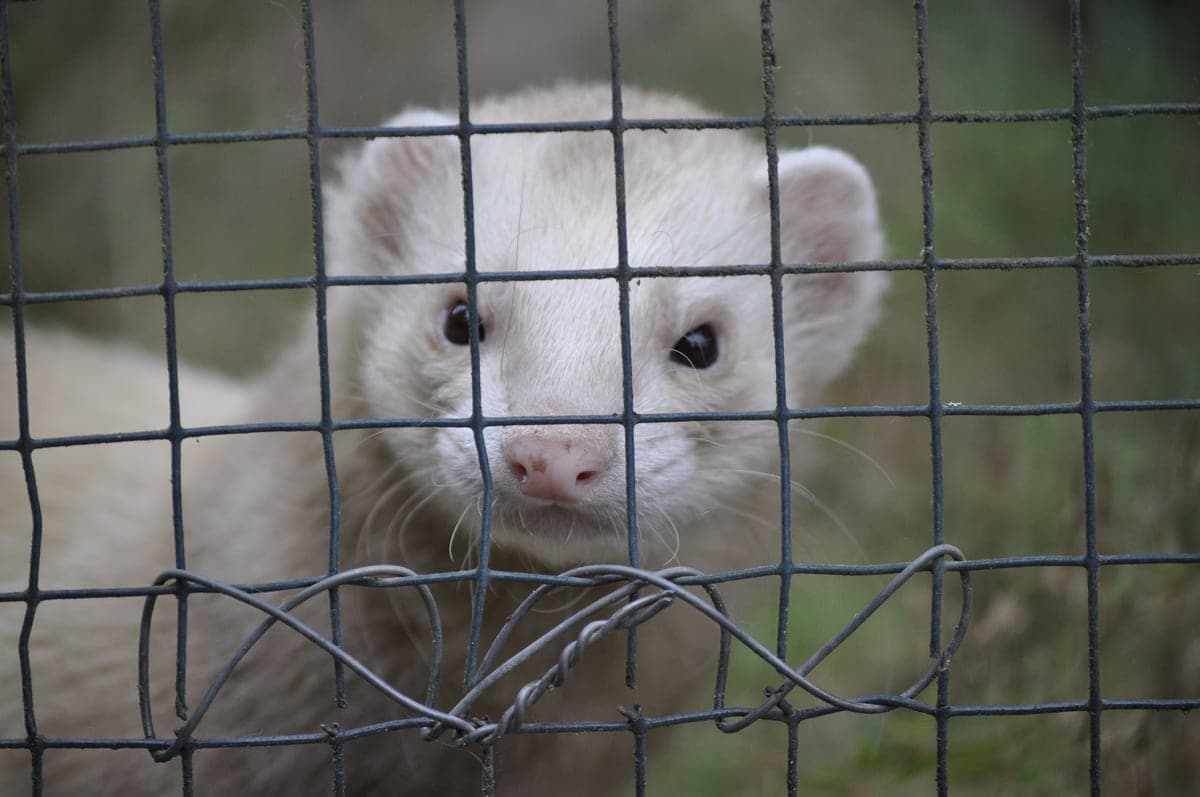
No veterinary or welfare body we read publishes a jump height for ferrets, and we are not going to invent one. What they publish is more useful than a number would be: ferrets are poor climbers that make short jumps, they have poor eyesight, and PDSA's instruction is to make sure they cannot fall far if they misjudge a jump. The Merck Veterinary Manual lists falls and trauma among the emergencies ferrets present with, with broken bones and internal injuries as the outcome. So the question that matters is not how high a ferret can jump up — it is how far it can fall down, and the answer you control is the drop between the levels of its cage. Keep upper-level drops short, cover the ramps, and slow the fall with a hammock under the platform.
People search for this figure for two reasons and both deserve a straight answer. Either you want to know how high a pen wall has to be, or you have a two-level cage and you are worried about the drop. The honest position on the first is that a ferret escapes a pen by climbing, squeezing or digging rather than by jumping it, so a wall height is the wrong specification to shop for. The second is a real risk with a real answer.
What is actually published
| Issuer | What it publishes |
|---|---|
| PDSA | Ferrets do not have brilliant eyesight, so make sure they cannot fall far if they misjudge a jump |
| Merck Veterinary Manual | Falls and trauma are among the emergencies ferrets are presented with, with broken bones or internal injuries as outcomes |
| VCA Animal Hospitals | Multilevel cages are preferred, with hammocks on upper levels and places to climb into, over and under; warns about heavy furniture a ferret could get trapped behind |
| No source we read | A jump height, in inches, centimeters or body lengths |
Read from each issuer's own page on 10 October 2026 and linked in the sources below. The last row is a statement about the absence of a figure, which we record as a fact rather than filling it in — the same policy the whole of /standards runs on.
That table is the page, really. Three sources all point at falling and none of them at jumping. The reason is anatomical: a ferret is a long-bodied, short-legged mustelid built to go through things rather than over them. It will get onto a surface by climbing something adjacent far more often than by jumping, which is why escape-proofing a ferret cage is about gaps, latches and the junction where a stand meets the cage rather than about height.
Why eyesight is the operative fact
Ferrets see poorly, particularly at distance and in good light, and they are strongly scent- and whisker-led. A ferret on an upper platform that wants to get to a hammock a foot away will commit to the move without a reliable read on the gap. PDSA's wording — do not let them fall far if they misjudge a jump — is written the way it is because the misjudgement is expected.
That is a design instruction, not a supervision instruction. You cannot watch a cage all day, and a ferret with poor eyesight does not learn the gap by failing at it once. What you can do is make the consequence of a misjudgement small, every time, by changing the cage.
The six changes that follow
- 1.Keep the drop between levels short. In a two-level cage the drop is set by the frame, but what sits under the opening is yours to choose. Put the hammock, the sleep sack or the dig box directly beneath the ramp opening.
- 2.Cover the ramps. A bare wire ramp is both a fall risk and a paw problem — MSD says bare wire may harm the pads on a ferret's paws. Ramp covers come with some cages and are cheap to add to the rest.
- 3.Fit a solid shelf rather than a wire one wherever the ferret jumps to. A limb through a gap at the moment of landing is how a short fall becomes a broken bone.
- 4.Sling a hammock under the upper platform. It is the single most effective change on this list: it turns a drop into a catch, and ferrets use it anyway.
- 5.Watch the junction between the cage and its stand. VCA's warning about furniture a ferret can get trapped behind applies inside the cage too. A gap between the pan and the frame at height is worse than the same gap at floor level.
- 6.For a single ferret, consider one level. A single-level cage removes this entire risk category. The best cages for one ferret makes that case properly.
Older ferrets, and the reason this gets worse
Ferret eyesight does not improve with age and cataracts are common in older animals. A cage layout that worked for three years can become a fall risk without anything about the cage changing. If an older ferret starts missing jumps it used to make, the answer is to lower the cage rather than to watch more closely: drop the hammocks, move the food and water to the level the animal sleeps on, and consider taking the upper level out of use entirely.
The same logic runs the other way for kits, who are both clumsier and small enough to fit through gaps an adult cannot. A kit in a two-level cage wants covered ramps and a hammock under the opening from day one, and it wants half-inch bar spacing, which is the specification that separates otherwise-identical cages across the whole ferret hub.
Cages where the levels are set up sensibly
The two-level Critter Nation has a locking swing-up ramp and full-width doors that make it easy to hang a hammock under the opening; the single-level 161 removes the drop altogether for one ferret; and the Savic Royal Suite splits into two independent single-level cages, which is the simplest fix for an older animal that should no longer be climbing.
 Illustrative
Ferrets of any age, and kits especially
MidWest Critter Nation Double Unit (162)
36 x 24 = 864 sq in (6 sq ft) per level, two levels
The half-inch bar spacing is the whole argument: it is the same cage as the Ferret Nation with a gap a ferret kit cannot get its head through.
Check price on AmazonWe do not print prices. #ad Disclosure
- Illustrative
A single ferret, or a first half of a double
MidWest Critter Nation Single Unit (161)
36 x 24 = 864 sq in (6 sq ft), one level
The same 6 sq ft floor and the same half-inch bars in one level, which is the right buy only if you are certain you will add the second unit.
Check price on AmazonWe do not print prices. #ad Disclosure
- Illustrative
Two ferrets that sometimes need separating
Savic Royal Suite 95 Rat and Ferret Cage
95 x 63 cm = 5,985 cm2, about 928 sq in (6.4 sq ft) per level
The most floor per level of the three big ferret cages and the only one that splits into two separate cages, at 13mm spacing that is functionally the Critter Nation's half-inch.
Check price on AmazonWe do not print prices. #ad Disclosure
What about pen walls, then?
If you came here to size a playpen, the specification to shop on is not height. A ferret gets out of a pen by squeezing under a panel, climbing a corner where two panels meet, or working a gate latch, and any pen tall enough to stop a determined climb is also tall enough that a fall from the top rail is the thing you were trying to avoid. Solid-sided pens beat tall wire ones, a secured lid beats extra height, and a ferret in a pen needs supervision in a way a ferret in a cage does not.
For the enclosure half of a setup, travel and outdoor ferret cages covers what actually holds a ferret outdoors, and it reaches the same conclusion: containment is about gaps and digging, not about jump height.
Questions people ask
How high can ferrets jump?
Can ferrets get hurt falling in their cage?
Are multi-level cages safe for ferrets?
How high should a ferret playpen wall be?
My older ferret keeps missing jumps. What should I change?
Sources
- PDSA — The ideal home for your ferret — That ferrets do not have brilliant eyesight, so make sure they cannot fall far if they misjudge a jump — the only direct statement on this question we found from a welfare body, read 10 October 2026
- Merck Veterinary Manual — Emergencies of Ferrets — Falls and trauma among the emergency presentations in ferrets, with broken bones or internal injuries as outcomes
- VCA Animal Hospitals — Ferrets: Housing — The stated preference for multilevel cages, hammocks on upper levels, places to climb into, over and under, and the warning about heavy furniture a ferret could get trapped behind
- MSD Veterinary Manual — Providing a Home for a Ferret — That bare wire may harm the pads on a ferret's paws, which is why the ramp-cover recommendation on this page is about paws as well as falls