Guides
Best mouse wheels
Two charities publish requirements for a mouse wheel and neither publishes a diameter. The requirements are the useful part.
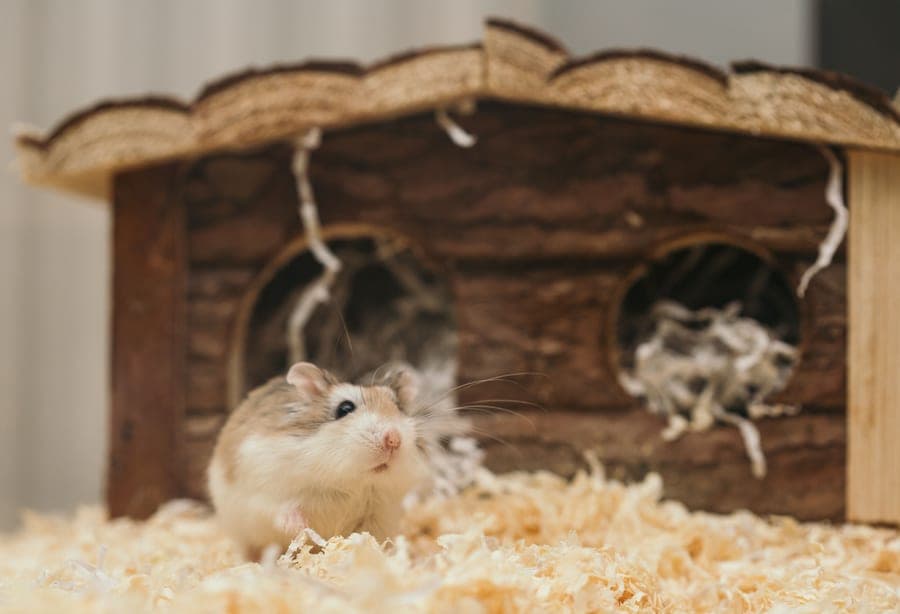
Buy the Niteangel Super-Silent 8.2 inch. It is the smallest wheel we assess and for mice that is the right end of the range: 8.2 inches of running diameter with a solid grooved track, a dual ball-bearing hub and no axle through the running space, which is exactly what the RSPCA asks for. Neither the RSPCA nor PDSA publishes a diameter for mice — the RSPCA asks that a wheel be a solid structure and axle-free, and PDSA asks that it be large enough for mice to run comfortably without bending their backs. Those two requirements eliminate most wheels on sale, which are slatted, meshed or built around a cross-bar, and they do it without needing a number. If you keep several mice and want one wheel they can all use, the 11 inch model is the same design one size up.
Mouse bedding depth and wheel design · no figure published
bedding at least 2cm deep to allow mice to dig; wheels should be a solid structure and axle-free
Our conversion: about three quarters of an inch of substrate, the lowest published digging depth for any rodent on this site
We assess five wheels on this site and three of them are appropriate for mice. The other two are 12.8 and 13 inches, which are Syrian hamster sizes: a wheel much larger than the animal is not dangerous, but it is harder to get moving and it eats floor area that matters more in a mouse enclosure than in a hamster one. Hamster wheel size sets out the diameter arithmetic in full, and the mechanism — a running surface too tight for the animal's spine — is identical across species.
The two published requirements, and what they rule out
Solid structure. A slatted or mesh running surface catches feet and tails, and a mouse's tail is long relative to its body and is in the wheel the whole time it is running. This is why every wheel we recommend has a continuous track.
Axle-free. The RSPCA names this specifically. A wheel with a cross-bar or a central axle running through the running space gives an animal something to be caught between as the wheel turns. A hub-mounted wheel has nothing in the running space at all. This single requirement removes most of the wheels bundled with pet-store cages.
Large enough to run without a bent back. PDSA's wording, and the honest reading is that it is a posture test rather than a number. Stand the wheel next to the animal: if the mouse's spine curves upward while it runs, the wheel is too small. For an adult mouse that threshold is somewhere around six to seven inches, which is why an 8.2 inch wheel is comfortably clear of it and a 4 inch pet-store wheel is not.
| Wheel | Diameter | Running surface | Axle | Mounting |
|---|---|---|---|---|
| Niteangel Super-Silent 8.2 in | 8.2 in | Solid track with raised grooves | None in the running space; dual ball-bearing hub | Weighted stand, adjusts 9.1-11.8 in |
| Niteangel Super-Silent 11 in | 11 in | Solid track with raised grooves | None in the running space; dual ball-bearing hub | Weighted stand, adjusts 11.6-15.4 in |
| Exotic Nutrition Silent Runner 12 in | 12 in | Solid track, 4.25 in wide | Ball-bearing hub | Cage-bar bracket included, or stands free |
Diameters, track widths and mounting figures are each manufacturer's published specifications, recorded in our product registry with the listing they were read from. No welfare body publishes a wheel diameter for mice, so there is no compliance column here to fill in.
| # | Product | Best for | Score | Price |
|---|---|---|---|---|
| 1 | 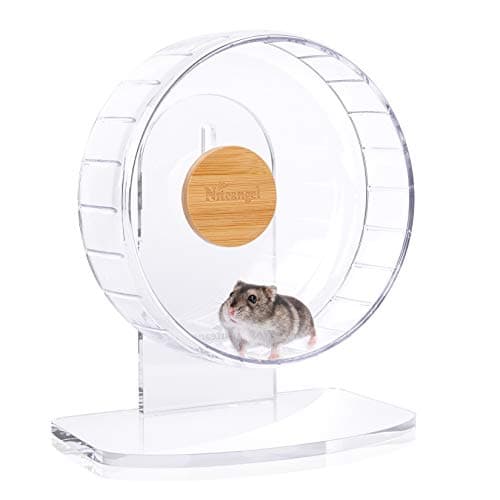 Niteangel Super-Silent Hamster Exercise Wheel, 8.2 inOccupies roughly 8 x 5 in of enclosure floor | Dwarf hamsters, gerbils and mice | 8.5out of 10 | $33.99View on Amazon Price as of October 17, 2026. #ad Disclosure |
| 2 | 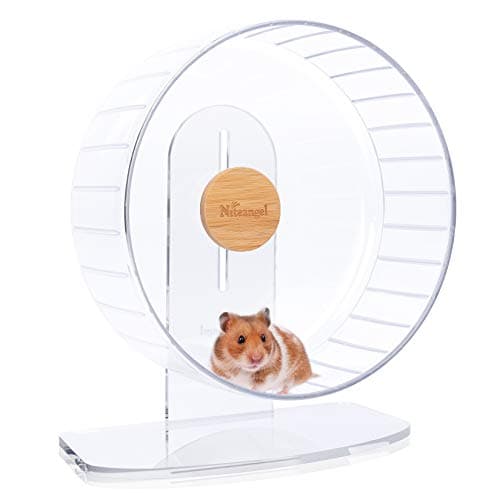 Niteangel Super-Silent Hamster Exercise Wheel, 11 inOccupies roughly 11 x 6 in of enclosure floor | A large dwarf, or a Syrian in a cage that cannot take 12.8 in | 8.2out of 10 | $43.99View on Amazon Price as of October 17, 2026. #ad Disclosure |
| 3 | 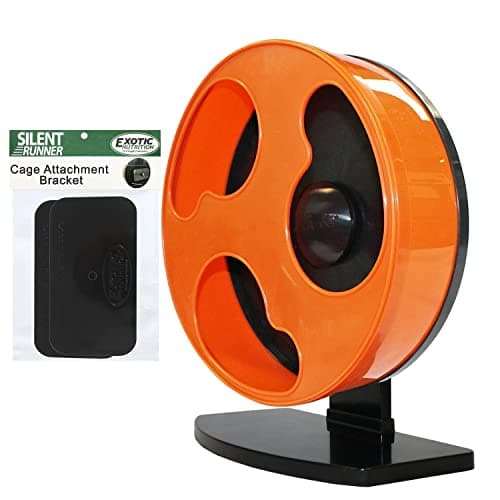 Exotic Nutrition Silent Runner 12 in (Regular)Mounts to cage bars or stands free; roughly 12 x 5 in of floor | Mounting a compliant wheel in a wire cage | 8.9out of 10 | $33.99View on Amazon Price as of October 17, 2026. #ad Disclosure |
Scores are our own assessment of published specifications against the thresholds set out in how we assess products. They are not test results and not customer ratings. Tap a row to read the full assessment.
The three, assessed
Our pick · Dwarf hamsters, gerbils and mice
Niteangel Super-Silent Hamster Exercise Wheel, 8.2 in
Clears the 20cm dwarf minimum by a fraction and does everything else right, which makes it the correct wheel for a dwarf and the wrong one for a Syrian.
- Dimensions
- 8.2 in running diameter; stand adjusts 9.1-11.8 in
- Continuous floor
- Occupies roughly 8 x 5 in of enclosure floor
- Bar spacing
- Not applicable
- Material
- Plastic drum on a dual ball-bearing hub with a weighted base
- Running surface
- Solid track with raised grooves; no slats, no bars, no axle
What it gets right
- 8.2 in clears the 8 in (20cm) PDSA dwarf minimum
- Solid surface and no axle
- Small enough to leave usable floor in a 550 sq in enclosure
What it gets wrong
- Well under every Syrian figure published
- Only 0.2 in of margin over the dwarf minimum
Who should buy something else
Never for a Syrian. At 8.2 in a Syrian runs with a visibly arched back, which is the exact failure this threshold exists to prevent.
Specifications read from Niteangel product listing on 27 September 2026. Floor-area arithmetic is ours and is shown above so you can redo it.
- Diameter vs threshold8
- Surface safety10
- Noise9
- Stability8
- Fit in a small enclosure10
Price as of October 17, 2026. #ad Disclosure
Number 2 · A large dwarf, or a Syrian in a cage that cannot take 12.8 in
Niteangel Super-Silent Hamster Exercise Wheel, 11 in
Inside the San Diego Humane Society's 10-12 in band for Syrians and one inch under PDSA's figure, which is exactly the kind of near-miss this site exists to point out.
- Dimensions
- 11 in running diameter; stand adjusts 11.6-15.4 in
- Continuous floor
- Occupies roughly 11 x 6 in of enclosure floor
- Bar spacing
- Not applicable
- Material
- Plastic drum on a dual ball-bearing hub with a weighted base
- Running surface
- Solid track with raised grooves; no slats, no bars, no axle
What it gets right
- Solid running surface and no central axle
- Fits enclosures where the 12.8 in will not
- Within the 10-12 in band the San Diego Humane Society gives for Syrians
What it gets wrong
- 11 in falls short of PDSA's 30cm (12 in) Syrian minimum
- The two published figures disagree here, and we take the stricter one
Who should buy something else
Not our pick for a Syrian if the 12.8 in fits your enclosure. Choosing 11 in to save an inch of height is optimizing the wrong variable.
Specifications read from Niteangel product listing on 27 September 2026. Floor-area arithmetic is ours and is shown above so you can redo it.
- Diameter vs threshold7
- Surface safety10
- Noise9
- Stability9
- Fit in a small enclosure9
Price as of October 17, 2026. #ad Disclosure
Number 3 · Mounting a compliant wheel in a wire cage
Exotic Nutrition Silent Runner 12 in (Regular)
Exactly 12 in and mountable to cage bars, which is the one thing the stand-based wheels cannot do in a wire cage with a shallow base.
- Dimensions
- 12 in diameter, 4.25 in track width, 13.5 in overall height
- Continuous floor
- Mounts to cage bars or stands free; roughly 12 x 5 in of floor
- Bar spacing
- Not applicable
- Material
- Plastic drum, ball-bearing hub, cage-attachment bracket included
- Running surface
- Solid track; an AutoClean perforated track is sold as an alternative
What it gets right
- 12 in meets PDSA's Syrian minimum on the nose
- Bar-mount bracket frees the whole floor beneath it
- 4.25 in track is wide enough that a Syrian is not running on an edge
What it gets wrong
- 12 in with zero margin; a wheel this size does not tolerate being mismeasured
- Bar mounting needs a cage with bars, which rules out the acrylic enclosures
- The perforated AutoClean track is a different product and a different decision
Who should buy something else
Not for a solid-walled enclosure with no bars to mount to, and not for a dwarf, which will find a 4.25 in track unnecessarily wide.
Specifications read from Exotic Nutrition product listing on 27 September 2026. Floor-area arithmetic is ours and is shown above so you can redo it.
- Diameter vs threshold9
- Surface safety10
- Noise8
- Stability9
- Mounting flexibility10
Price as of October 17, 2026. #ad Disclosure
Why the stand matters more than you would think
A free-standing wheel on a weighted base sits on the substrate, which means it sits on a surface that moves. Fill an enclosure four inches deep, put a stand-mounted wheel on top of it, and the base sinks unevenly as the mice dig around it — at which point the wheel runs out of true and starts making the noise it was sold as not making. There are two fixes and both are worth knowing: stand the wheel on a flat tile or offcut buried level with the substrate, or mount the wheel to a wall instead.
That second option is the reason the Exotic Nutrition Silent Runner is on this page despite being a 12 inch wheel. It ships with a bracket that bolts through cage bars or mesh, which takes the wheel off the floor entirely — and in a mouse enclosure, floor is the thing you are shortest of. If you are running a barred cage or a mesh-lidded solid enclosure with a frame to bolt to, a mounted wheel is the better engineering answer.
What not to buy
- Anything slatted, meshed or barred. Fails the RSPCA's solid-structure requirement outright, and it is the most common failure in the category because a slatted wheel is cheaper to mold.
- Anything with a cross-bar or an axle through the running space. Fails the axle-free requirement. This includes most wheels supplied with a cage.
- Exercise balls. Not a wheel and not covered by either charity's wheel guidance. An animal in a ball cannot stop, cannot see out properly and cannot choose to leave, which is the opposite of what a wheel offers.
- A 4 or 5 inch wheel, whatever the box says. The posture test is the test. A mouse running with a visibly curved spine is being harmed slowly by a product sold as enrichment.
- A wheel too large to turn easily. A 13 inch wooden wheel is a fine Syrian product and a poor mouse one: a 25 gram animal struggles to get a heavy drum moving, and the wheel then goes unused while occupying 85 square inches of floor.
The rest of the enclosure decision is in the best mouse cages, and the substrate the wheel will be standing on is in the best bedding for mice.
Questions people ask
What size wheel does a mouse need?
Are mesh or slatted wheels safe for mice?
Do mice actually use wheels?
Can two mice share one wheel?
Sources
- RSPCA: mice environment — The solid-structure and axle-free wheel requirements, and the statement that a wheel should not be the only enrichment.
- PDSA: the ideal home for your mice — The requirement that a wheel be large enough to run in without bending the back.
- MSPCA: suggestions for housing small animals — The 30 minutes a day of supervised exercise outside the enclosure.