Guides
Best mouse cages
One published figure decides this category before floor area does, and it is a bar-spacing figure rather than a size one.
Buy the BUCATSTATE 3.0 in the 47 inch size. It is the enclosure we would put mice in, and the reason is not its 1,109 square inches of floor — it is that the walls are acrylic in an aluminum frame, so they wipe clean and do not absorb urine. Mouse urine is the thing that decides whether an enclosure is still pleasant to live beside in month six, and it is the specification nobody shops on. The runner-up is the Niteangel Vista Large, which is a better-looking enclosure with an MDF carcass that will take up odor if the liner is ever breached. The point to understand before you buy anything is that the only numeric figure a veterinary charity publishes for mouse housing is a bar gap: PDSA asks for bars no more than 6mm apart, and no barred product on this page verifiably meets it. The one habitat that claims 6mm, the Kaytee CritterTrail One Level, prints 6mm in its listing copy and 0.29 inch — which is 7.4mm — in its own specification table on the same page, and it is a 230 square inch habitat we would not recommend as a home at either figure. That is why our top picks have no bars at all.
Mouse cage bar spacing · minimum
barred cages are best as long as the bars are no more than 6mm apart
Our conversion: about 1/4 inch, which is half the 1/2 inch spacing of a typical small-animal cage
Mice are the species where the published guidance is least helpful and the pet aisle is least honest, and the two problems are related. PDSA states in plain words that most mouse cages sold in pet shops are not nearly big enough, and then declines to publish the floor area that would let you check. The RSPCA publishes a bedding depth of 2cm and no floor area at all. The MSPCA publishes dimensions, but offers two alternatives that work out at different sizes. So a buyer who wants to do this properly has three documents and no single number between them, which is how a 230 square inch plastic habitat ends up on a shelf labeled as a mouse home.
This page measures six enclosures against what those three bodies do say. Mouse cage size works the floor-area arithmetic out in full, and mouse cage bar spacing deals with the 6mm figure on its own, because it is the figure that removes most of the market and it deserves its own page.
The figure that is published, and the figure that is not
Mouse cage suggested dimensions · suggested minimum
a 12in x 12in x 20in wire cage or a 20 gallon aquarium for one to three mice, ideally with a mesh topper and multiple levels
Our conversion: 144 sq in of floor if the 20in figure is the height, or 288 to 360 sq in depending on which 20 gallon tank is meant
Read that figure carefully, because the two options MSPCA gives are not equivalent. A 12 x 12 x 20 inch wire cage, if the 20 inches is the height, gives 144 square inches of floor. A 20 gallon aquarium gives either 288 square inches in the high format or 360 in the long format, going by the standard tank dimensions in the retail chart we cite below. The same sentence from the same organization therefore offers a floor that varies by a factor of two and a half depending on which half you act on. We take the largest of those readings, 360 square inches, as the number to beat, and we say plainly that this is our reading rather than a published standard.
| Enclosure | Continuous floor | Bar spacing | Walls | Meets 6mm? |
|---|---|---|---|---|
| BUCATSTATE 3.0, 47 in | 1,109 sq in | No bars | Acrylic in an aluminum frame | No gap to fail |
| Niteangel Vista Large | 1,069 sq in | No bars on the long walls | MDF with a glass front, mesh lid | No gap to fail |
| Niteangel Vista Medium | 924 sq in | No bars on the long walls | MDF with a glass front, mesh lid | No gap to fail |
| IKEA DETOLF, on its back | 1,086 sq in | None: glass on four sides | Tempered glass, no lid supplied | No gap to fail |
| Prevue 528 | 480 sq in base interior | 3/8 in (9.5mm) | Powder-coated wire | No, 3.5mm too wide |
| Kaytee CritterTrail One Level | 230 sq in | 6mm in the copy, 0.29 in (7.4mm) in the spec table | Plastic shell with wire panels | Claimed, not verifiable |
Floor figures are each manufacturer's published dimensions with our own arithmetic shown on the product cards below; bar spacing is as published by the manufacturer or its retailer. The last column is measured against the PDSA figure above. Kaytee's own page for the CritterTrail One Level publishes two figures that contradict each other — 6mm in the marketing copy and a bar spacing of 0.29 inch, or 7.4mm, in the specification table — so we record it as claimed rather than met, and name both numbers. A solid-walled enclosure has no bar gap to fail, which is why the solid formats dominate the top of this page.
What we ranked these on
- 1.Whether an adult mouse can get out. First, because a containment failure is not a comfort issue. PDSA's 6mm is half the half-inch spacing a typical small-animal cage is built to, and a half-inch gap does not reliably hold an adult mouse, let alone a young one. A solid wall solves this absolutely; a 6mm barred wall solves it at the cost of nearly every size option on the market.
- 2.Whether the walls absorb urine. The specification that decides how this enclosure smells in month six, and the one no listing addresses. Mice scent-mark constantly and produce a sharper-smelling urine than hamsters for their size. Acrylic, glass and coated steel wipe clean. MDF, particleboard and untreated timber do not.
- 3.Continuous floor against our 360 square inch reading. Floor area matters, and it comes third here only because the two filters above remove more products than it does. All four solid enclosures on this page clear 360 square inches by more than double.
- 4.Airflow across the lid. PDSA prefers barred cages to glass or plastic ones specifically on airflow grounds, and the objection is real: a solid-sided box moves no air sideways, so all exchange happens overhead. The answer is a full-footprint mesh lid rather than a vented panel, which is set out in hamster cage ventilation and applies unchanged here.
- 5.Whether you have to build anything. We rate a finished product above a conversion, and say so where a conversion wins on area anyway.
Mouse bedding depth and wheel design · no figure published
bedding at least 2cm deep to allow mice to dig; wheels should be a solid structure and axle-free
Our conversion: about three quarters of an inch of substrate, the lowest published digging depth for any rodent on this site
| # | Product | Best for | Score | Price |
|---|---|---|---|---|
| 1 | 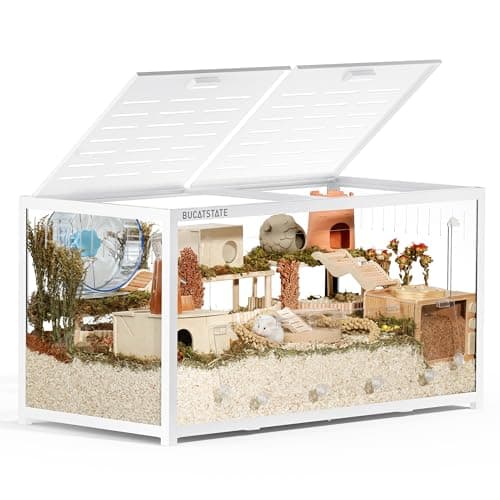 BUCATSTATE Hamster Cage 3.0, 47 in47 x 23.6 = 1,109 sq in (7.7 sq ft) by our arithmetic | Deep burrowing without a DIY build | 9.0out of 10 | $265.99$279.995% offView on Amazon Price as of October 17, 2026. #ad Disclosure |
| 2 | 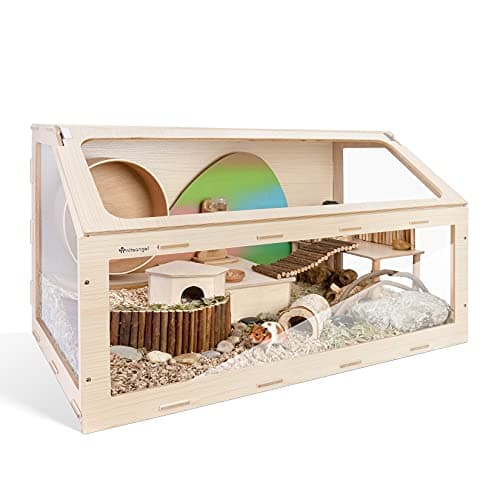 Niteangel Vista Hamster Cage, Large47.1 x 22.7 = 1,069 sq in external footprint | A Syrian that needs real burrowing depth | 9.1out of 10 | $309.95View on Amazon Price as of October 17, 2026. #ad Disclosure |
| 3 | 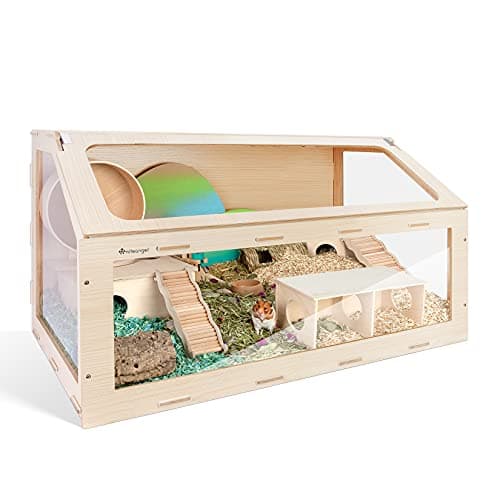 Niteangel Vista Hamster Cage, Medium40.7 x 22.7 = 924 sq in external footprint | Clearing the threshold in under four feet of shelf | 8.6out of 10 | $256.90View on Amazon Price as of October 17, 2026. #ad Disclosure |
| 4 | 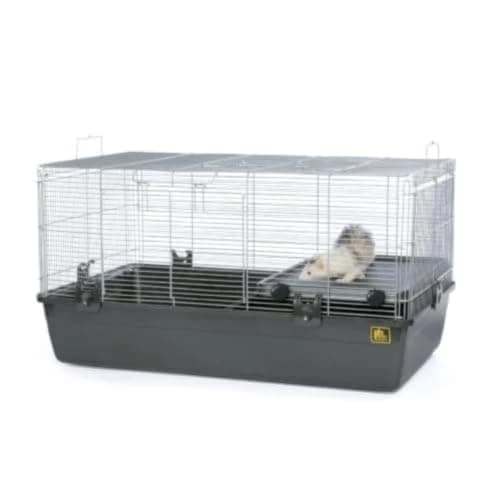 Prevue Pet Products Universal Small Animal Home 52830 x 16 = 480 sq in of interior base floor | A dwarf hamster or a bar-spacing problem | 6.2out of 10 | $119.99View on Amazon Price as of October 17, 2026. #ad Disclosure |
| 5 | 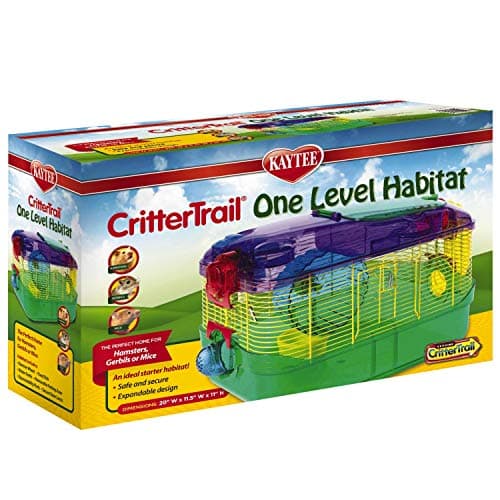 Kaytee CritterTrail One Level Habitat20 x 11.5 = 230 sq in | A short-term carrier or a hospital cage, not a home | 2.6out of 10 | $69.95View on Amazon Price as of October 17, 2026. #ad Disclosure |
| 6 | IKEA DETOLF glass display cabinetlaid on its back, 163 x 43 cm = 7,009 cm2, or 1,086 sq in | The most floor area per dollar, if you will build a lid | 8.4out of 10 | No buy link: not sold on Amazon, and on no programme we are part of. |
Scores are our own assessment of published specifications against the thresholds set out in how we assess products. They are not test results and not customer ratings. Tap a row to read the full assessment.
The six, measured
Our pick · Deep burrowing without a DIY build
BUCATSTATE Hamster Cage 3.0, 47 in
The deepest substrate capacity we could verify on a mainstream enclosure: an 11 in bedding claim on a 1,109 sq in floor is the combination almost nothing else offers.
- Dimensions
- 47 x 23.6 x 25.5 in; manufacturer states 7.8 sq ft of floor
- Continuous floor
- 47 x 23.6 = 1,109 sq in (7.7 sq ft) by our arithmetic
- Bar spacing
- No bars: clear acrylic panels in an aluminum frame
- Material
- Aluminum frame with thickened clear acrylic panels
- Bedding depth possible
- Manufacturer states the deep base takes up to 11 in of bedding
What it gets right
- 1,109 sq in clears our 775 sq in floor by 43 percent
- 11 in of stated bedding capacity exceeds PDSA's 25cm (10 in) figure
- Acrylic and aluminum wipe clean and do not absorb urine
- Stackable frame, so a second unit can go above without extra floor space
What it gets wrong
- Acrylic scratches, and a scratched panel is permanently cloudy
- No bars means no climbing surface; enrichment has to come from the layout
- A full 11 in of substrate in this footprint is a lot of bedding to buy and replace
Who should buy something else
Wrong for a hamster that climbs rather than digs. If your animal spends its waking hours on the bars, an enclosure with no bars removes most of what it does.
Specifications read from BUCATSTATE product listing on 27 September 2026. Floor-area arithmetic is ours and is shown above so you can redo it.
- Floor area vs threshold10
- Bedding depth10
- Wheel compatibility8
- Material durability8
- Cleaning access9
Price as of October 17, 2026. #ad Disclosure
Number 2 · A Syrian that needs real burrowing depth
Niteangel Vista Hamster Cage, Large
The largest mainstream single-piece hamster enclosure we could verify, and the only one whose external footprint clears our 775 sq in floor with room to spare even after you allow for wall thickness.
- Dimensions
- 47.1 x 22.7 x 26.9 in external (manufacturer-listed)
- Continuous floor
- 47.1 x 22.7 = 1,069 sq in external footprint
- Bar spacing
- No bars on the long walls: MDF panels with a mesh top
- Material
- MDF carcass with aspen veneer, glass front, wire mesh lid
- Bedding depth possible
- Deep front glass panel takes roughly 10 in of substrate
What it gets right
- 1,069 sq in external footprint clears the 775 sq in PDSA minimum by a wide margin
- Solid panels on three sides mean substrate can be piled deep without spilling
- Mesh lid takes a 12 in wheel mounted from above
- Front glass makes bedding depth visible, so you can see when it drops below 10 in
What it gets wrong
- MDF absorbs urine if the liner is breached; it is not a wipe-clean surface
- Heavy and awkward to move once filled with 10 in of substrate
- Assembly is not tool-free
Who should buy something else
Skip it if you want to hose the enclosure out. MDF and water are a bad combination, and a glass tank or a coated-steel cage is the better choice for anyone who cleans that way.
Specifications read from Niteangel product listing on 27 September 2026. Floor-area arithmetic is ours and is shown above so you can redo it.
- Floor area vs threshold10
- Bedding depth9
- Wheel compatibility9
- Material durability7
- Cleaning access8
Price as of October 17, 2026. #ad Disclosure
Number 3 · Clearing the threshold in under four feet of shelf
Niteangel Vista Hamster Cage, Medium
The same design as the Large in a footprint that still clears 775 sq in, for a room that cannot take a four-foot enclosure.
- Dimensions
- 40.7 x 22.7 x 22.9 in external (manufacturer-listed)
- Continuous floor
- 40.7 x 22.7 = 924 sq in external footprint
- Bar spacing
- No bars on the long walls: MDF panels with a mesh top
- Material
- MDF carcass with aspen veneer, glass front, wire mesh lid
- Bedding depth possible
- Roughly 9 in behind the front glass
What it gets right
- 924 sq in external footprint still clears the PDSA minimum
- Fits a standard 42 in shelf or console where the Large does not
- Same solid-wall construction for deep substrate
What it gets wrong
- 22.9 in rear height limits how tall a wheel you can mount inside
- Same MDF moisture caveat as the Large
Who should buy something else
Not the one if you have the space for the Large. The extra 145 sq in costs little and there is no welfare argument for choosing less floor.
Specifications read from Niteangel product listing on 27 September 2026. Floor-area arithmetic is ours and is shown above so you can redo it.
- Floor area vs threshold9
- Bedding depth8
- Wheel compatibility8
- Material durability7
- Cleaning access8
Price as of October 17, 2026. #ad Disclosure
Number 4 · A dwarf hamster or a bar-spacing problem
Prevue Pet Products Universal Small Animal Home 528
The tightest bar spacing on any mainstream wire cage at 3/8 in, on a floor that falls well short of 775 sq in — a safety win and a space failure in the same product.
- Dimensions
- 32.5 x 19 x 17.5 in external; base interior 30 x 16 in
- Continuous floor
- 30 x 16 = 480 sq in of interior base floor
- Bar spacing
- 3/8 in (9.5mm) wire spacing
- Material
- Powder-coated wire on a deep plastic base
- Base depth
- 6.25 in deep tubby base
What it gets right
- 3/8 in spacing is narrow enough for a dwarf hamster, where 1/2 in is not
- 6.25 in base is unusually deep for a wire cage
- Two large access doors, front and roof
- Wire walls give a climbing surface the acrylic enclosures do not
What it gets wrong
- 480 sq in of interior floor is 38 percent short of the 775 sq in minimum
- 6.25 in of base depth caps substrate well below PDSA's 10 in figure
- The listing notes wider gaps at the corners than the 3/8 in quoted spacing
Who should buy something else
Not a primary enclosure for any hamster if you are measuring against a published minimum. We list it because its bar spacing solves a real problem, not because its floor is adequate.
Specifications read from Prevue 528 listing on 27 September 2026. Floor-area arithmetic is ours and is shown above so you can redo it.
- Floor area vs threshold3
- Bedding depth4
- Bar spacing safety10
- Material durability8
- Cleaning access9
Price as of October 17, 2026. #ad Disclosure
Number 5 · A short-term carrier or a hospital cage, not a home
Kaytee CritterTrail One Level Habitat
230 sq in is under a third of the published minimum, and the manufacturer's own listing names gerbils and mice rather than hamsters.
- Dimensions
- 20 x 11.5 x 11 in
- Continuous floor
- 20 x 11.5 = 230 sq in
- Bar spacing
- 6mm (manufacturer-listed)
- Material
- Plastic base and shell with wire panels
- Stated suitability
- Listed by the manufacturer for gerbils or mice
What it gets right
- 6mm bar spacing is genuinely safe for the smallest animals
- Light, cheap and easy to disinfect
What it gets wrong
- 230 sq in is 70 percent short of the 775 sq in minimum
- No meaningful substrate depth
- The supplied wheel is far too small for any hamster
Who should buy something else
Not housing for a hamster of any species. If you already own one, it is useful as a temporary carrier while you clean the real enclosure, and nothing more.
Specifications read from Kaytee product listing on 27 September 2026. Floor-area arithmetic is ours and is shown above so you can redo it.
- Floor area vs threshold1
- Bedding depth1
- Bar spacing safety9
- Material durability5
- Cleaning access8
Price as of October 17, 2026. #ad Disclosure
Number 6 · The most floor area per dollar, if you will build a lid
IKEA DETOLF glass display cabinet
A furniture cabinet that gives 1,086 sq in of continuous floor for less than any purpose-built enclosure of that size, provided you accept that it ships without a lid.
- Dimensions
- 163 x 43 x 37 cm (64.1 x 16.9 x 14.6 in)
- Continuous floor
- laid on its back, 163 x 43 cm = 7,009 cm2, or 1,086 sq in
- Bar spacing
- None: tempered glass on all four sides
- Material
- Tempered glass with a particleboard top and base, steel shelf supports
- Usable height on its back
- 37cm (14.6 in), enough for roughly 10 in of substrate under a mesh lid
What it gets right
- 1,086 sq in of continuous floor, 40 percent above our threshold
- Glass is non-porous, wipe-clean and holds deep substrate without bowing
- Widely available and easy to replace a panel on
What it gets wrong
- No lid is supplied. You must build or buy a mesh top, which is real work
- Not sold as a pet enclosure, so no manufacturer supports that use
- Heavy, and the glass makes it awkward for one person to move
- No climbing surfaces at all
Who should buy something else
Not for anyone who wants an out-of-the-box solution. It is a cabinet, and turning it into safe housing is a small project with a mesh lid at the end of it.
Specifications read from Published DETOLF dimensions (dimensions.com) on 27 September 2026. Floor-area arithmetic is ours and is shown above so you can redo it.
Illustrative- Floor area vs threshold10
- Bedding depth9
- Ready to use4
- Material durability9
- Cleaning access9
Not sold on Amazon and on no programme we are part of, so there is no buy link here. Its specifications are cited on the assessment instead.
The 6mm problem, stated plainly
There is one product in our registry that claims a bar gap narrow enough to meet PDSA's figure, and when you read its listing properly it claims two. Kaytee's page for the CritterTrail One Level says 6mm wire spacing in the copy and gives a bar spacing of 0.29 inch in the specification table, and 0.29 inch is 7.4mm. Those cannot both be true, the difference straddles the published figure exactly, and Kaytee is the only manufacturer in the category publishing anything near it. The same habitat is 230 square inches of floor, which is a quarter of what the solid enclosures above give you and well under two thirds of the largest reading of the MSPCA figure. So the nearest thing to a mouse-legal barred product on sale is the smallest thing on this page and its own maker disagrees about whether it qualifies — which is a structural problem with the category rather than a criticism of one cage.
Why the Prevue 528 is here and not higher
The 528 publishes 3/8 inch (9.5mm) wire spacing, which is the tightest on any mainstream wire cage and the reason we recommend it for dwarf hamsters in the Prevue 528 review. For mice it is 3.5mm too wide, and those 3.5mm are the whole argument: the figure PDSA publishes is 6mm, the best mainstream wire cage is 9.5mm, and the only thing in between on general sale is a 230 square inch tube habitat whose own two published figures disagree about which side of the line it falls on. We have left it on the page because it answers the question a lot of people are really asking, which is whether any proper wire cage will do. The answer is that the best one still does not meet the published figure.
What not to buy
- Tube habitats sold as mouse homes. The CritterTrail family and its imitators have the tightest bar gap in the category and a fraction of the floor, and the tubes are the part people buy them for and the part that causes trouble. Are hamster tube cages safe applies to mice with the sizes scaled down and the conclusion unchanged.
- Anything with a wire mesh floor or wire platforms. MSPCA advises a solid bottom and warns that wire mesh bottoms and platforms can cause abrasions to feet. A mouse weighs a fraction of a rat and its feet are proportionally smaller, so the margin is worse rather than better.
- A sealed lid on a glass tank. The one configuration that turns the airflow objection into a real problem. Mesh across the full footprint, every time.
- A cage chosen for its number of levels. Levels are useful and they are not floor. Our 360 square inch reading is continuous floor at one level, the same way every other figure on this site is measured.
- Cotton-wool style nesting fluff. PDSA rules out cotton-like materials for mice by name; the RSPCA makes the same point about hamsters, for the same reason, in safe and unsafe hamster bedding.
What we would buy
For two or three mice in a room you spend time in, the BUCATSTATE 3.0 47 inch with a full mesh lid, a bed of paper substrate several inches deep and an 8 inch solid wheel. For the same animals where cost is the binding constraint and you are willing to build a lid, a DETOLF on its back gives almost the same floor for a fraction of the price, and the DETOLF conversion is the same build for mice as it is for hamsters. What we would not buy at any price is a half-inch barred cage, because the containment figure is published, it is 6mm, and no amount of floor area compensates for an enclosure the animal can leave.
The three we would actually choose between
A wipe-clean acrylic box, an MDF-and-glass enclosure that is larger in practice than it looks, and the conversion that beats both on area if you will build the lid yourself.
Deep burrowing without a DIY build
BUCATSTATE Hamster Cage 3.0, 47 in
47 x 23.6 = 1,109 sq in (7.7 sq ft) by our arithmetic
The deepest substrate capacity we could verify on a mainstream enclosure: an 11 in bedding claim on a 1,109 sq in floor is the combination almost nothing else offers.
$265.99$279.995% offView on AmazonPrice as of October 17, 2026. #ad Disclosure
A Syrian that needs real burrowing depth
Niteangel Vista Hamster Cage, Large
47.1 x 22.7 = 1,069 sq in external footprint
The largest mainstream single-piece hamster enclosure we could verify, and the only one whose external footprint clears our 775 sq in floor with room to spare even after you allow for wall thickness.
$309.95View on AmazonPrice as of October 17, 2026. #ad Disclosure
- Illustrative
The most floor area per dollar, if you will build a lid
IKEA DETOLF glass display cabinet
laid on its back, 163 x 43 cm = 7,009 cm2, or 1,086 sq in
A furniture cabinet that gives 1,086 sq in of continuous floor for less than any purpose-built enclosure of that size, provided you accept that it ships without a lid.
No buy link: not sold on Amazon, and on no programme we are part of.
Questions people ask
What size cage do two mice need?
Can mice live in a hamster cage?
Is a glass tank or a barred cage better for mice?
How many mice should live together?
Sources
- PDSA: the ideal home for your mice — The 6mm bar-spacing figure, the airflow preference, nesting materials and the 18-22C range.
- RSPCA: mice environment — The 2cm bedding depth, the solid axle-free wheel requirement and the absence of a floor-area figure.
- MSPCA: suggestions for housing small animals — The 12 x 12 x 20in or 20 gallon figure for one to three mice, and the warning against wire floors.
- Standard aquarium dimensions chart — Retail-published tank dimensions, used to convert the 20 gallon figure into square inches of floor.
- Kaytee: CritterTrail One Level Habitat listing — Publishes 6mm wire spacing in its copy and a bar spacing of 0.29 in in its specification table, and lists the habitat for mice by name. Read 17 October 2026.