Guides
Mouse cage bar spacing
The only numeric figure a veterinary charity publishes for mouse housing is a bar gap, and almost nothing on sale meets it.
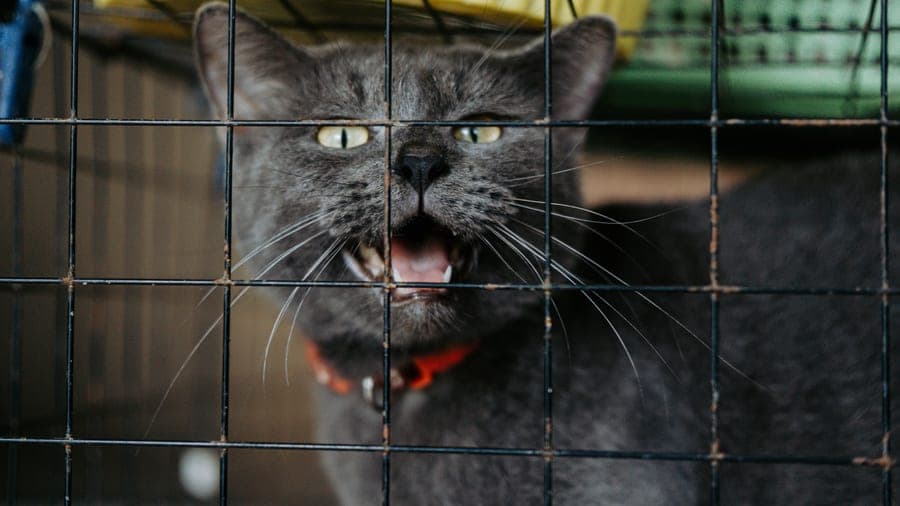
6mm, and the practical consequence is that you should stop shopping for a barred mouse cage. PDSA publishes bars no more than 6mm apart for mice. The tightest spacing on any mainstream wire small-animal cage we have verified is the Prevue 528 at 3/8 inch, which is 9.5mm — 58 percent wider than the figure. Most cages in the category are built to 1/2 inch, which is 12.7mm, or more than double it. The nearest thing to a compliant barred product is the Kaytee CritterTrail One Level, and its own listing publishes two figures that disagree: 6mm wire spacing in the copy, and a bar spacing of 0.29 inch — 7.4mm — in the specification table on the same page. It is also 230 square inches of floor, a quarter of what a solid-walled enclosure gives you. So the two real options are a barred habitat that is far too small and whose maker cannot say whether it meets the figure, or a solid-walled enclosure with a full mesh lid, where there is no bar gap anywhere on the animal's level at all. We recommend the second.
Mouse cage bar spacing · minimum
barred cages are best as long as the bars are no more than 6mm apart
Our conversion: about 1/4 inch, which is half the 1/2 inch spacing of a typical small-animal cage
This is worth dwelling on, because bar spacing is the one specification where being close is worth nothing. A floor that is 10 percent under a published minimum is a slightly cramped enclosure. A bar gap 50 percent over a published maximum is not a slightly leaky enclosure — it is an open one, and the failure happens in a single evening rather than gradually.
What the gaps on sale actually are
| Product | Published spacing | In millimeters | Against 6mm |
|---|---|---|---|
| Kaytee CritterTrail One Level | 6mm in the copy, 0.29 in in the spec table | 6.0mm or 7.4mm | Claimed, not verifiable |
| Prevue 528 | 3/8 in | 9.5mm | 58 percent over |
| Savic Hamster Heaven Metro | 9.5mm | 9.5mm | 58 percent over |
| MidWest Critter Nation 161 and 162 | 1/2 in | 12.7mm | 112 percent over |
| Savic Royal Suite 95 | 13mm | 13.0mm | 117 percent over |
| MidWest Ferret Nation 182 | 1 in | 25.4mm | 323 percent over |
| BUCATSTATE 3.0 and Niteangel Vista | No bars | Not applicable | No gap to fail |
Spacing figures are as published by each manufacturer or its retailer and are recorded in our product registry with the listing they were read from. The conversions and the percentages are ours. The CritterTrail row carries two figures because Kaytee's own product page carries two: 6mm in the marketing copy and a bar spacing of 0.29 inch in the specification table, read 17 October 2026. We print both rather than choosing the one that suits the argument.
Notice what is not in that table: a mainstream wire cage, in a usable size, at a verified 6mm. It does not exist in our registry and we could not find one in the category. The gap between 6mm and 9.5mm is three and a half millimeters, and it is the whole market — with one 230 square inch habitat sitting inside it whose maker publishes both ends.
Why 6mm, and why a mouse is not a small hamster
A rodent gets through any gap its skull will pass through, because the ribcage and shoulders compress and the skull does not. Bar spacing is therefore really a skull measurement, which is the same test we apply in ferret escape-proofing and hamster cage bar spacing. An adult Syrian hamster's skull will not pass a half-inch gap. A dwarf hamster's sometimes will, which is why we recommend 3/8 inch for dwarfs. An adult mouse weighs roughly 20 to 40 grams against a Syrian's 120 to 200, and its skull is proportionally smaller again — so PDSA's 6mm is not an abundance of caution, it is the same test applied to a much smaller animal.
The two honest answers
Answer one: buy solid walls. A glass tank, an acrylic enclosure or an MDF-and-glass box has no gap on the animal's level, so the figure becomes irrelevant rather than nearly met. The lid is then the only opening, and welded mesh at a 1cm aperture sits above the substrate, where a mouse has to climb to reach it and has nothing to push through at floor level. This is what we recommend, and it is how the best mouse cages is ranked.
Answer two: accept the CritterTrail for what it is. Kaytee does list it for mice by name, and it publishes the tightest bar figures in the category even if it publishes two of them. It is also 230 square inches, which is less than two thirds of the smallest reading of the MSPCA figure and a quarter of a solid enclosure. We would use it as a carrier, a quarantine cage or a short-term setup rather than a home, and we say the same about it in Kaytee cages explained. If you do use it, treat 7.4mm as the figure to plan around rather than 6mm, because that is the number in the specification table and it is the less favourable of the two.
The tightest habitat, the tightest wire cage, and the format that sidesteps the figure
One product claims the published gap in its copy, contradicts itself in its specification table and is too small to live in either way; one is the best wire cage in the category and is still 58 percent over; one has no bars at all. That is the whole decision.
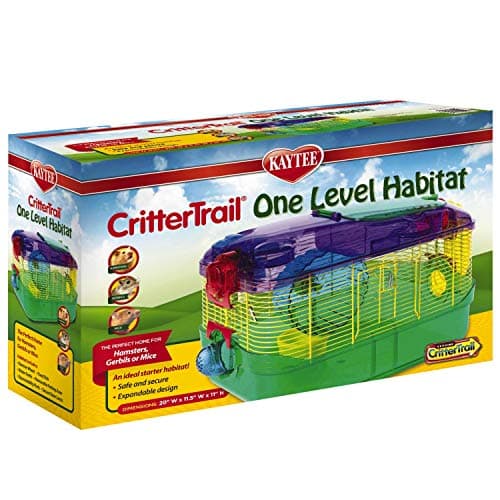
A short-term carrier or a hospital cage, not a home
Kaytee CritterTrail One Level Habitat
20 x 11.5 = 230 sq in
230 sq in is under a third of the published minimum, and the manufacturer's own listing names gerbils and mice rather than hamsters.
$69.95View on AmazonPrice as of October 17, 2026. #ad Disclosure
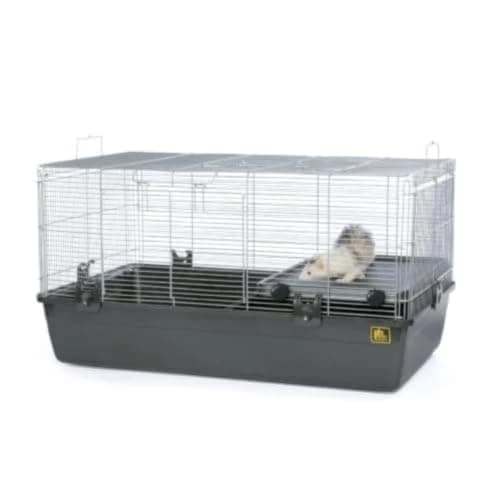
A dwarf hamster or a bar-spacing problem
Prevue Pet Products Universal Small Animal Home 528
30 x 16 = 480 sq in of interior base floor
The tightest bar spacing on any mainstream wire cage at 3/8 in, on a floor that falls well short of 775 sq in — a safety win and a space failure in the same product.
$119.99View on AmazonPrice as of October 17, 2026. #ad Disclosure
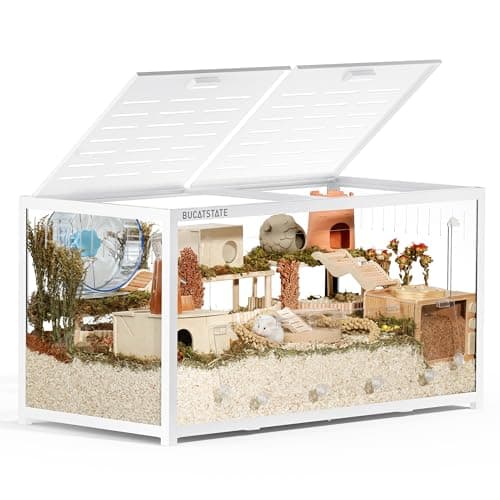
Deep burrowing without a DIY build
BUCATSTATE Hamster Cage 3.0, 47 in
47 x 23.6 = 1,109 sq in (7.7 sq ft) by our arithmetic
The deepest substrate capacity we could verify on a mainstream enclosure: an 11 in bedding claim on a 1,109 sq in floor is the combination almost nothing else offers.
$265.99$279.995% offView on AmazonPrice as of October 17, 2026. #ad Disclosure
Checks to run before you buy
- 1.Measure between the bars, not between their centres. A listing quoting centre-to-centre on 2mm wire is describing a gap 2mm narrower than it sounds. Where a manufacturer does not say which it means, assume the worse reading.
- 2.Check the corners. The Prevue 528's own listing notes wider gaps at the corners than its quoted 3/8 inch, and corners are where a determined animal works. A quoted figure is a wall figure, not a whole-cage figure.
- 3.Check the gap at pan level. The join between a wire top and a plastic base is a gap on many cages, and it sits at exactly the height a mouse is standing.
- 4.Check the latch, not just the door. A mouse is too light to force a latch and small enough to use a door that does not sit flush.
- 5.If the published figures disagree, use the worse one. Kaytee prints both 6mm and 0.29 inch for the One Level, and 7.4mm is the number to plan around. Where nothing is published at all, treat it as unknown rather than as a pass.
The companion figure to this one is floor area, which nobody publishes for mice at all — mouse cage size works out the 360 square inch reading we buy to and shows the tank-footprint arithmetic behind it.
Questions people ask
Can a mouse get through 1/2 inch bars?
Is 3/8 inch bar spacing safe for mice?
What mesh size should a mouse enclosure lid be?
Sources
- PDSA: the ideal home for your mice — The 6mm bar-spacing figure and the preference for barred cages on airflow grounds.
- RSPCA: mice environment — Mouse environment guidance; publishes no bar-spacing or floor-area figure.
- MSPCA: suggestions for housing small animals — Asks for a solid bottom and warns against wire mesh bottoms and platforms.
- Kaytee: CritterTrail One Level Habitat listing — Publishes 6mm wire spacing in its copy and a bar spacing of 0.29 in in its specification table, and lists the habitat for mice by name. Read 17 October 2026.