Guides
Rats or mice?
The two species most often treated as the same decision need opposite enclosures, and the bar gap is why.
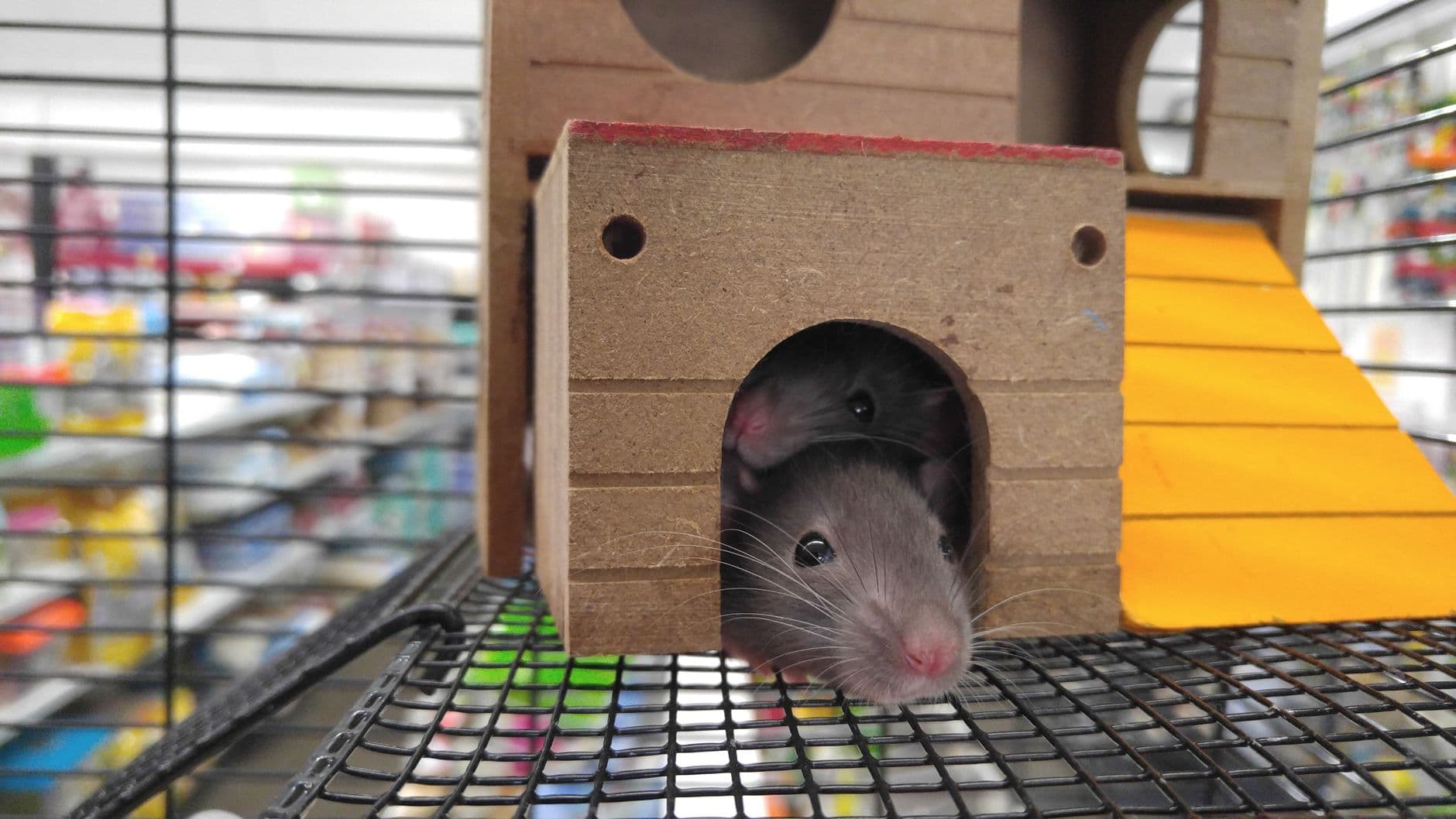
Buy rats if you want an animal that interacts with you, and buy a Critter Nation Double to put them in. Buy mice if you want a colony to watch in a smaller space, and buy a solid-walled enclosure with a mesh lid rather than any barred cage. The two species sit side by side in the same aisle and need opposite enclosures: a rat cage is tall, barred at 1/2 inch, multi-level and open, because rats climb and need vertical space — the Neville expert consensus asks for 90 to 120cm in both height and width. A mouse enclosure is sealed, because PDSA publishes 6mm as the maximum bar gap for mice and a rat cage at 12.7mm is more than double that. Putting mice in a rat cage is the single most common mistake in this comparison, and it is a containment failure rather than a comfort one.
Pet rat cage dimensions, expert consensus · recommendation
anything below 90-120cm in height, and below 90-120cm in width, is not suitable; a cage with a minimum of two tiers
Our conversion: about 35 to 47 inches in each of height and width
Mouse cage bar spacing · minimum
barred cages are best as long as the bars are no more than 6mm apart
Our conversion: about 1/4 inch, which is half the 1/2 inch spacing of a typical small-animal cage
Those two thresholds are the comparison. A cage built to hold rats properly has a bar gap that will not hold a mouse, and an enclosure built to hold mice properly has no bars for a rat to climb. There is no single product that is the right answer for both, which is worth knowing before you walk into a shop intending to decide when you get there.
Side by side on the published figures
| Rat | Mouse | |
|---|---|---|
| Cage size published | 24 x 24 x 24in for one or two (MSPCA); not below 90-120cm in height and width (Neville et al. 2022) | 12 x 12 x 20in or a 20 gallon tank for one to three (MSPCA) |
| Bar spacing published | 1/2 in (MSPCA) | 6mm maximum (PDSA) |
| Levels | Multiple, explicitly; a minimum of two tiers | Not specified; floor area is the constraint |
| Floor type | Solid bottom; no wire mesh platforms (MSPCA) | Solid bottom; no wire mesh platforms (MSPCA) |
| Bedding depth published | None; material guidance only (RSPCA) | At least 2cm (RSPCA) |
| Wheel | Solid-floored, over 16in (Neville et al.) | Solid and axle-free, no diameter (RSPCA) |
| Typical adult weight | 250-500g | 20-40g |
| Right enclosure format | Tall multi-level barred cage | Solid-walled box with a mesh lid |
Each figure is quoted from the body named in the cell and linked under Sources. The weight ranges are widely published reference figures rather than one organization's. Where nothing is published, the cell says so.
Why the bar gap settles it
A rodent gets through any gap its skull will pass, and the skull is the only part that does not compress. MSPCA publishes 1/2 inch bars for rats, which is 12.7mm, and every mainstream rat cage is built to it — the Critter Nation 161 and 162 both publish 1/2 inch. PDSA publishes 6mm for mice. So a rat cage's bar gap is 112 percent wider than the published mouse figure, and the one product in our registry that claims 6mm has 230 square inches of floor — a quarter of what a rat needs per level — and prints 0.29 inch in its own specification table as well. The two requirements are not reconcilable in one product, and mouse cage bar spacing sets out why there is nothing on sale in between.
What each species is actually like
Rats are the more interactive animal, by a wide margin. They learn names, they come to the door of the cage and they tolerate handling in a way few small pets do. The Neville expert consensus asks for one to two hours a day out of the cage, which tells you how the species is meant to be kept: the cage is where a rat sleeps, not where it lives. That is a real time commitment and it is the main argument against rats for a household that cannot offer it.
Mice are the more watchable animal and the less demanding one. A group of females in a well-furnished solid enclosure is active, visibly social and much less dependent on you. MSPCA asks for at least 30 minutes a day of supervised time outside the enclosure, against the Neville consensus of one to two hours for rats. If the honest assessment of your week is half an hour, that difference is the decision.
Space and cost run the other way from what people expect. A compliant rat cage is a large, expensive piece of furniture: 90 to 120cm in both height and width, two tiers minimum, which is the Critter Nation Double. A compliant mouse enclosure is 360 square inches of floor by our reading of the MSPCA figure, which is a 20 gallon long tank or an acrylic box. Rats are the bigger purchase and the bigger room commitment; mice are the bigger consumables bill per animal and the bigger cleaning routine.
Smell. Both species mark. Rats produce more waste and are easier to litter-train; mice produce less and spread it everywhere. The deciding factor is the enclosure material rather than the animal, which is why we pick mouse enclosures on whether the walls absorb urine in the best mouse cages, and why a rat cage is almost always coated steel with a deep removable pan.
The right cage for each, and the one that is only right for one of them
The Critter Nation Double is our first pick for rats: 6 sq ft per level, two levels, 1/2 inch bars. The BUCATSTATE 3.0 47 inch is our first pick for mice, on 1,109 sq in of wipe-clean acrylic with no bar gap at all. The CritterTrail One Level is the only product here with bars anywhere near the published mouse figure, and its own listing publishes both 6mm and 0.29 in; at 230 sq in it is a carrier rather than a home for either species.
Ferrets of any age, and kits especially
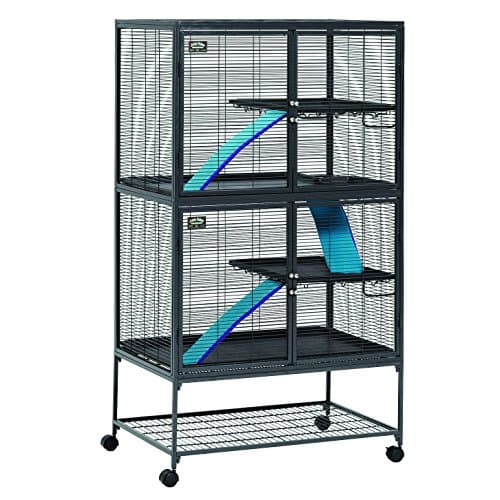
MidWest Critter Nation Double Unit (162)
36 x 24 = 864 sq in (6 sq ft) per level, two levels
The half-inch bar spacing is the whole argument: it is the same cage as the Ferret Nation with a gap a ferret kit cannot get its head through.
$339.99View on AmazonPrice as of October 17, 2026. #ad Disclosure
Deep burrowing without a DIY build
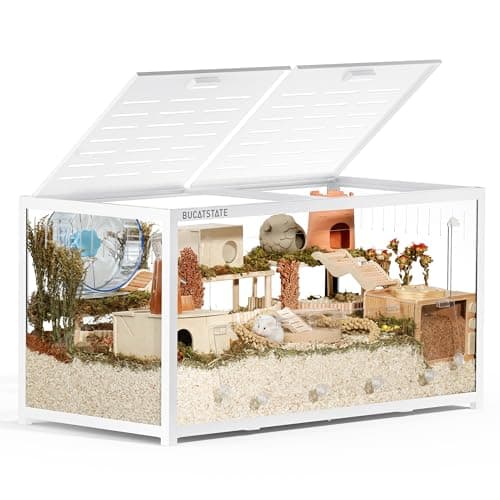
BUCATSTATE Hamster Cage 3.0, 47 in
47 x 23.6 = 1,109 sq in (7.7 sq ft) by our arithmetic
The deepest substrate capacity we could verify on a mainstream enclosure: an 11 in bedding claim on a 1,109 sq in floor is the combination almost nothing else offers.
$265.99$279.995% offView on AmazonPrice as of October 17, 2026. #ad Disclosure
A short-term carrier or a hospital cage, not a home
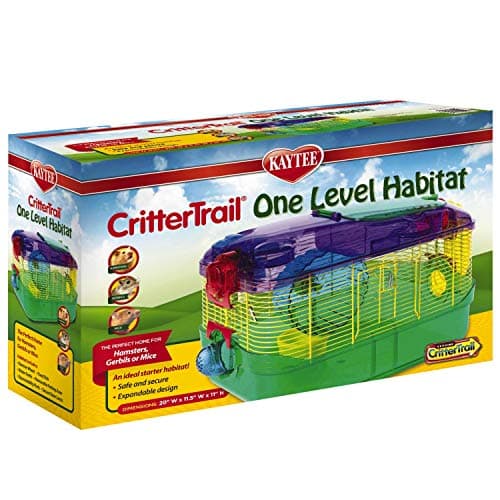
Kaytee CritterTrail One Level Habitat
20 x 11.5 = 230 sq in
230 sq in is under a third of the published minimum, and the manufacturer's own listing names gerbils and mice rather than hamsters.
$69.95View on AmazonPrice as of October 17, 2026. #ad Disclosure
The verdict, by buyer
- You want an animal that knows you: rats, and budget an hour a day outside the cage.
- You have half an hour a day: mice. The published out-of-cage figures differ by a factor of two to four between the species.
- You have a tall corner and no shelf space: rats. A rat cage uses height; a mouse enclosure uses floor.
- You have a four-foot shelf and no floor space: mice, in a solid-walled enclosure.
- You already own a 1/2 inch barred cage: rats. Do not put mice in it.
- You already own a 20 gallon long tank: mice. It is 360 square inches, which meets our reading of the figure, and it is nowhere near a rat enclosure.
The full rat shortlist is the best rat cages, with the figures behind it in rat cage size; the mouse equivalents are the best mouse cages and mouse cage size.
Questions people ask
Can mice live in a rat cage?
Can rats and mice live together?
Are rats or mice better for a beginner?
Which needs the bigger cage, a rat or a mouse?
Sources
- MSPCA: suggestions for housing small animals — The 24in cube and 1/2 inch bars for rats, and the 12 x 12 x 20in or 20 gallon figure for mice.
- Neville, Hunter, Benato, Mendl and Paul, Veterinary Record 192(3):e1839 — The expert-consensus rat cage dimensions, the two-tier minimum and the out-of-cage time.
- PDSA: the ideal home for your mice — The 6mm bar-spacing figure for mice.
- RSPCA: rats environment — Rat flooring, bar and bedding guidance, and the absence of a numeric rat cage size.
- RSPCA: mice environment — The 2cm bedding depth and the wheel requirements for mice.