Guinea pigs
How much hay do guinea pigs need?
The published answer is unlimited, which is correct and useless at a checkout. This is the same answer in pounds per month.
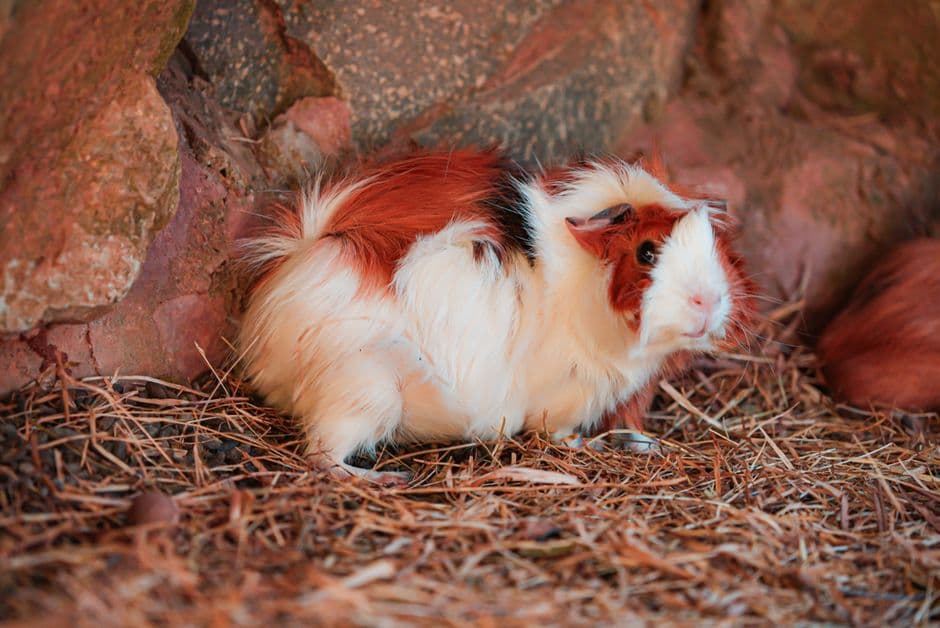
The published answer is unlimited, and the practical answer is that a guinea pig should always have a pile of hay bigger than its own body in front of it, replaced fresh every day rather than topped up. VCA Animal Hospitals names unlimited timothy or other low-calcium hay offered throughout the day and publishes no weight at all, and no other body we have found publishes one either. So here is the arithmetic nobody prints: a guinea pig eats roughly its body weight in hay over a week to ten days, which for a 2 to 2.5 lb adult works out at about 1 to 1.5 lb of hay a week once you allow for the proportion that gets sat on, soiled and wasted rather than eaten. For a pair that is around 2.5 to 3 lb a week, or 10 to 13 lb a month, which is why a 5 lb box is a fortnight's supply for two pigs and a 20 lb box is the sensible purchase. Those figures are ours, derived as described below, and they are not published by anyone.
Guinea pig hay and vitamin C · minimum
unlimited timothy or other low-calcium hay, offered throughout the day, plus 10 mg to 50 mg of vitamin C per day
We want to be precise about what is and is not sourced here, because this is a page where it would be easy to invent authority. The requirement — unlimited low-calcium hay, offered throughout the day, as the most important part of the diet — is VCA's and we quote it. The quantity in pounds is our arithmetic, built from a published body weight range for the species and an intake assumption we state openly rather than hide. If you want a figure from a government or a charity, the honest answer is that for guinea pigs there is not one. For rabbits there is, and the contrast is instructive.
Daily hay quantity for a rabbit · minimum
an amount equivalent to each rabbit's body size should be provided each day, making up at least 80% of each rabbit's daily food intake
That is rabbit guidance and we are not applying it to guinea pigs as though it were theirs. What it shows is what a quantity figure looks like when a body does publish one: an amount equivalent to the animal's own body size, every day, making up at least 80 percent of daily intake. A guinea pig is a smaller animal with the same hay-dependent digestive and dental physiology, and the daily-bundle-the-size-of-the-animal rule of thumb travels across the two species better than any weight in grams would. How much hay does a rabbit need a day works the rabbit version through in full.
What that is per month, by herd size
| Guinea pigs | Hay eaten per week | With waste, per week | Per month | Box size we would buy |
|---|---|---|---|---|
| One | About 1 lb | 1 to 1.5 lb | 4 to 6 lb | A 10 lb box, or 5 lb if storage is tight |
| Two | About 2 lb | 2.5 to 3 lb | 10 to 13 lb | A 20 lb box |
| Three | About 3 lb | 3.5 to 4.5 lb | 15 to 19 lb | A 20 lb box, monthly |
| Four | About 4 lb | 5 to 6 lb | 20 to 26 lb | A 40 lb box, or two 20 lb boxes |
Entirely our arithmetic, from an adult guinea pig weight of roughly 2 to 2.5 lb and the widely used rule that a cavy eats about its own body weight in hay over a week to ten days. The waste column assumes a quarter to a half of what you put down is soiled or bedded in rather than eaten, which is what happens in a cage with a hay rack and a litter corner. No veterinary body publishes any of these numbers and we are not attributing them to one.
The reason the waste column is as large as the eaten column is worth stating plainly: hay is not only food for this species. Guinea pigs burrow into it, sit in it, sleep in it and toilet in it, and a pile they have slept in is not a pile they will eat. That is not a problem to be solved by putting down less — it is the cost of the behavior, and a hay rack plus a separate loose pile is how you get both jobs done without paying for the whole lot twice.
Why the quantity is a housing question
A pile of hay the size of the animal, in a cage that has to hold 10.5 square feet of floor for a pair under the figure we buy to, takes up real room. Humane World for Animals publishes 7.5 square feet as the bare minimum for two guinea pigs and 10.5 as preferred, and we recommend the preferred figure in guinea pig cage size — partly because a pair that has to walk around a hay mountain in 7.5 square feet does not have 7.5 square feet. Food, water, two hides and a hay pile each take a bite out of the floor, and the published minimum assumes the animals can still move.
- Use a rack for the eating hay and a loose pile for the nesting hay. The rack keeps a portion clean and off the floor; the pile is what the animals actually live in. Trying to do both jobs with one pile is how hay gets expensive.
- Replace rather than top up. VCA asks for hay offered throughout the day, and the RSPCA names dust-free hay as suitable bedding and feeding material. Fresh daily, with yesterday's soiled portion out, is the routine.
- Put the hay away from the latrine corner. Guinea pigs toilet where they eat if you let the two overlap, and then you are buying hay to throw away.
- Store the bulk box somewhere dry and ventilated, not sealed. Hay in a sealed tub holds moisture and goes musty; hay in a cardboard box in a dry room keeps for months.
- Buy the big box. Hay is cheaper per pound in 20 and 40 lb sizes by a wide margin, and this is a consumable you will be buying for five to seven years.
What the hay is doing, which is why unlimited is the figure
VCA names hay as the most important part of a guinea pig's diet on two specific grounds: it provides the fiber that keeps the intestinal bacteria working, and the chewing that wears down continuously growing teeth. Both of those are rate-dependent rather than quantity-dependent, which is the real reason the published answer is unlimited rather than a weight. A guinea pig that eats a fixed ration in two hours and then has nothing spends the rest of the day not chewing, and the teeth do not stop growing while it waits.
The one thing hay does not supply is vitamin C, which guinea pigs cannot synthesize. VCA puts the requirement at 10 to 50 mg a day and directs it to fortified pellets and fresh vegetables rather than hay, and notes that pellets should be used or replaced within 90 days of manufacture because the vitamin C in them degrades. That is a feeding fact rather than a housing one, and it is the one place where unlimited hay is not the whole answer.
The hay we would buy in bulk
A second cutting as the everyday hay, a widely stocked bagged timothy for topping up between deliveries, and a graded medium cut where you want consistency rather than a cutting number. All three are low-calcium grass hays, which is what VCA specifies.
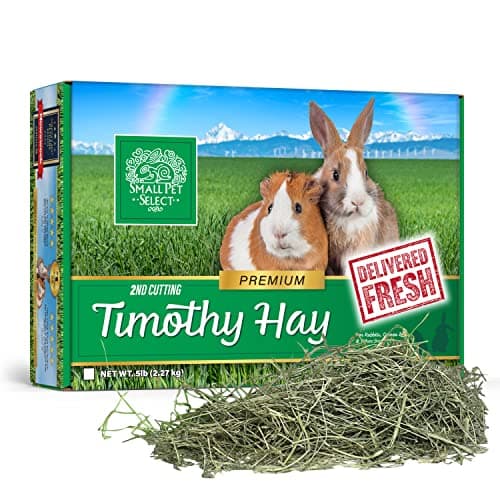
Everyday hay for a healthy adult rabbit or guinea pig
Small Pet Select 2nd Cutting Timothy Hay
Not applicable
The one hay here that tells you which cutting is in the box before you open it, which is the only way to buy the same texture twice.
$26.99View on AmazonPrice as of October 17, 2026. #ad Disclosure
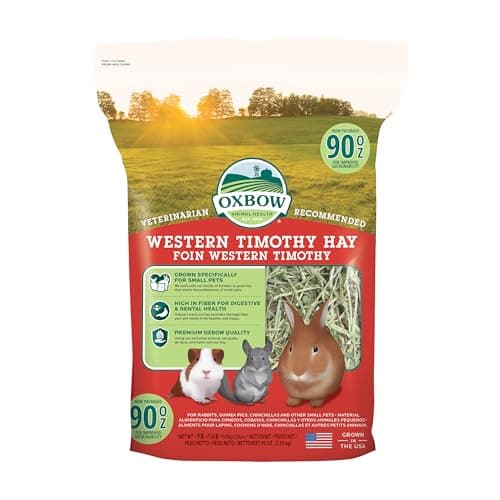
Availability, small bags, and topping up between deliveries
Oxbow Western Timothy Hay
Not applicable
The hay you can buy at eight on a Sunday evening in almost any pet shop in the country, which is a real advantage bought at the price of knowing what texture is in the bag.
$21.68View on AmazonPrice as of October 17, 2026. #ad Disclosure
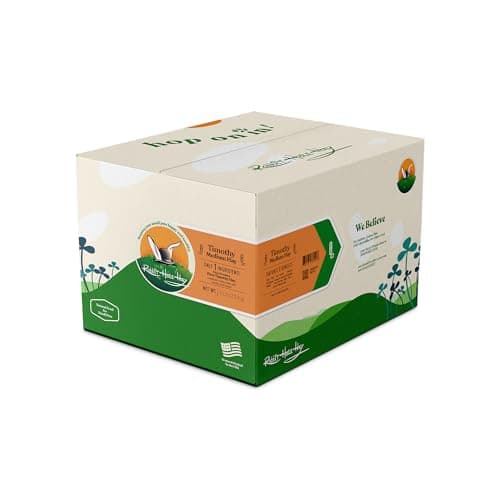
Everyday hay where you want graded consistency rather than a cutting number
Rabbit Hole Hay Ultra Premium Medium Timothy Hay
Not applicable
The everyday hay in a range whose soft cut gets all the attention, and the one most healthy adult rabbits and guinea pigs should actually be eating.
$35.43View on AmazonPrice as of October 17, 2026. #ad Disclosure
Which cut suits which animal is the subject of the best hay for guinea pigs, and if you also keep rabbits, alfalfa versus timothy hay explains why the legume hay on the same shelf is for a different animal at a different stage of life.
Questions people ask
How much hay does a guinea pig eat per day?
How much hay should I buy for two guinea pigs?
Can guinea pigs have too much hay?
Should hay be used as bedding as well as food?
Sources
- VCA Animal Hospitals: guinea pigs feeding — Unlimited timothy or other low-calcium hay, the fiber and dental reasoning, and the 10-50 mg vitamin C requirement.
- RSPCA: guinea pigs environment — Names dust-free hay as suitable, and rules out softwood, cotton wool and coarse materials like straw.
- Humane World for Animals: guinea pig housing requirements — The 7.5 and 10.5 sq ft figures that decide whether a hay pile fits.
- Scottish Government: pet rabbit welfare guidance — Quoted as the contrast case: a published daily quantity, for rabbits rather than guinea pigs.