Guinea pigs
The best hay for guinea pigs
Unlimited, timothy or another low-calcium grass hay, available all day. The brand matters much less than whether the seller will tell you which cut is in the box.
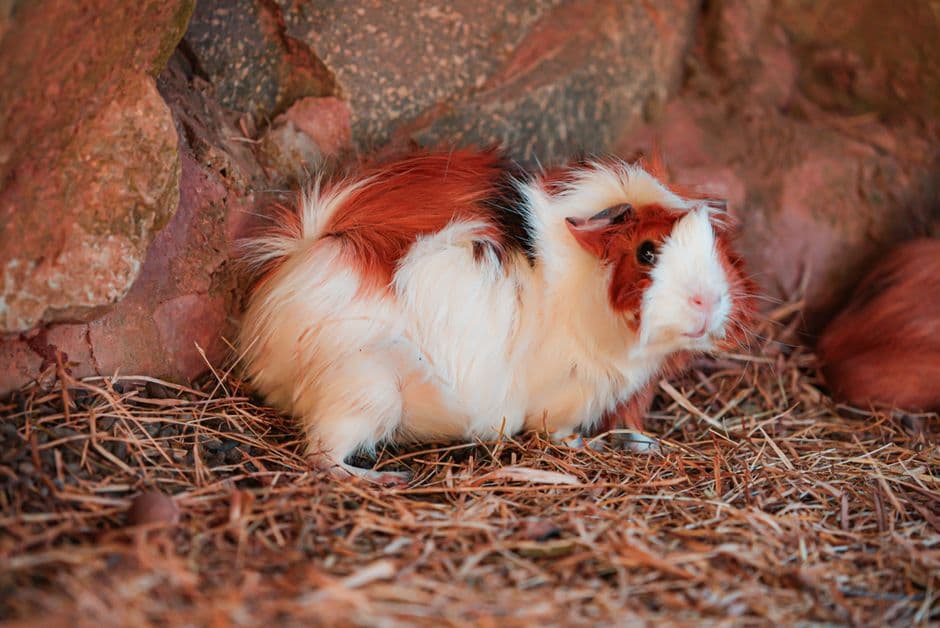
Buy Small Pet Select 2nd Cutting Timothy Hay. VCA specifies unlimited timothy or other low-calcium hay for guinea pigs, offered throughout the day, and names hay as the most important part of the diet — so the thing that separates one good timothy hay from another is not the species on the label but whether the same texture turns up in the next box. Small Pet Select names the cutting on the box, which is the only mechanism here that makes a repeat order repeatable. Rabbit Hole Hay grades to a texture standard instead, which works just as well. Oxbow is the one to buy when you need hay today from a shop.
Guinea pig hay and vitamin C · minimum
unlimited timothy or other low-calcium hay, offered throughout the day, plus 10 mg to 50 mg of vitamin C per day
Two things make guinea pig hay different from rabbit hay, and both are worth stating before any product. The first is calcium: VCA's wording is timothy or other low-calcium hay, which is what rules alfalfa out as an everyday feed for an adult guinea pig rather than a treat or a growth diet. The second is vitamin C. Guinea pigs cannot make their own, VCA publishes a requirement of 10 to 50mg a day, and hay does not supply it — the hay decision and the vitamin C decision are separate, and getting the first one right does nothing for the second.
This site already assesses the same hays for rabbits on the best timothy hay for rabbits. The products overlap heavily. The reasoning does not, which is why this is a separate page rather than a cross-link.
The criteria, in the order they are applied
- 1.A low-calcium grass hay, as a pass or fail. Timothy, orchard or meadow. Alfalfa is a legume and is not an everyday adult hay; a bag that is part alfalfa is still part alfalfa.
- 2.Repeatability. Does the seller commit to a cut or a graded texture? A hay that arrives soft one month and coarse the next is a hay a fussy guinea pig stops eating.
- 3.Texture for the animal in front of you. Softer, leafier cuts for a senior or a picky eater; coarser, stemmier cuts for dental wear and an animal gaining weight.
- 4.Dust and leaf loss. The RSPCA specifies dust-free hay for guinea pigs, and a box that is half leaf dust at the bottom is a box you paid hay prices for.
- 5.Volume and price, last. Hay is the base of the diet, offered throughout the day, so the practical question is whether the seller offers a size that makes that affordable.
| # | Product | Best for | Score | Price |
|---|---|---|---|---|
| 1 |  Illustrative IllustrativeSmall Pet Select 2nd Cutting Timothy HayNot applicable | Everyday hay for a healthy adult rabbit or guinea pig | 9.0out of 10 | Check price on Amazon We do not print prices. #ad Disclosure |
| 2 | Illustrative Rabbit Hole Hay Ultra Premium Medium Timothy HayNot applicable | Everyday hay where you want graded consistency rather than a cutting number | 8.9out of 10 | Check price on Amazon We do not print prices. #ad Disclosure |
| 3 | Illustrative Oxbow Western Timothy HayNot applicable | Availability, small bags, and topping up between deliveries | 7.6out of 10 | Check price on Amazon We do not print prices. #ad Disclosure |
| 4 | Illustrative Small Pet Select 1st Cutting Timothy HayNot applicable | Dental wear and animals that need a higher-fiber, less rich hay | 8.2out of 10 | Check price on Amazon We do not print prices. #ad Disclosure |
Scores are our own assessment of published specifications against the thresholds set out in how we assess products. They are not test results and not customer ratings. Tap a row to read the full assessment.
The three we would actually order
A hay that names its cutting, a hay that grades to a texture standard, and the one that is on a shelf near you when the delivery has not arrived. All three are timothy grass hay suitable for unlimited adult feeding; full assessments of all four are below.
- Illustrative
Everyday hay for a healthy adult rabbit or guinea pig
Small Pet Select 2nd Cutting Timothy Hay
Not applicable
The one hay here that tells you which cutting is in the box before you open it, which is the only way to buy the same texture twice.
Check price on AmazonWe do not print prices. #ad Disclosure
- Illustrative
Everyday hay where you want graded consistency rather than a cutting number
Rabbit Hole Hay Ultra Premium Medium Timothy Hay
Not applicable
The everyday hay in a range whose soft cut gets all the attention, and the one most healthy adult rabbits and guinea pigs should actually be eating.
Check price on AmazonWe do not print prices. #ad Disclosure
- Illustrative
Availability, small bags, and topping up between deliveries
Oxbow Western Timothy Hay
Not applicable
The hay you can buy at eight on a Sunday evening in almost any pet shop in the country, which is a real advantage bought at the price of knowing what texture is in the bag.
Check price on AmazonWe do not print prices. #ad Disclosure
What the sellers do and do not commit to
| Hay | Cut or grade stated | Texture | Best for | Sizes |
|---|---|---|---|---|
| Small Pet Select 2nd Cutting | Cutting named on the box | Leafy, soft stem, some flowery heads | Everyday hay for a healthy adult | 2 to 40 lb |
| Rabbit Hole Hay Medium Timothy | Graded to a texture standard | Between the seller's soft and coarse grades | Everyday hay where grading beats a cutting number | Multiple |
| Oxbow Western Timothy | Deliberately neither, and says so | Varies between bags | Buying hay today, locally | Small bags up |
| Small Pet Select 1st Cutting | Cutting named on the box | Coarse, high fiber, more seed head | Dental wear and an overweight animal | 2 to 40 lb |
Each seller's own published description of its product, read 2026-09-29 and linked on every product card. The best-for column is our editorial assessment. Oxbow states on its own product page that it does not commit to a cutting, which is recorded here as a fact about the product rather than as a criticism.
Oxbow's row deserves a word, because it reads worse than it is. Oxbow publishes a guaranteed analysis — crude fiber at 32 percent maximum — and declines to name a cutting, on the stated basis that the cut is less meaningful than the overall quality. That is a legitimate position. It also means the bag you get in March may be noticeably coarser than the one you got in January, and for a guinea pig that has already refused one coarse batch, that matters more than a fiber percentage does.
Which cut for which guinea pig
- A healthy adult: a second cutting or a medium grade. Leafy enough to be eaten reliably, stemmy enough to do dental work.
- A senior, or any animal with poor dental condition: the softest grade you can buy. A hay that gets refused does nothing at all, and that is the failure mode to avoid.
- An overweight guinea pig, or one not wearing its teeth down: a first cutting. Coarser, higher fiber, more seed head, and less rich.
- A guinea pig under about six months, or pregnant: this is the one case where alfalfa has a role, and it is a veterinary conversation rather than a shopping one. We are not going to publish a growth-diet protocol we have no source for.
How much, where to put it, and the vitamin C part
Unlimited is the published answer, and it is not a figure to interpret. VCA asks for hay offered throughout the day on the basis that it provides the fiber that keeps the bacteria in the intestinal tract working and the chewing that wears down continuously growing teeth. In practice that means a pile that never runs out, refreshed daily, rather than a measured ration. How much hay a rabbit needs a day works through the same logic for the species next door, where there is a statutory figure.
Where it goes matters more than people expect. Hay in a rack keeps it cleaner; hay in a pile is what guinea pigs actually dig through and eat most of. Most pairs end up with both, and the pile is the one that empties. Keep it away from the corner the animals use as a toilet, which on a pair's cage is usually a predictable corner within a week.
And the separate requirement: VCA publishes 10 to 50mg of vitamin C a day, directed at vitamin C-fortified pellets and fresh green or colored vegetables rather than at hay, and notes that pellets should be used or replaced within 90 days of manufacture because the vitamin C in them degrades. That last detail is the one most owners have never been told, and it is on the bag.
The assessments
Our pick · Everyday hay for a healthy adult rabbit or guinea pig
Small Pet Select 2nd Cutting Timothy Hay
The one hay here that tells you which cutting is in the box before you open it, which is the only way to buy the same texture twice.
- Dimensions
- Sold in 2, 5, 10, 20, 25 and 40 lb boxes (manufacturer-listed)
- Continuous floor
- Not applicable
- Bar spacing
- Not applicable
- Material
- Timothy grass hay, second cutting, grown in the Pacific Northwest, USA
- Cut sold
- 2nd cutting, named on the box. The seller describes it as leafy with a soft stem and a medium amount of flowery heads
What it gets right
- The cutting is stated on the product, so a repeat order is the same hay
- Softer texture and a higher leaf-to-stem ratio than 1st cutting, per the seller
- Sold up to 40 lb, which is the sensible way to buy something that is 85 percent of a diet
- The seller positions it as the everyday hay for a healthy adult rather than a specialist cut
What it gets wrong
- Costs more per pound than a farm-store bale
- Box sizes are large enough that a single rabbit needs somewhere dry to keep the rest
- The 2 lb size was listed as backordered when we read the page
Who should buy something else
Not the right buy for a rabbit that needs maximum dental wear or is gaining weight on a rich hay. That animal wants 1st cutting, which is the coarser product from the same seller.
Specifications read from Small Pet Select product page on 29 September 2026. Floor-area arithmetic is ours and is shown above so you can redo it.
Illustrative- Consistency between orders9
- Texture for an adult9
- Size range9
- Dust and leaf loss8
- Value per pound7
We do not print prices. #ad Disclosure
Number 2 · Everyday hay where you want graded consistency rather than a cutting number
Rabbit Hole Hay Ultra Premium Medium Timothy Hay
The everyday hay in a range whose soft cut gets all the attention, and the one most healthy adult rabbits and guinea pigs should actually be eating.
- Dimensions
- Sold from 4 oz up to 40 lb (manufacturer-listed)
- Continuous floor
- Not applicable
- Bar spacing
- Not applicable
- Material
- Timothy grass hay, graded between the seller's soft and coarse cuts
- Cut sold
- Graded to a balanced profile: thinner stems and broader leaves than the coarse cut, described by the seller as the everyday hay
What it gets right
- Sits between soft and coarse, which is where a healthy adult belongs
- Graded per batch, so the texture repeats between orders
- Same wide size ladder as the soft cut, including 4 oz trial bags
What it gets wrong
- Premium pricing against a pet-shop bag
- Ordered from the seller rather than picked up locally tonight
Who should buy something else
Not for an animal that has already refused a medium-texture hay. If yours picks out the leaf and leaves the stems, buy the soft cut and accept the dental trade-off rather than buying this and hoping.
Specifications read from Rabbit Hole Hay product page on 29 September 2026. Floor-area arithmetic is ours and is shown above so you can redo it.
Illustrative- Consistency between orders9
- Texture for an adult9
- Dental wear8
- Size range10
- Value per pound6
We do not print prices. #ad Disclosure
Number 3 · Availability, small bags, and topping up between deliveries
Oxbow Western Timothy Hay
The hay you can buy at eight on a Sunday evening in almost any pet shop in the country, which is a real advantage bought at the price of knowing what texture is in the bag.
- Dimensions
- Sold in 15 oz, 40 oz, 90 oz, 9 lb, 25 lb and 50 lb (manufacturer-listed)
- Continuous floor
- Not applicable
- Bar spacing
- Not applicable
- Material
- Timothy grass hay. Guaranteed analysis lists crude fiber at 32.00% maximum
- Cut sold
- None stated. Oxbow does not sell hay by cutting number and prints no cutting on the bag
What it gets right
- Stocked almost everywhere, in the smallest bag sizes here
- Publishes a guaranteed analysis, which neither cut-specific seller prints
- 15 oz and 40 oz bags make it cheap to trial on a new or fussy animal
- Oxbow states the hay is hand-sorted and hand-packed and grown specifically for small pets
What it gets wrong
- No cutting on the bag, so texture varies between bags and between seasons
- Among the more expensive per pound once you are past the small bags
- An animal that liked one bag may refuse the next, and you have no way to see why
Who should buy something else
Not the right buy if your animal is fussy about texture, because a repeatable texture is the one thing this product does not offer. Buy a stated cutting instead.
Specifications read from Oxbow product page on 29 September 2026. Floor-area arithmetic is ours and is shown above so you can redo it.
Illustrative- Consistency between orders5
- Texture for an adult8
- Availability10
- Dust and leaf loss7
- Value per pound6
We do not print prices. #ad Disclosure
Number 4 · Dental wear and animals that need a higher-fiber, less rich hay
Small Pet Select 1st Cutting Timothy Hay
The coarse end of the same seller's range, and the one to buy when the problem is a rabbit that is overweight or not wearing its teeth down.
- Dimensions
- Sold in the same box ladder as the 2nd cutting (manufacturer-listed)
- Continuous floor
- Not applicable
- Bar spacing
- Not applicable
- Material
- Timothy grass hay, first cutting, grown in the Pacific Northwest, USA
- Cut sold
- 1st cutting, named on the box. Higher fiber and coarser than the 2nd, with more of the flowery heads
What it gets right
- High fiber and less fattening than the later cuts, per the seller
- More stem and seed head, which is the part that does the dental work
- Same stated-cutting consistency as the 2nd cutting
What it gets wrong
- Coarse enough that a fussy animal may refuse it outright
- Not the everyday choice the seller itself recommends for a healthy adult
Who should buy something else
Not for a senior rabbit, an animal with poor dental condition, or a known picky eater. Those animals want a softer cut, and a hay that gets refused does nothing at all.
Specifications read from Small Pet Select product page on 29 September 2026. Floor-area arithmetic is ours and is shown above so you can redo it.
Illustrative- Consistency between orders9
- Texture for an adult6
- Dental wear10
- Dust and leaf loss8
- Value per pound7
We do not print prices. #ad Disclosure
Questions people ask
What is the best hay for guinea pigs?
How much hay does a guinea pig need?
Can guinea pigs eat alfalfa hay?
Is timothy or orchard hay better for guinea pigs?
Does hay provide a guinea pig's vitamin C?
Should guinea pig hay go in a rack or a pile?
Sources
- VCA Animal Hospitals — Guinea pigs, feeding — Specifies unlimited timothy or other low-calcium hay offered throughout the day as the most important part of the diet, the fiber and dental reasoning, the 10-50mg a day vitamin C requirement from fortified pellets and fresh vegetables, and the 90-day pellet freshness note
- RSPCA — Guinea pig environment — Names dust-free hay among the suitable materials, which is why dust and leaf loss are assessment criteria here
- Oxbow Animal Health — Western Timothy — Guaranteed analysis listing crude fiber at 32.00% maximum, and the manufacturer's own statement that it does not commit to a cutting
- Small Pet Select — 2nd cutting timothy hay — The cutting named on the product and the seller's description of texture and leaf-to-stem ratio