Rabbits
How much hay does a rabbit need a day?
A bundle at least as big as the rabbit itself, every single day. Which makes hay a housing problem as well as a feeding one.
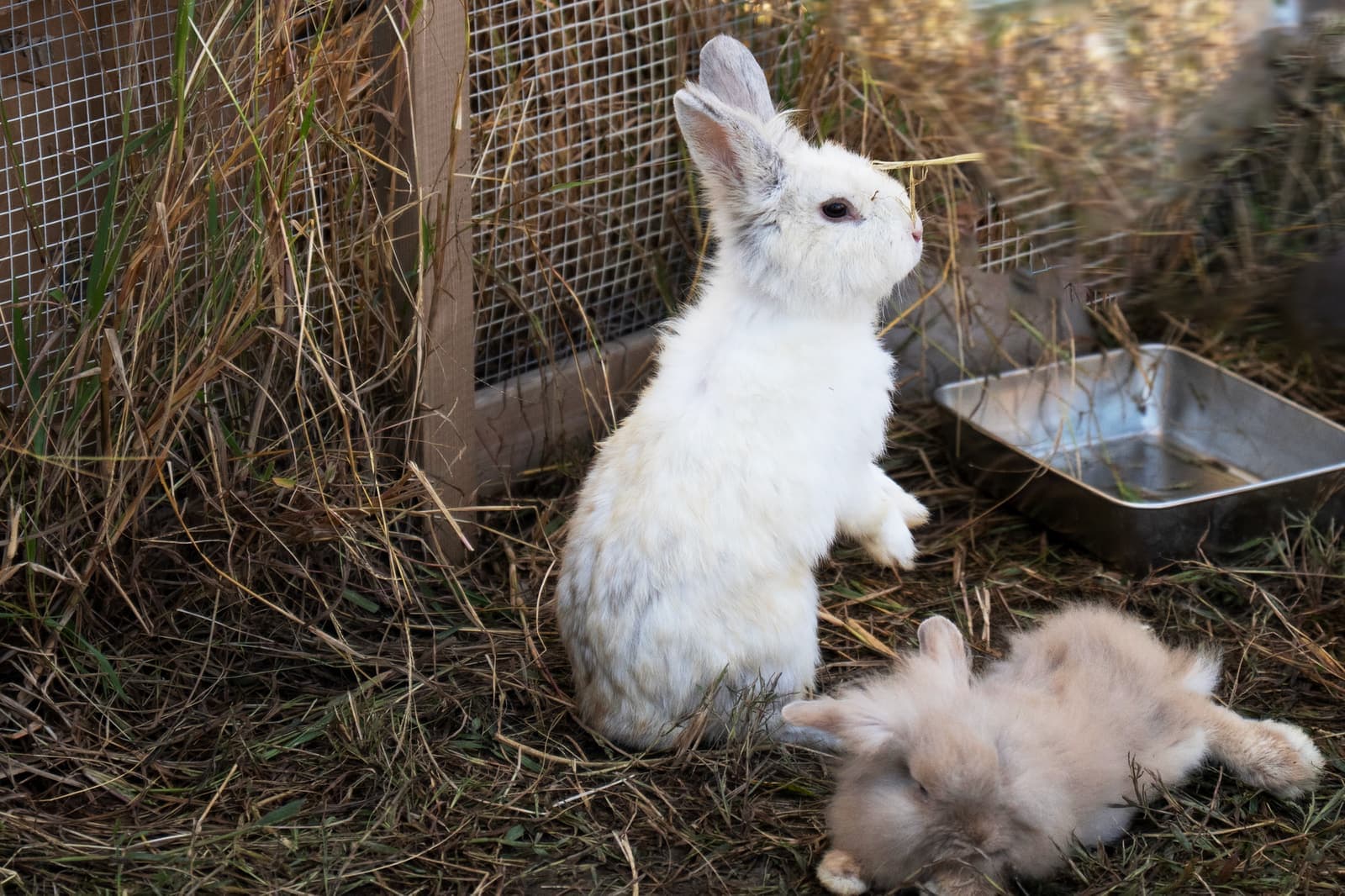
A bundle of hay at least as big as the rabbit's own body, every day. That is the Scottish Government's published welfare guidance, which also sets hay at a minimum of 80 percent of daily food intake and requires access to it throughout the day and night. The House Rabbit Society independently puts hay at 85 percent of an adult rabbit's diet, offered in large unlimited amounts, fresh, daily. In practice: fill the rack, fill it again when it empties, and never let it run out.
Daily hay quantity for a rabbit · minimum
an amount equivalent to each rabbit's body size should be provided each day, making up at least 80% of each rabbit's daily food intake
There are two useful ways to state a hay quantity and the published guidance gives you both. One is a share of the diet, which tells you how hay relates to everything else you feed. The other is a physical amount, which is what you can actually act on at seven in the morning. The body-size rule is the second kind, and it is the most practical sentence published anywhere about feeding a rabbit.
The two published positions
| Body | Daily amount | Share of the diet | Availability |
|---|---|---|---|
| Scottish Government, Pet Rabbit Welfare Guidance | An amount equivalent to each rabbit's body size, each day | At least 80 percent of daily food intake | Access throughout the day and night; food available 24 hours a day |
| House Rabbit Society | Large, unlimited amounts, offered fresh daily | 85 percent of an adult rabbit's diet | Unlimited |
Each body's own wording, read 4 October 2026 and linked at the foot of this page. The Scottish guidance is statutory welfare guidance rather than a charity recommendation, which is why we lead with it.
Those agree to within five percentage points, from two organizations with no connection to each other, which is worth noticing. Most of the figures on this site come from a single issuer and have to be presented as one body's position. This one is as close to settled as anything in small-animal husbandry gets.
What a bundle the size of a rabbit actually looks like
This is the part that surprises people, so it is worth being concrete. Hay is almost entirely air. A medium rabbit is roughly the volume of a large shoebox, and matching that volume in loose hay is a double armful — the sort of quantity that looks like a mistake the first time you put it in a rack.
By weight, that is a much smaller number than it looks, which is why weighing hay is a poor way to think about it. The guidance is deliberately volumetric. A rabbit does not eat all of it; it eats the parts it wants, tramples the rest, and sits in what is left, and all three of those are the behavior working rather than waste.
Why this is a housing figure, not just a feeding one
A volume the size of the animal, present at all times, has to physically exist inside the enclosure, and that is a design constraint most hutches ignore completely.
Run the arithmetic against a typical timber hutch-and-run package and the problem is obvious. Our rabbit hutch pillar sets out that the Rabbit Welfare Association and Fund and the RSPCA both publish 3m x 2m x 1m — about 64.5 square feet — and that the largest package we could verify provides 17.46 square feet. Into that already-inadequate space you now have to fit a hay volume the size of the rabbit, a water source, a litter area and a shelter, without the hay sitting where the animal urinates.
- Hay goes above the floor, not on it. A rack, a hanging bag or a basket keeps the bulk of it out of the wet. Hay on a hutch floor is hay you are replacing twice a day.
- Put hay next to the litter area, not in the far corner. Rabbits eat and toilet at the same time, which sounds unfortunate and is simply how the animal works. Siting the rack over or beside the tray is how you get both jobs done in one corner and keep the rest of the floor clean.
- Keep it off the ground in an outdoor hutch especially. Damp hay molds, and a hutch floor is the dampest surface in the enclosure. Hutch flooring covers the base materials this interacts with.
- Never under the water bottle. The drip zone is a permanently wet patch, and a mold culture in a feed is a different order of problem from a mold patch in bedding.
- Scale the rack to the animal, not the hutch. A clip-on rack sold with a hutch typically holds a fraction of a day's published amount. Most rabbits need a rack that looks absurdly large for the enclosure, which is a comment on the enclosure.
The hay to buy in that quantity
Two hays that commit to a texture, and the one you can buy locally when a delivery is late. At 80 to 85 percent of a diet, bulk sizes are the only sensible way to buy. Full assessments are in the timothy hay roundup.
 Illustrative
Everyday hay for a healthy adult rabbit or guinea pig
Small Pet Select 2nd Cutting Timothy Hay
Not applicable
The one hay here that tells you which cutting is in the box before you open it, which is the only way to buy the same texture twice.
Check price on AmazonWe do not print prices. #ad Disclosure
- Illustrative
Everyday hay where you want graded consistency rather than a cutting number
Rabbit Hole Hay Ultra Premium Medium Timothy Hay
Not applicable
The everyday hay in a range whose soft cut gets all the attention, and the one most healthy adult rabbits and guinea pigs should actually be eating.
Check price on AmazonWe do not print prices. #ad Disclosure
- Illustrative
Availability, small bags, and topping up between deliveries
Oxbow Western Timothy Hay
Not applicable
The hay you can buy at eight on a Sunday evening in almost any pet shop in the country, which is a real advantage bought at the price of knowing what texture is in the bag.
Check price on AmazonWe do not print prices. #ad Disclosure
What the hay is doing, which explains why the figure is so high
Eighty-five percent of a diet sounds extreme until you look at what the guidance says it is for. The Scottish Government's wording is that rabbits need a diet high in fiber to wear down their continuously growing teeth and keep their digestive tract functioning properly. Those are two separate jobs and both of them are mechanical.
The teeth grow continuously throughout the animal's life, and the only thing that stops them overgrowing is the grinding action of chewing long fiber for hours a day. The gut is designed to have fiber moving through it constantly, and it slows and then stops when that supply is interrupted. Neither job can be done by a concentrated food, which is why the ratio is so lopsided and why pellets are a small supplement rather than the meal.
It also explains why the published amount is a volume rather than a calorie figure. What the rabbit needs is not the energy in the hay. It is the hours spent chewing it.
If your rabbit is not eating enough hay
- 1.Cut the pellets first. A rabbit filled up on concentrate has no reason to work at hay. Pellets are the small part of the diet, and reducing them is the single most effective way to raise hay intake.
- 2.Change the texture before you change the brand. An animal refusing hay is usually refusing a texture. Second cutting, graded medium and soft hays are genuinely different products, and the timothy hay roundup sets out which is which.
- 3.Offer it fresh rather than topped up. The House Rabbit Society's wording is fresh daily. Hay that has been in the rack three days has been breathed on, trodden through and picked over, and a rabbit will often take the same hay enthusiastically when it is new.
- 4.Give it more than one hay place. A single rack is a single opportunity. Two sites, one of them at ground level in a clean dry spot, raises intake in a way that costs nothing.
- 5.Then speak to a vet. A rabbit that has stopped eating hay may be telling you about its teeth rather than its opinion of the hay, and reduced hay intake is one of the earliest signs of dental disease. This site publishes housing guidance and nothing on it is veterinary advice.
Questions people ask
How much hay does a rabbit need a day?
How much hay does a rabbit eat in a day?
Can a rabbit have too much hay?
Why do rabbits need so much hay?
Where should hay go in a rabbit hutch?
My rabbit will not eat hay. What should I do?
Sources
- Scottish Government — Pet rabbit welfare guidance — An amount equivalent to each rabbit's body size each day, at least 80 percent of daily food intake, good quality dust-free hay available 24 hours a day, for dental wear and digestive function
- House Rabbit Society — Food and diet — Hay should comprise 85 percent of an adult rabbit's diet, in large unlimited amounts offered fresh daily; adults on timothy and other grass hays
- Rabbit Welfare Association and Fund — Space recommendations — The 3m x 2m x 1m enclosure figure this hay volume has to fit inside