Hamsters
Best sand baths for hamsters
A sand bath is the cheapest thing you can add to a hamster enclosure and the easiest to get wrong, because half the aisle is selling a different product under a similar word.
Buy the BUCATSTATE 6.6 lb fine bath sand, and buy a tray bigger than the one published figure in this category. Sand baths have no welfare minimum attached to them: PDSA and the RSPCA publish nothing about sand for hamsters at all, and the only container specification anyone publishes — at least 6 x 6 x 9 in with 1 to 2 in of material in the bottom — is VCA's, written for chinchillas bathing in dust. Within that gap the decision is simple. Buy sand, never dust. Buy it unscented and undyed. Prefer a bag that names what the mineral is and states it is calcium-free, because crushed-limestone play sand sets hard once it is wet. Then buy enough of it, because one inch of sand in a 92 square inch tray weighs about five pounds, and the published routines in this category all say to change it weekly.
Dust bath container and routine (chinchillas) · minimum
a dust box for bathing should be at least 6 x 6 x 9 in and have 1 to 2 in of dust in the bottom; dust baths should be provided for 10-15 minutes daily and removed after use, and the dust changed every week
Our conversion: 15 x 15 x 23cm, with 2.5 to 5cm of material
Every other category on this site starts with a published number and measures products against it. This one starts with an absence. PDSA's hamster housing advice is specific to the centimeter about bedding depth, wheel diameter and cage floor, and it does not mention sand. The RSPCA's hamster environment page asks for a dust-free substrate and safe nesting material, and it does not mention sand either. So a page about sand baths has to be honest about what it is built on before it ranks anything.
What it is built on is four things: VCA's chinchilla dust-box figure, which is the only container specification published anywhere in the category; PDSA naming chinchilla sand for a gerbil dust bath on its gerbil page; Supreme Petfoods publishing a depth, a session length and a change interval for its own bathing sand; and the stated composition of each bag we could verify as currently sold. That is a thinner evidence base than the one behind how big a hamster cage should be, and saying so is part of the job.
If you are here because the sand bath is the last item on a list, the hamster cage setup checklist is the page that covers the other eight, and how deep hamster bedding should be is the one that explains why the tray sits on top of ten inches of substrate rather than on the cage floor.
Hamster sand bath (PDSA) · no figure published
no figure published — PDSA's hamster housing advice does not mention a sand or dust bath at all
Sand is not dust, and that is the whole filter
The two products sit side by side in the same aisle, are described with overlapping words, and are not interchangeable. Chinchilla dust is a milled powder, sized to penetrate a coat dense enough that a chinchilla cannot be bathed in water. VCA's instruction for it is to provide the dust for 10 to 15 minutes daily and then remove it — so even the animal it is made for does not live with it in the enclosure. The same page asks that the product be one made specifically for chinchillas.
A hamster or a gerbil rolling in that powder is a different proposition. It is a smaller animal, usually in a deep-bedded enclosure where airflow at floor level is already the weak point — the problem cage ventilation covers in full — and the tray is normally left in permanently rather than offered for a quarter of an hour. Sand, graded as grains rather than as powder, does the coat-conditioning job without the airborne fraction. That is why every product on this page is sold as sand and why the Kaytee product many older guides still recommend is not: Kaytee's own site now lists a chinchilla dusting powder, not a bath sand.
The four things we buy on
- 1.Sold as sand, not as dust. The first filter and the one that eliminates the most. A product described as a dusting powder, bathing dust or grooming powder is a chinchilla product. One exception in presentation only: a couple of sands market themselves with the word 'dust bath' in the title while plainly being graded sand, and we say so on the card rather than disqualifying a good bag over its listing copy.
- 2.Unscented and undyed. A sand bath is something an animal rolls in with its face and then grooms off itself. Several ranges on sale add a floral scent, including one of the brands recommended below in its other variant. There is no version of a scented bath sand we would use, and no welfare body anywhere asks for one.
- 3.A named composition, and calcium-free. The useful question is not the color of the sand but what mineral it is. Quartz and natural desert sand stay loose when damp; crushed limestone and other carbonate sands — which is what a lot of hardware-store play sand is — set like weak mortar once a hamster urinates in them, and that happens in the first week in a tray the animal has adopted as a toilet. Two of the five below state calcium-free or name quartz outright. The rest say 'natural desert sand' and nothing more.
- 4.Enough of it to follow the routine. This is the criterion nobody writes about, and the arithmetic below is why it decides which bag to buy. Both published routines in this category say to change the sand weekly. One inch of dry sand over the floor of a 92 square inch tray weighs roughly five pounds, so a two and a half pound bag is half a fill, and a weekly change on a Syrian-sized tray gets through more sand in a month than most owners expect.
| # | Product | Best for | Score | Price |
|---|---|---|---|---|
| 1 | 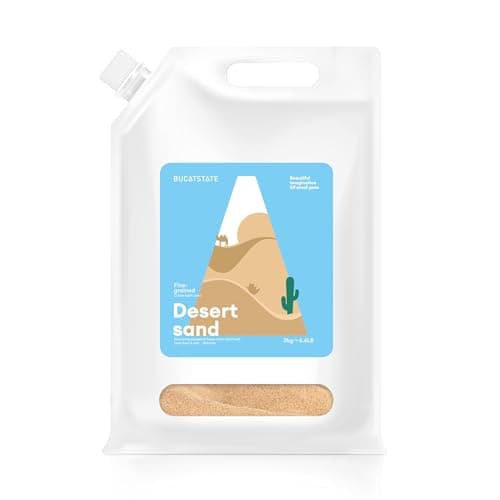 BUCATSTATE Hamster Bath Sand, 6.6 lb FineAbout three 1 in fills of VCA's 6 x 6 in minimum dust box, or one and a third fills of a 92 sq in tray — our arithmetic at 97 lb of dry sand per cubic foot | Filling a bath properly and refilling it weekly | 8.8out of 10 | $19.99View on Amazon Price as of October 22, 2026. #ad Disclosure |
| 2 | 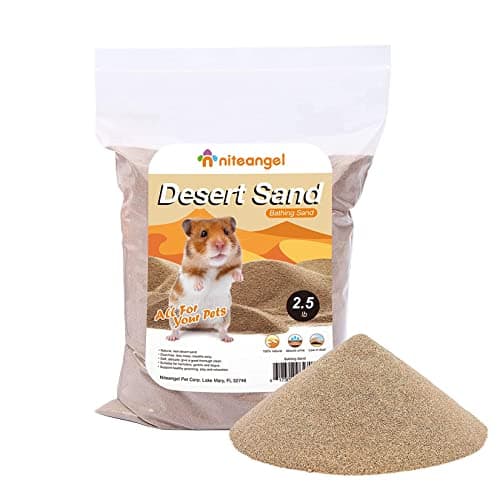 Niteangel Hamster Desert Bath Sand, 2.5 lbAbout one 1 in fill of a 6 x 6 in box, or half a fill of a 92 sq in tray — our arithmetic at 97 lb per cubic foot | A tray the animal uses as a toilet as well as a bath | 8.5out of 10 | $13.99View on Amazon Price as of October 22, 2026. #ad Disclosure |
| 3 | 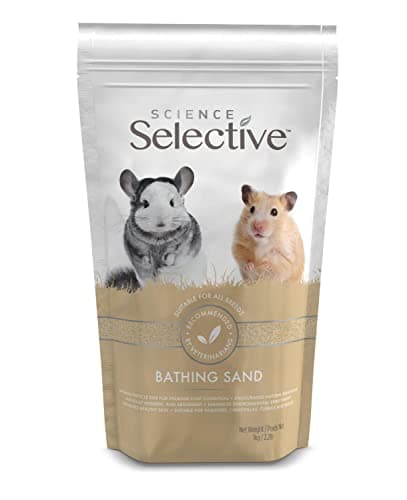 Supreme Science Selective Bathing Sand, 1 kgSupreme's own instruction is about 1 in (2.5cm) in a high-sided tray; 2.2 lb is roughly one such fill of a 6 x 6 in box, our arithmetic | Owners who want the method published alongside the product | 8.6out of 10 | $11.09View on Amazon Price as of October 22, 2026. #ad Disclosure |
| 4 | 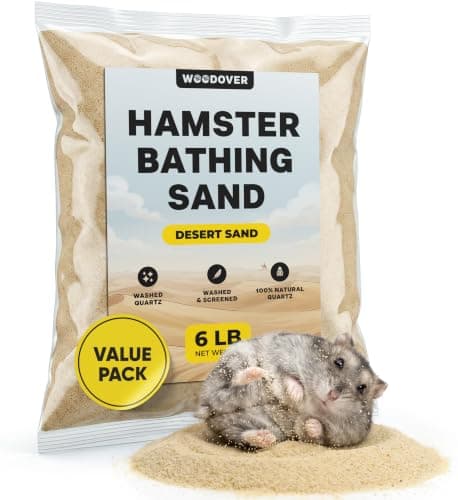 Woodover Pure Desert Bath Sand, 6 lbAbout three 1 in fills of a 6 x 6 in box, or one and a quarter fills of a 92 sq in tray — our arithmetic at 97 lb per cubic foot | Knowing what the sand is made of | 8.3out of 10 | $23.99View on Amazon Price as of October 22, 2026. #ad Disclosure |
| 5 | 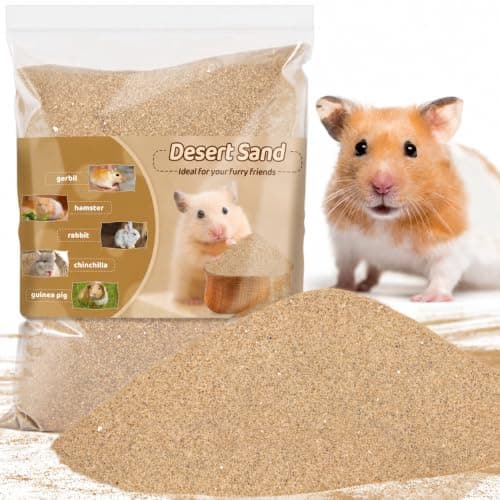 Sukh Hamster Desert Sand, Coarse, 14 ozUnder a pound: roughly half a 1 in fill of a 6 x 6 in box — a trial size, not a month's supply | Trying a sand bath before committing to a big bag | 7.9out of 10 | $5.99$6.498% offView on Amazon Price as of October 22, 2026. #ad Disclosure |
Scores are our own assessment of published specifications against the thresholds set out in how we assess products. They are not test results and not customer ratings. Tap a row to read the full assessment.
The five, and what each bag actually states
| Sand | Pack weight | Stated composition | Scented? | 1 in fills of a 6 x 6 in box | 1 in fills of a 92 sq in tray |
|---|---|---|---|---|---|
| BUCATSTATE 6.6 lb fine | 6.6 lb (3 kg) | Natural desert sand, stated calcium-free and no-dust | No (a scented variant exists in the range) | About 3 | About 1.3 |
| Niteangel Desert Bath Sand | 2.5 lb (40 oz) | Natural desert sand, stated no-dust and clumping | No | About 1.2 | About 0.5 |
| Supreme Science Selective Bathing Sand | 1 kg (2.2 lb) | Bathing sand, stated optimal particle size | No | About 1 | About 0.4 |
| Woodover Pure Desert Bath Sand | 6 lb | Stated 100 percent natural quartz mineral | No | About 3 | About 1.2 |
| Sukh Desert Sand, coarse | 14 oz | Natural desert sand, coarse grade, stated dust-free | No | About 0.5 | About 0.2 |
Pack weights and composition claims are each manufacturer's or listing's own published figures, read 22 October 2026 and linked on every product card below. The fills-per-bag columns are our arithmetic, using the Engineering ToolBox figure of 97 lb per cubic foot for dry sand. They are rounded, because bulk density varies with grain size and how firmly the sand settles.
The container, and the one figure that exists
VCA publishes a dust box of at least 6 x 6 x 9 in, holding 1 to 2 in of material. That is 36 square inches of floor and it is written for a chinchilla, an animal several times the size of a Syrian hamster — which tells you the figure is about room to roll over, not about body length. Transferred to a hamster tray it is a floor, not a target, and we would treat it as the absolute smallest thing worth buying.
Our own line, labeled as ours: at least 8 x 8 in for a dwarf and around 10 x 8 in for a Syrian, with walls deep enough to hold an inch of sand without it being kicked straight out, and open at the top. A Syrian is five to seven inches long nose to tail base. A 6 x 6 in tray is barely the animal's own length across, and a hamster that cannot turn over in the sand will stand in it and use it as a toilet instead — which is not a failure, it is just a different product than the one you bought.
The Niteangel wooden box below publishes 11.8 x 7.8 in, which is 92 square inches: about two and a half times VCA's figure, and the only sand container we could verify that states its dimensions at all. Most do not, which is remarkable for a product whose entire function is a size.
The container we would use
A published footprint, deep walls, an open top and enough weight that a hamster launching into it does not move it. One inch of sand in this tray is about five pounds, which is the number that should decide which bag you buy.
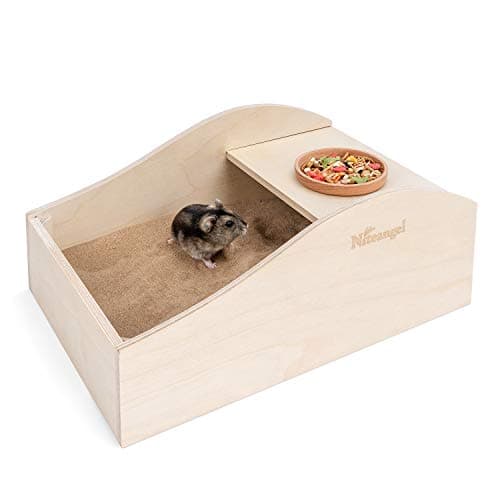
A Syrian-sized animal that needs room to roll
Niteangel Wooden Sand-Bath Box, Medium
11.8 x 7.8 = 92 sq in of tray floor, our arithmetic from the listed size
The container we would use: a published footprint about two and a half times the only tray figure anyone publishes, deep enough to hold an inch of sand, and open so a Syrian can turn around in it.
$26.99View on AmazonPrice as of October 22, 2026. #ad Disclosure
What a weekly change really costs
Both published routines in this category — VCA's for chinchilla dust and Supreme's for its own bathing sand — say to change the material weekly and to pull soiled material out as it appears. Hold that against the pack weights and the picture changes.
- A 6 x 6 in box at 1 in deep holds about 2 lb of sand. Weekly changes are roughly 8 lb a month, so one 6.6 lb bag is most of a month.
- A 10 x 8 in tray at 1 in deep holds about 4.5 lb. Weekly changes are around 18 lb a month — three big bags.
- The 92 sq in Niteangel box at 1 in deep holds about 5 lb, which is more than any single bag on this page except the BUCATSTATE and the Woodover.
- In practice most owners sift the soiled clumps out daily and do a full change monthly rather than weekly, which is a defensible compromise and is exactly why the clumping sand below earns its place. We are telling you what the published routine costs so that the compromise is one you chose.
This is the same shape of problem as the one on how deep hamster bedding should be: the published figure is reasonable, and the packs on sale are sized for a smaller version of the job. Best gerbil bedding runs the equivalent arithmetic for substrate volume, where filling a minimum enclosure to the published depth needs more liters than any single pack holds.
What not to buy
- Chinchilla dusting powder. The right product for a chinchilla and the wrong one for a hamster or a gerbil, for the reason set out above. If you keep chinchillas, best chinchilla bedding is the page for the rest of that setup.
- Any scented or dyed sand. Floral variants are sold by at least two of the brands on this page. The scent is for the owner and the animal cannot leave the room.
- Hardware-store play sand you have not checked. Much of it is crushed limestone, which sets when wet, and the fine fraction is substantial. If it is the only option, washed and thoroughly dried quartz play sand is usable — baking it dry is the step people skip — but you are doing work a 6 lb bag of graded bath sand has already done.
- Reptile calcium sand. Calcium carbonate, marketed for a different class of animal, sold in the same shape of bag. It clumps on contact with urine and there is no reason to put it in a rodent enclosure.
- A tray with a lid as the only sand container. A covered sand box in a deep-bedded enclosure is the one configuration where the dust question stops being theoretical. If you want a covered dig box, fill it with substrate rather than sand.
Does a hamster actually need one?
No welfare body on our list says so, and we are not going to invent a mandate. What is defensible from the published material is narrower and still worth the few dollars: PDSA names a chinchilla-sand dust bath for gerbils to keep the coat in condition, Supreme lists hamsters, gerbils, chinchillas and degus as bathing-sand species on its own product page, and VCA's chinchilla routine shows what a bath is for — coat condition, with the material removed before it becomes bedding.
The practical argument is the one most owners notice first. Hamsters are fastidious, and a tray of clean sand usually becomes the toilet corner within a day or two. That concentrates the mess in a scoopable container instead of spreading it through ten inches of substrate, which makes spot-cleaning a 30-second job and a full strip-down a monthly one rather than a weekly one. A sand tray is, in that sense, less a grooming accessory than a litter tray the animal chose for itself.
The assessments
Our pick · Filling a bath properly and refilling it weekly
BUCATSTATE Hamster Bath Sand, 6.6 lb Fine
The bag we would buy first: a genuinely large quantity of unscented, calcium-free sand with a pour spout, from the one brand in this category that states what the sand is not as well as what it is.
- Dimensions
- 6.6 lb (3 kg) bag with a pour spout (manufacturer-listed)
- Continuous floor
- About three 1 in fills of VCA's 6 x 6 in minimum dust box, or one and a third fills of a 92 sq in tray — our arithmetic at 97 lb of dry sand per cubic foot
- Bar spacing
- Not applicable
- Material
- Natural desert sand; manufacturer states calcium-free and no-dust
- Scent
- Unscented in this variant. The same range also sells a flower-scented version, which we would not put in an enclosure
What it gets right
- 6.6 lb is three fills of a small tray, so a weekly change is a routine rather than a rationing exercise
- Manufacturer states calcium-free, which is the one compositional claim that matters here
- Pour spout, which sounds trivial until you have tipped sand into a 7 in tray from a slit bag
- Unscented, undyed, and sold as bath sand rather than as a cage-wide substrate
What it gets wrong
- The no-dust claim is the manufacturer's and no grain-size distribution is published
- Fine grade: it travels further out of an open tray than the coarse sands do
- The scented variant of the same product sits beside it on the listing and the bags look alike
- Heavy to store once opened; the bag does not reseal well
Who should buy something else
Not for a chinchilla. Chinchillas are bathed in dust rather than sand, and VCA asks for a product made specifically for chinchillas.
Specifications read from Manufacturer listing on 22 October 2026. Floor-area arithmetic is ours and is shown above so you can redo it.
- Material claims9
- Grain suitability8
- Quantity per pack10
- Scent and dye10
- Handling9
Price as of October 22, 2026. #ad Disclosure
Number 2 · A tray the animal uses as a toilet as well as a bath
Niteangel Hamster Desert Bath Sand, 2.5 lb
The tidiest of the five in practice, because it is sold on clumping: a tray most hamsters adopt as a toilet is far easier to maintain when the wet sand lifts out in a lump.
- Dimensions
- 2.5 lb / 40 oz bag (manufacturer-listed)
- Continuous floor
- About one 1 in fill of a 6 x 6 in box, or half a fill of a 92 sq in tray — our arithmetic at 97 lb per cubic foot
- Bar spacing
- Not applicable
- Material
- Natural desert sand; manufacturer states no dust and clumping on contact with urine
- Behavior when soiled
- Manufacturer states it clumps, which is what you want in a sand tray being used as a toilet and is why it spot-cleans well
What it gets right
- Clumps when wet, so a daily scoop takes seconds and the rest of the tray stays usable
- From the brand behind two of the enclosures we rate highest, with a listing that states what it is
- 2.5 lb is a sensible first bag if you are not sure the animal will use a tray at all
- Unscented and undyed
What it gets wrong
- Smallest pack of the five, so a weekly full change gets expensive per pound
- Clumping sand compacts if the tray is deep and left unstirred
- The no-dust claim is the manufacturer's; no particle-size figure is published
- Darker grains show less soiling, which cuts both ways
Who should buy something else
Not the bag to buy if you keep several animals or intend to change the sand weekly all year. Buy a bigger bag of the same kind of sand.
Specifications read from Manufacturer listing on 22 October 2026. Floor-area arithmetic is ours and is shown above so you can redo it.
- Material claims8
- Grain suitability9
- Quantity per pack6
- Scent and dye10
- Handling9
Price as of October 22, 2026. #ad Disclosure
Number 3 · Owners who want the method published alongside the product
Supreme Science Selective Bathing Sand, 1 kg
The only sand in this category whose maker publishes how to use it — a depth, a bath length and a change interval — which is why it is here despite being one of the smaller bags.
- Dimensions
- 1 kg (2.2 lb) bag (manufacturer-listed)
- Continuous floor
- Supreme's own instruction is about 1 in (2.5cm) in a high-sided tray; 2.2 lb is roughly one such fill of a 6 x 6 in box, our arithmetic
- Bar spacing
- Not applicable
- Material
- Bathing sand; Supreme states an optimal particle size for coat condition
- Published usage
- Supreme publishes the method: about 1 in of sand in a high-sided tray, baths of 10-20 minutes, soiled sand removed at once and the sand changed at least weekly
What it gets right
- Supreme publishes a depth, a duration and a change interval, and they line up with the figures VCA publishes for chinchilla dust baths
- Listed for hamsters, gerbils, chinchillas and degus by the manufacturer rather than by a reseller
- Established small-pet brand with a product page you can check the bag against
- Fine, soft grade aimed at coat condition rather than at litter use
What it gets wrong
- 1 kg is about one tray-fill, and the published advice is to change it weekly
- Stock on the US listing has been thin every time we have checked it
- Sold as bathing sand, so it is not the bag to use as a cage-corner toilet
- No particle-size figure is published, only the claim that the size is optimal
Who should buy something else
Not for a cage-wide toilet corner or for anyone buying by the pound. This is a grooming product sold in a grooming quantity.
Specifications read from Supreme Petfoods product page on 22 October 2026. Floor-area arithmetic is ours and is shown above so you can redo it.
- Material claims9
- Grain suitability9
- Quantity per pack6
- Scent and dye10
- Published method10
Price as of October 22, 2026. #ad Disclosure
Number 4 · Knowing what the sand is made of
Woodover Pure Desert Bath Sand, 6 lb
The clearest compositional claim of the five — quartz, named as such — in a bag big enough to change weekly, and the pick if you want to know what the mineral actually is.
- Dimensions
- 6 lb bag (manufacturer-listed)
- Continuous floor
- About three 1 in fills of a 6 x 6 in box, or one and a quarter fills of a 92 sq in tray — our arithmetic at 97 lb per cubic foot
- Bar spacing
- Not applicable
- Material
- Manufacturer states 100 percent natural quartz mineral
- Stated composition
- Quartz rather than crushed limestone, which is the distinction that matters: carbonate play sands set like mortar once they get wet
What it gets right
- Names the mineral rather than describing the color, which almost no listing in this aisle does
- 6 lb is around three fills of a small tray, so several weekly changes per bag
- Unscented and undyed
- Quartz does not set hard when damp the way carbonate sands do
What it gets wrong
- Newer listing from a small brand with no manufacturer site to check the bag against
- Marketed as a mineral dust bath, which muddles the sand-versus-dust distinction this page is about
- No grain-size figure published
- Among the more expensive of the five per pound whenever we have looked
Who should buy something else
Not a chinchilla dust. Despite the listing's wording this is bath sand, and a chinchilla needs a product sold specifically as chinchilla dust.
Specifications read from Manufacturer listing on 22 October 2026. Floor-area arithmetic is ours and is shown above so you can redo it.
- Material claims9
- Grain suitability8
- Quantity per pack9
- Scent and dye10
- Brand transparency6
Price as of October 22, 2026. #ad Disclosure
Number 5 · Trying a sand bath before committing to a big bag
Sukh Hamster Desert Sand, Coarse, 14 oz
The cheapest honest way to find out whether your hamster will use a sand tray at all, and the coarsest grade of the five, which is the grade that stays where you put it.
- Dimensions
- 14 oz bag (manufacturer-listed)
- Continuous floor
- Under a pound: roughly half a 1 in fill of a 6 x 6 in box — a trial size, not a month's supply
- Bar spacing
- Not applicable
- Material
- Natural desert sand, coarse grade; manufacturer states dust-free
- Grade
- Coarse. The same brand sells a white fine silica version, and coarse is the one to pick for an open tray
What it gets right
- Small bag and a low outlay, so an unused tray is not a wasted purchase
- Coarse grade travels least out of an open tray and raises the least airborne material
- Unscented and undyed
- Sold as a bedding or bath sand rather than as a dust
What it gets wrong
- 14 oz is one shallow tray-fill; it is not a supply
- The brand's better-known product is a very fine white silica sand, and the two listings look similar
- No manufacturer site to check the bag against
- Coarse grains are less pleasant for rolling than the fine grades, by the usual accounts
Who should buy something else
Not for an owner who already knows the animal uses a tray. Buy weight instead; this is a sample.
Specifications read from Manufacturer listing on 22 October 2026. Floor-area arithmetic is ours and is shown above so you can redo it.
- Material claims7
- Grain suitability9
- Quantity per pack4
- Scent and dye10
- Value for a trial10
Price as of October 22, 2026. #ad Disclosure
What we would buy
The BUCATSTATE 6.6 lb fine, for most people. It is the only bag here that states calcium-free, the pour spout genuinely matters when you are filling a tray inside a cage, and 6.6 lb is enough weight to follow the published routine for most of a month rather than rationing a one-pound bag. Its real weakness is the scented sibling product sitting next to it on the same listing page, and you should check which one is in the cart.
The Niteangel 2.5 lb if the tray is going to be a toilet, which it probably is. Clumping is the right property for that job and it makes the daily sift trivial. Buy it knowing it is half a fill of a large tray.
The Supreme 1 kg if you want the method on the packet. It is the only product in this category whose maker publishes a depth, a duration and a change interval, and those figures line up with VCA's — which is a small thing that says a lot about who has thought about the product. The Woodover 6 lb if naming the mineral matters more to you than the price per pound, and the Sukh 14 oz only to find out whether your hamster uses a tray at all before you commit to a big bag.
For the rest of the enclosure, best hamster bedding covers the substrate that goes under the tray and the best hamster cages covers the enclosure that has to have room for both. Gerbil owners should read best gerbil cages alongside this page: the sand advice is the same, and PDSA's gerbil guidance is where the clearest charity recommendation for a dust bath actually appears.
Questions people ask
Do hamsters need a sand bath?
What is the difference between hamster sand and chinchilla dust?
How big should a hamster sand bath be?
How much sand do you put in a sand bath?
Can you use play sand for a hamster?
How often should sand in a sand bath be changed?
Will a hamster use the sand bath as a toilet?
Sources
- VCA Animal Hospitals — Chinchillas: Housing — The 6 x 6 x 9 in dust box with 1-2 in of dust, the 10-15 minute daily session, the weekly dust change, and the instruction to buy a dust product made specifically for chinchillas
- Supreme Petfoods — Science Selective Bathing Sand — The only manufacturer-published usage method in the category: about 1 in of sand in a high-sided tray, baths of 10-20 minutes, soiled sand removed at once and a weekly change; also the listed species
- PDSA — The ideal home for your hamster — Cited for what it does not contain: no sand or dust bath guidance of any kind, alongside its detailed 25cm bedding depth and 20cm/30cm wheel figures
- RSPCA — Hamster environment — Cited for the same absence, plus its requirement for dust-free substrate and the warning against fluffy nesting material
- PDSA — The ideal home for your gerbils — Names chinchilla sand for a gerbil dust bath — the clearest species-level sand recommendation either UK charity publishes
- Engineering ToolBox — densities of soils and sands — The 97 lb per cubic foot figure for dry sand used in every fills-per-bag calculation on this page