Ferrets
How many ferrets can you have in one cage?
Three or four in a multilevel cage, on VCA's own wording — but the ceiling is set by the floor area per animal and by the litter corner, not by the headcount.
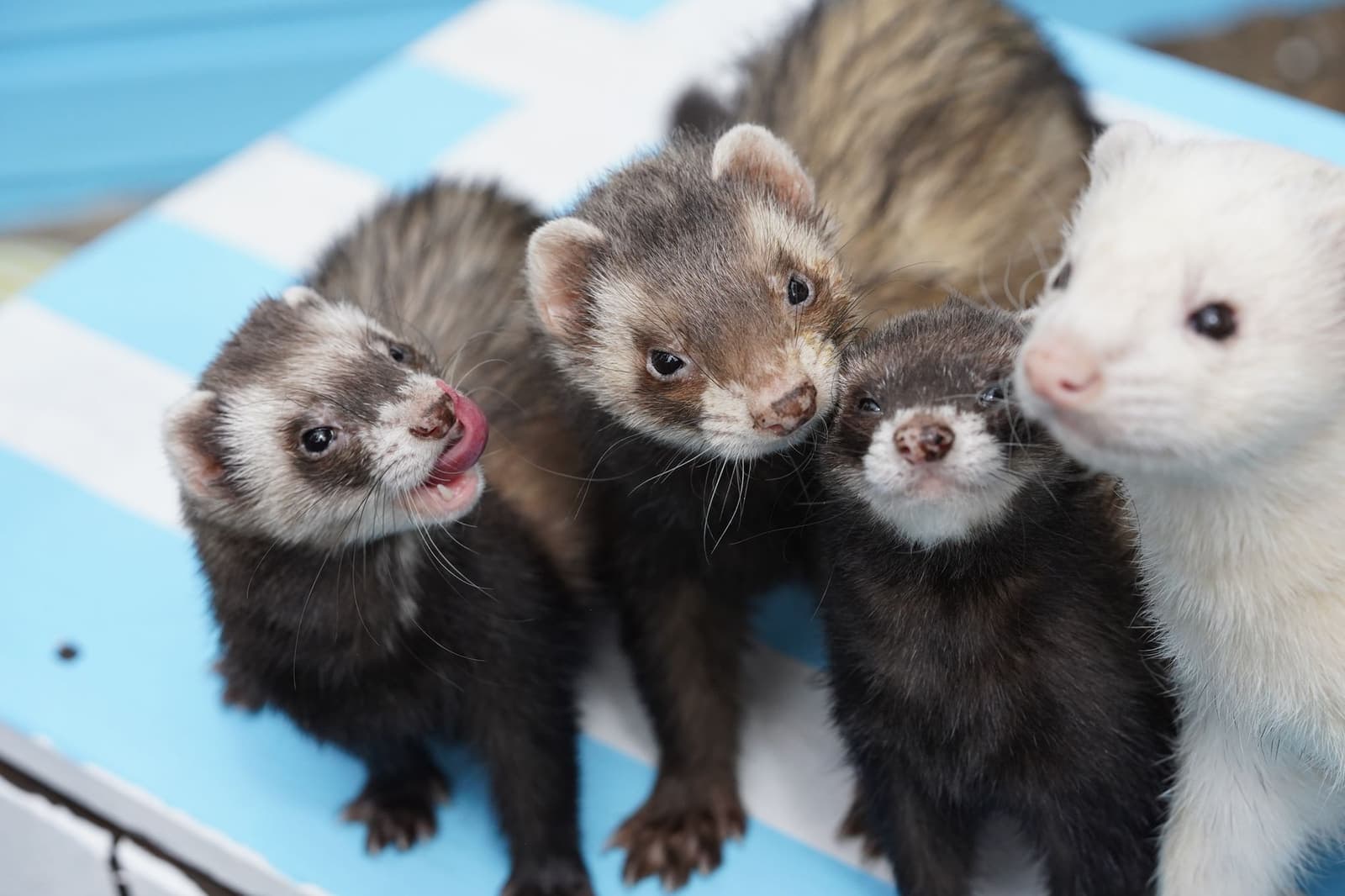
Three or four. VCA states that multilevel cages are preferred for up to three or four ferrets in one enclosure, which is the only numeric answer any of the bodies we read publishes to this question. In practice the ceiling on your cage is lower than the ceiling on the species: a two-level Critter Nation 162 gives 12 square feet across both floors, which is three square feet each at four ferrets, and the thing that fails first is not space but the litter corner, because four ferrets produce four ferrets' worth of waste into pans sized for two. The number that matters more than the headcount is PDSA's: a minimum floor space of 10 square meters per pair, about 107 square feet. Read against that, every cage sold is a sleeping box, and a group of four needs a connected pen or a ferret-proofed room, not a bigger cage.
Ferret cage suggested minimum · suggested minimum
24in x 24in x 18in high (60cm x 60cm x 45cm)
Our conversion: 576 square inches, or 4 square feet, of floor
This question gets answered badly online in both directions — people say one ferret per cage, which no source supports, and people say as many as fit, which no source supports either. Here is everything that is actually published.
| Issuer | On how many ferrets | On space |
|---|---|---|
| VCA Animal Hospitals | Multilevel cages are preferred for up to three or four ferrets in one enclosure | Suggested minimum cage 24 x 24 x 18in; at least two to three hours a day out |
| PDSA | Ferrets are highly social and need the company of other ferrets; keep them in pairs or small groups | A minimum floor space of 10 square meters per pair, the bigger the better |
| MSD Veterinary Manual | No figure published for group size | A wire cage at least 3ft x 3ft x 2ft for roaming while confined |
Quoted from each issuer's own page, linked below and read 10 October 2026. Where a source publishes nothing we say so rather than filling the cell in.
Two things follow from that table. The first is that keeping one ferret alone is the option with the least support in the published guidance — PDSA is explicit that ferrets need the company of other ferrets. If you have a single ferret, the guidance is pointing you towards a second, not towards a smaller cage. The best cages for one ferret covers the single-animal case on its own terms.
The second is that the upper bound is soft. VCA's three or four is attached to a cage type — multilevel — rather than to a floor area, so it is a statement about the kind of cage a group needs rather than a licence to put four ferrets in any two-storey cage on the market.
What three or four ferrets actually means in the cages people own
| Cage | Total floor, both levels | Two ferrets | Three ferrets | Four ferrets |
|---|---|---|---|---|
| MidWest Critter Nation 162 | 12 sq ft | 6 sq ft each | 4 sq ft each | 3 sq ft each |
| Savic Royal Suite 95 | About 12.8 sq ft | 6.4 sq ft each | 4.3 sq ft each | 3.2 sq ft each |
| MidWest Ferret Nation 182 | 12.5 sq ft | 6.25 sq ft each | 4.2 sq ft each | 3.1 sq ft each |
Totals are the manufacturers' published per-level dimensions added together; the per-animal columns are our arithmetic. Adding levels together is our reading — none of the published figures is stated as a per-animal allowance, and none of these sources sets a floor area per ferret.
At four ferrets you are at roughly three square feet each, which is below VCA's four-square-foot suggested minimum per cage even though the cage as a whole is three times that figure. We are not going to claim that crosses a published line, because no source publishes a per-animal figure. What we will say is that it is the point where the cage stops being the thing you are managing and the hours out of it become the whole welfare question.
What a group needs that a pair does not
- More sleeping places than ferrets. Ferrets pile up to sleep, but a group also needs somewhere for the animal that wants to be out of the pile. Two hammocks and a sleep sack for three ferrets, not one hammock.
- A second litter pan, in a different corner. One pan for four ferrets is the single most common cause of a cage that smells no matter how often it is cleaned.
- Two water sources. A group blocks a single bottle, and a dominant animal can hold a corner.
- Separable housing, or a plan for it. Groups fall out, animals get ill, and new arrivals need quarantine. The Savic Royal Suite splits into two independent cages, which is the cleanest answer to all three.
- More out-of-cage time, not the same amount shared. VCA's two to three hours is per day for the ferrets, and four ferrets taking turns in a single session is not four ferrets getting their hours.
The three multilevel cages that support a group
VCA's answer is tied to the cage type rather than to a floor area, so these are the three two-level cages we would actually put three or four ferrets in: the half-inch-barred Critter Nation, the Savic that splits into two cages when a group falls out, and the Ferret Nation, which is fine for adults but not for kits at one-inch bars.
 Illustrative
Ferrets of any age, and kits especially
MidWest Critter Nation Double Unit (162)
36 x 24 = 864 sq in (6 sq ft) per level, two levels
The half-inch bar spacing is the whole argument: it is the same cage as the Ferret Nation with a gap a ferret kit cannot get its head through.
Check price on AmazonWe do not print prices. #ad Disclosure
- Illustrative
Two ferrets that sometimes need separating
Savic Royal Suite 95 Rat and Ferret Cage
95 x 63 cm = 5,985 cm2, about 928 sq in (6.4 sq ft) per level
The most floor per level of the three big ferret cages and the only one that splits into two separate cages, at 13mm spacing that is functionally the Critter Nation's half-inch.
Check price on AmazonWe do not print prices. #ad Disclosure
- Illustrative
Adult ferrets that climb
MidWest Ferret Nation Double Unit (182)
36 x 25 = 900 sq in (6.25 sq ft) per level, two levels
Slightly more floor per level than the Critter Nation and a one-inch bar gap, which is fine for a grown ferret and the reason kits escape.
Check price on AmazonWe do not print prices. #ad Disclosure
Why we would stop at three in most homes
This is our position and we are labeling it as ours, because no source publishes it. In the cages sold today, three ferrets is where floor area per animal, the number of usable litter corners and the daily cleaning load all still work in a normal household. Four is within VCA's wording and is perfectly achievable, but it needs a connected pen and a second pan as a condition of entry rather than an upgrade.
The figure that should really govern the decision is PDSA's 10 square meters per pair. Nothing sold as a ferret cage comes within a tenth of it, which means the cage was never the plan for any number of ferrets. What size cage a ferret needs sets out all three figures, and travel and outdoor cages covers the enclosure half of a setup that actually approaches PDSA's number.
Introducing a new ferret to an existing cage
Do not put a new ferret straight into an occupied cage. Quarantine first, in separate housing, which is the practical argument for a cage that splits or for keeping a single-level unit as a spare. Then introduce on neutral ground with both animals out of their cages, and only move them in together once that is going well. Clean the cage thoroughly before the move so it smells less like one animal's territory, and watch the litter corner for a fortnight — a group that has stopped using the pan is telling you the corner is contested.
Two more things worth getting right at the same time. Check the bar spacing against the new animal rather than against the one you already have, because a kit gets through gaps an adult cannot — see escape-proofing. And go through what not to put in a ferret cage before the new arrival, since a bored newcomer is the ferret most likely to chew something it should not.
Questions people ask
How many ferrets can you have in one cage?
Can you keep just one ferret?
Do two ferrets need a bigger cage than one?
How much space does each ferret need?
Can I put a new ferret straight in with my existing one?
Sources
- VCA Animal Hospitals — Ferrets: Housing — The statement that multilevel cages are preferred for up to three or four ferrets in one enclosure, the 24 x 24 x 18in suggested minimum, and the daily litter box cleaning instruction
- PDSA — The ideal home for your ferret — That ferrets are highly social animals needing the company of other ferrets and should be kept in pairs or small groups, and the 10 square meters per pair floor space figure
- MSD Veterinary Manual — Providing a Home for a Ferret — The 3ft x 3ft x 2ft cage figure, and the absence of any published group-size figure on the same page