Guides
The best pocket pets, and what each one actually needs
Pocket pet is a size description of the animal. It says nothing about the enclosure — and the published minimums for these four species run from 144 to 775 square inches.

A pocket pet is a small mammal small enough to be handled in one hand — in veterinary and pet-trade usage that normally means mice, hamsters, gerbils and rats, and sometimes stretches to guinea pigs, chinchillas and ferrets, which is where the term stops being useful. The important part is what it does not mean: none of these animals is housed in anything pocket-sized. The published floor minimums for the four core species run from MSPCA's 144 square inches for one to three mice up to 775 square inches for a pair of hamsters or gerbils, and the housing cost barely varies between them. If you want the cheapest of the four to house correctly, it is mice — and the gap is smaller than it looks, because the mouse figure is published as a suggestion while the hamster and gerbil figures are published as minimums.
This page exists because the search term is a shopping term and the answer it usually gets is a list of temperaments. If you want the species compared on cost, lifespan and daily time, the best small pets compared on what they need already does that and does it properly. What follows is the narrower question: what the phrase covers, and what the enclosure bill looks like once you take the published figures seriously.
Which animals the term actually covers
There is no governing body for the phrase, so the honest answer is a range of usage rather than a definition. Veterinary practices and exotics clinics use pocket pet as a catch-all for small mammals that are neither cats nor dogs, and the list almost always contains mice, rats, hamsters and gerbils. Beyond that it widens: plenty of clinics include guinea pigs, chinchillas, ferrets and hedgehogs under the same heading for scheduling purposes, which tells you the term is about the kind of appointment rather than about the size of the animal.
We use the narrow reading on this page — mice, hamsters, gerbils, rats — for one reason: those four are the species where someone searching for a pocket pet is likely to be making a genuine choice between them. Nobody weighs a ferret against a mouse. If guinea pigs are on your list, the guinea pig section starts from a floor figure published in square feet rather than square inches, and that difference in units is the whole answer to whether a guinea pig belongs in this category.
The four, and the figure published for each
| Species | Published figure | Stated for | Issuer | What it is published as |
|---|---|---|---|---|
| Mice | 12 x 12 x 20in cage, or a 20 gallon aquarium | One to three mice | MSPCA | Suggested minimum |
| Hamsters | 100 x 50cm (775 sq in) of floor | One hamster, dwarf or Syrian | PDSA, citing a German welfare body | Minimum |
| Gerbils | 100 x 50 x 50cm (775 sq in) of floor | Two gerbils; 120 x 50cm for three | Woodgreen Pets Charity | Minimum |
| Rats | 24 x 24 x 24in with multiple levels, 1/2in bars | One or two rats | MSPCA | Suggested minimum |
Each figure is quoted as its issuer states it, with the full wording, qualifiers and conversions on the threshold cards below and in our standards section. The arithmetic turning 100 x 50cm into 775 square inches and 24 x 24in into 576 square inches is ours.
Mouse cage suggested dimensions · suggested minimum
a 12in x 12in x 20in wire cage or a 20 gallon aquarium for one to three mice, ideally with a mesh topper and multiple levels
Our conversion: 144 sq in of floor if the 20in figure is the height, or 288 to 360 sq in depending on which 20 gallon tank is meant
Read the four rows together and the pattern is clearer than any temperament comparison. Two of the figures come from UK charities and are published as minimums; two come from the MSPCA and are published as suggestions. Three of the four are stated for more than one animal, because mice, gerbils and rats are all social species that should not be kept alone — which means the figure is a starting point for a pair, not a per-animal allowance you can halve. The hamster is the exception in both directions: it is the one species here that must be housed alone, and it has the largest published minimum.
What that means for the bill
- 1.Mice are the cheapest to house correctly, and it is not close on the figure. MSPCA's 12 x 12in footprint is 144 square inches, which is a fifth of the hamster figure. The catch is the bar gap: PDSA publishes 6mm for mice, and almost nothing sold as a small-pet cage is built that tight, which pushes most buyers towards a tank or a solid-walled enclosure instead. The best mouse cages works through which products actually clear it, and mouse cage bar spacing is the page that explains why so few do.
- 2.Hamsters and gerbils cost the same to house, because the figure is identical. 775 square inches, from two unrelated issuers, for two different animals. The practical difference is depth: the gerbil guidance adds 20 to 30cm of substrate and advises against bar cages outright, so the gerbil setup is a glass or solid-walled box and the hamster setup can be a well-built wire cage. Gerbil versus hamster takes that head to head.
- 3.Rats cost less in floor and more in cage. 576 square inches over multiple levels is the smallest footprint of the three social species, but the half-inch bar requirement and the climbing behavior mean the honest answer is a tall multi-level cage, and those are the most expensive enclosures on this site. The best rat cages and rat cage bar spacing cover it.
- 4.The substrate bill tracks the floor area, not the animal. This is the cost that surprises people. Filling 775 square inches to the published depth is several large bags of bedding every time you do a full change, which is why per-liter price matters more than pack price. Best gerbil bedding runs that arithmetic in full; the answer for a minimum gerbil enclosure is over 100 liters, which is more than any single pack on sale holds.
The enclosures these figures point to
One enclosure per answer: the solid-panelled box that clears 775 square inches for a hamster or a pair of gerbils, the acrylic version that holds the deepest substrate, the multi-level cage with half-inch bars for rats, and the tight-barred wire cage for a dwarf hamster or a mouse-sized budget. Full assessments, with what each one fails at, on the species pages linked above.
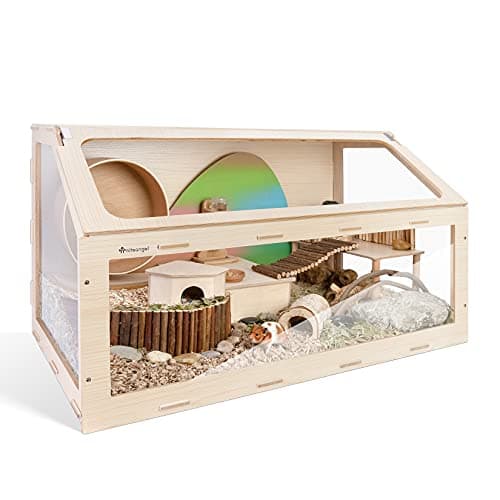
A Syrian that needs real burrowing depth
Niteangel Vista Hamster Cage, Large
47.1 x 22.7 = 1,069 sq in external footprint
The largest mainstream single-piece hamster enclosure we could verify, and the only one whose external footprint clears our 775 sq in floor with room to spare even after you allow for wall thickness.
$309.95View on AmazonPrice as of October 22, 2026. #ad Disclosure
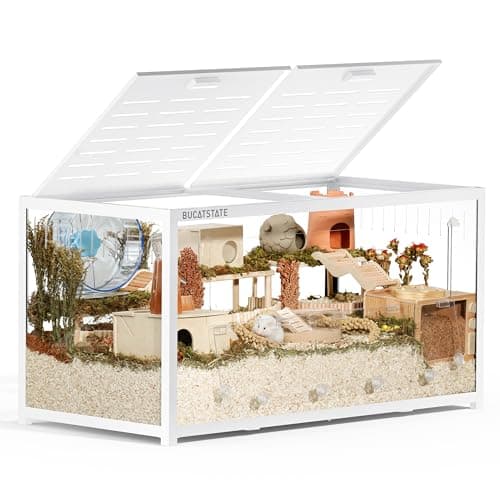
Deep burrowing without a DIY build
BUCATSTATE Hamster Cage 3.0, 47 in
47 x 23.6 = 1,109 sq in (7.7 sq ft) by our arithmetic
The deepest substrate capacity we could verify on a mainstream enclosure: an 11 in bedding claim on a 1,109 sq in floor is the combination almost nothing else offers.
$279.99View on AmazonPrice as of October 22, 2026. #ad Disclosure
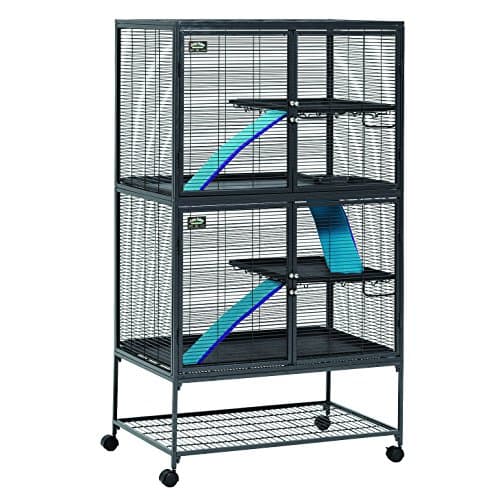
Ferrets of any age, and kits especially
MidWest Critter Nation Double Unit (162)
36 x 24 = 864 sq in (6 sq ft) per level, two levels
The half-inch bar spacing is the whole argument: it is the same cage as the Ferret Nation with a gap a ferret kit cannot get its head through.
$327.99View on AmazonPrice as of October 22, 2026. #ad Disclosure
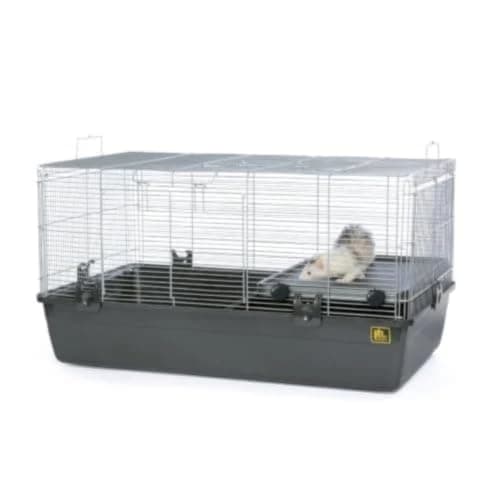
A dwarf hamster or a bar-spacing problem
Prevue Pet Products Universal Small Animal Home 528
30 x 16 = 480 sq in of interior base floor
The tightest bar spacing on any mainstream wire cage at 3/8 in, on a floor that falls well short of 775 sq in — a safety win and a space failure in the same product.
$119.99View on AmazonPrice as of October 22, 2026. #ad Disclosure
What the pet shop will sell you instead
Every one of these species has a starter kit built for it, and the kits are the reason this category has a reputation problem. A tube habitat marketed for hamsters offers roughly 448 square inches of usable floor against a published 775. The small plastic cages sold for mice are usually under 100 square inches with a bar gap a mouse walks straight through. The wheel in the box is almost always too small — PDSA publishes 20cm for a dwarf hamster and 30cm for a Syrian, and a kit wheel is commonly 11 or 12cm.
The fix is not expensive, it is just a different order of purchase: buy the enclosure against the published figure first, then the substrate, then the wheel, then a sand tray — the bathing sands we assess are the cheapest item in any of these four setups — and treat everything in the kit as a bonus rather than as the setup. What size wheel a hamster needs is the companion page for the item kits get most wrong, and the small pet housing overview is where the published figures for every species on this site sit side by side.
Which one we would actually choose
Mice, if the constraint is space or money, and you are willing to solve the bar-gap problem with a tank or a solid-walled enclosure rather than a wire cage. 144 square inches is a figure most people can find room for, a trio of female mice is genuinely entertaining to watch, and the whole setup costs less than the wheel some hamster owners buy.
Rats, if you want an animal that interacts with you rather than one you watch, and you can afford the cage. They are the most responsive of the four by a distance and the published figure is modest; the cost sits in the enclosure and in the fact that they should be kept in pairs or more.
A hamster only if you are prepared for 775 square inches for one animal that will be asleep whenever you are not, and a pair of gerbils if you want the most interesting behavior in the group and you are willing to buy bedding by the hundred liters. Either way the enclosure is the decision; everything else on the shelf is reversible.
If this has pushed you towards a species rather than away from one, the next page to read is the one for that animal: best hamster cages, best gerbil cages, best mouse cages or best rat cages. Each one starts with the figure above and names the products that clear it.
Questions people ask
What is a pocket pet?
What is the best pocket pet for a small apartment?
Are pocket pets kept in small cages?
Which pocket pet is the friendliest?
Can pocket pets be kept alone?
Are guinea pigs pocket pets?
Sources
- MSPCA — Suggestions for housing small animals — The 12 x 12 x 20in mouse figure, the 20 gallon aquarium alternative, and the 24 x 24 x 24in multi-level rat cage with 1/2in bars
- PDSA — The ideal home for your hamster — The cited 100 x 50cm cage minimum, the 25cm bedding depth, and the 20cm and 30cm wheel diameters for dwarf and Syrian hamsters
- Woodgreen Pets Charity — How to house your gerbils — The 100 x 50 x 50cm figure for two gerbils, the 120 x 50cm figure for three, and the advice against wire cages
- PDSA — The ideal home for your mice — The 6mm bar spacing figure that rules out most wire cages sold for mice